Patrick McDonnell, creator of Mutts is a serious fan of sequential art. In honor of ComicsCon, he published the following sequence July 15-21, 2019. Each panel is an homage to a classic Marvel Comics character (mostly from the Silver Age).
If you're also a fan of classic comic books, this was a real treat.
Views and reviews of over-looked and under-appreciated culture and creativity
Showing posts with label comic strip. Show all posts
Tuesday, July 23, 2019
Monday, June 17, 2019
Barney Google Birthday Cameos
![]() |
| Barney Google meets Spark Plug, 1922. |
Who was Barney Google?
"Take Barney Google F'instance" launched in 1919, written and drawn by Billy DeBeck. DeBeck was one of the developers of the "big foot" style of comic art (Robert Crumb paid homage to it).The strip initially appeared in newspaper sports sections. Google was a sportsman of sorts -- a plunger who hung around boxing matches and horse races.
In 1922 he became the owner of a broken-down plug names Spark Plug. And that's when the strip took off. During the 1920s and 1930s "Barney Google" soared in popularity. The franchise spawned movie cartoons, toys, and even some Tin Pan Alley songs.
I think the 100th-anniversary celebrations would have made sense had the strip remained essentially unchanged. But it didn't.
![]() |
| One of the Barney Google-themed songs to enter the Hit Parade. |
Postwar readers of the strip have only seen Snuffy Smith, with rare appearances by Barney Google and Spark Plug. ( I suspect those appearances are only to keep the copyright current.)
So this anniversary celebrates the former star of the strip -- kind of an odd thing.
A strange collection of cameos
"Snuffy Smith" -- er, I mean "Barney Google" -- is distributed by King Features Syndicate. Some other King Features comics marked the anniversary with varying degrees of success.I found the first and next-to-last examples especially odd.
| I'm not sure what this one's all about. Where's Spark Plug? |
| Without a doubt, this is the oddest tribute. So Barney Google and Snuffy Smith are in the same universe as Mark Trail!? |
Tuesday, February 19, 2019
Mark Trail, - Comic Strip Hero, Comic Strip Fan
Jack Allen introduced a curious interlude into the Mark Trail comic strip mid-February, 2019. Mark & family had just finished up an adventure in the Yucatan Peninsula. The following week a new storyline would start in the Bahamas.
As our heroes flew off, Mark steers the conversation into an unusual topic.
The awards referred to are the Reuben Awards, given by the National Cartoonists Society It's an interesting overview of the role of comic strips have had in American society. I don't know who's up for a Reuben award in 2019, but I hope Jack Allen's on the list!
BTW - the Jungle Jim strip referred to ran from 1934-1954. It was originally drawn by Alex Raymond. So yeah, Rusty, it was so cool.
As our heroes flew off, Mark steers the conversation into an unusual topic.
The awards referred to are the Reuben Awards, given by the National Cartoonists Society It's an interesting overview of the role of comic strips have had in American society. I don't know who's up for a Reuben award in 2019, but I hope Jack Allen's on the list!
BTW - the Jungle Jim strip referred to ran from 1934-1954. It was originally drawn by Alex Raymond. So yeah, Rusty, it was so cool.
Tuesday, January 08, 2019
Classical Pearls Before Swine
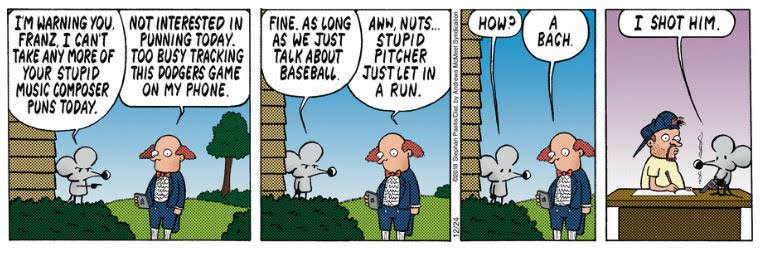
December 2018, Stephen Pastis introduced a new character in his strip Pearls Before Swine. Franz, the Punning Piano Teacher riffs on composer names.
Naturally, it was a theme I quite enjoyed. Some names are regular staples for puns. Franz Joseph Haydn (pronounced "High-den") and Franz Liszt (pronounced "list") are easy and frequent targets. But that's only the starting point for Pastis:
Tuesday, December 11, 2018
Mutts 3-Panel Meta
Patrick McDonnell, the creator of Mutts, has played with comic strip conventions before. The week of December 3-8, 2018 he riffed on a core concept of the art.
Daily humor strips usually have three panels. The first sets up the premise. The middle establishes the pattern. The third upends the pattern with the punchline.
In the sequence below, note how each daily strip plays with a different aspect of this convention.
In the first strip, McDonnell brings to our attention that, while each panel may look identical, each represents a different moment in time. The characters move from the second to the third panel because time has passed.
In the second sequence, McDonnell further explores this concept. The background to all three panels is identical, each representing the same scene in a different moment. Mooch refuses to leave the first panel, so he's absent from the second. Earl does the same in the second, so the third panel is empty. The humor derives from characters willing themselves out of the sequence.
The third sequence further develops the concept. Here, Earl remains in all three panels. Mooch however, disappears from the sequence.
The fourth sequence presents another variant. First neither characters stayed in the timeline through all three panels. Then Earl stayed. Now both appear in the last panel. But Mooch still opted out of the timeline in the second panel. So where did he go?
Note the changes in the fifth sequence. Here the landscape spans all three panels. So each panel still represents a different moment, but now also a different location. McDonnell places Mooth and Earl's word balloon across panels one and two. And Earl isn't in the second panel -- he's calling from the third. Here, the humor plays on the function of that last panel.
The final sequence also plays on the role of the last panel. The bear (the punchline) arrives too soon.
For those interested in the art of sequential art, this week entertained on several levels.
Daily humor strips usually have three panels. The first sets up the premise. The middle establishes the pattern. The third upends the pattern with the punchline.
In the sequence below, note how each daily strip plays with a different aspect of this convention.
In the first strip, McDonnell brings to our attention that, while each panel may look identical, each represents a different moment in time. The characters move from the second to the third panel because time has passed.
In the second sequence, McDonnell further explores this concept. The background to all three panels is identical, each representing the same scene in a different moment. Mooch refuses to leave the first panel, so he's absent from the second. Earl does the same in the second, so the third panel is empty. The humor derives from characters willing themselves out of the sequence.
The third sequence further develops the concept. Here, Earl remains in all three panels. Mooch however, disappears from the sequence.
The fourth sequence presents another variant. First neither characters stayed in the timeline through all three panels. Then Earl stayed. Now both appear in the last panel. But Mooch still opted out of the timeline in the second panel. So where did he go?
The final sequence also plays on the role of the last panel. The bear (the punchline) arrives too soon.
For those interested in the art of sequential art, this week entertained on several levels.
Tuesday, August 28, 2018
Judge Parker - The Wurst Story
I've written before about the imaginative ways writer Francesco Marciuliano and artist Mike Manley approach a daily adventure strip. They've taken Judge Parker from a somewhat staid dramatic strip into the realm of international intrigue -- and then some.
Most recently I wrote about the sequence surrounding the off-stage death of a supporting character, Godiva Danube. It's revealed that the purpose of Danube's death was to lure April Parker and her father (both ex-CIA agents) back into the country. Their former employers, a rogue branch of the Agency, wanted them eliminated.
And you thought the daily funnies were just for kids.
It's revealed that April and her father's handler, Wurst, set them up. But not by choice. What happens next is the subject of this sequence from August, 2018,
It's a sequence that would have worked in any current spy movie. Once he knows his sister is safe, Wurst takes his revenge. And it turns out his sister is in the business, too.
Two people die violently in this sequence, but it's implied rather than shown. And, given that only one strip is revealed each day, Marciuliano and Manley artfully keep the tension high and the pacing tight.
Artistry such as this is why I keep reading the daily comics page.
Most recently I wrote about the sequence surrounding the off-stage death of a supporting character, Godiva Danube. It's revealed that the purpose of Danube's death was to lure April Parker and her father (both ex-CIA agents) back into the country. Their former employers, a rogue branch of the Agency, wanted them eliminated.
And you thought the daily funnies were just for kids.
It's revealed that April and her father's handler, Wurst, set them up. But not by choice. What happens next is the subject of this sequence from August, 2018,
It's a sequence that would have worked in any current spy movie. Once he knows his sister is safe, Wurst takes his revenge. And it turns out his sister is in the business, too.
Two people die violently in this sequence, but it's implied rather than shown. And, given that only one strip is revealed each day, Marciuliano and Manley artfully keep the tension high and the pacing tight.
Artistry such as this is why I keep reading the daily comics page.
Tuesday, July 10, 2018
Death in Comics - Godiva Danube
There's an advantage to writing a gag-a-day strip as opposed to those with continuing stories. Each strip is self-contained. Panel one sets up the gag, panel two puts it in motion, and panel three delivers the punchline.
An adventure strip has a different outline. The first panel provides a thumbnail recap, panel two continues the story, and panel three is the cliffhanger (panels two and three are often combined). There's an art to pacing the story. Make the recap too detailed, and regular readers will get bored. Have a ho-hum cliffhanger, and new readers won't come back the next day. Don't move the story along far enough and everyone gets bored. And if there are no surprises, then over time there will be no readers.
Writer Francesco Marciuliano and artist Mike Manley continue their masterful run on Judge Parker with some truly innovative story-telling. Excerpts from this sequence that ran May-June 2018 are a good example. Marciuliano has several stories arcs running concurrently and uses them to great advantage.
In a long sequence, two contract killers return to the US. April and her father are both ex-CIA black ops agents. April's escaped from federal prison and is reluctant to return to the states. She's also the ex-wife of Judge Randy Parker.
The person at left is Neddy Spenser. She's the adopted daughter of Abby Spenser. Her husband and Randy Parker were part of the same law firm. Did April unknowingly accept a contract on a family member?
The first twist: the door the assassins are knocking on isn't the one Neddy's behind. Note that Neddy lives in apartment 3G. Apartment 3G was started by Nicholas P. Dallis in 1961. He also created Rex Morgan, M.D. (1953), and Judge Parker (1952).
So whose door were the killers knocking on?
Godiva Danube was a singer/actress/celebrity. She had been in a failed business with Neddy Spenser (see Sophie's Crash, part 2). Earlier in 2018, she had returned to the strip to invite Neddy to come to Hollywood with her as her PA. Neddy did go to LA, not as Danube's assistant, but as an aspiring screenwriter. That's why she's waitressing. Marciuliano also frames her sequences with movie script settings in the upper left corner.
The second twist: the cause of death. The casual reader might not remember that the contract stipulated the death was to look like natural causes.
The third twist: change of location. Danube switched hotels suddenly. So April and her father were at the wrong location. And Danube was using an alias she couldn't possibly know (as just an actress/singer).
The fourth twist: enter the CIA. Early on in this story April was concerned that they were being lured to back to the US. The mystery of Godiva Danube's death will only deepen, and I suspect Marciuliano will keep me guessing -- one panel at a time.
Tuesday, May 29, 2018
Mutts Goes Meta
During the week of May 21-26, 2018 cartoonist Patrick McDonnell stepped outside of his comic strip. Mutts spent the week contemplating the structure of the 3-panel gag strip -- as a way to deliver 3-panel gags.
The strip above addresses the pacing of the 3-panel gag. Many of the other strips for the week looked at different aspects of the structure - and most don't need additional commentary.
The last of the sequence references Ernie Bushmiller. Bushmiller was the original artist/writer for Nancy. Bushmiller pared down his strip to its bare essence, and his tenure is one that most comic strip artists admire (including Patrick McDonnell, apparently).
And for a week of strips that looked at the foundation of the 3-panel form, it made perfect sense.
Subscribe to:
Posts (Atom)