Showing posts with label Prickly City. Show all posts

Tuesday, September 02, 2014

Prickly City's Phantom Gap

Scott Stantis' Prickly City is, at heart, a comic strip that uses humor to make political commentary. It's not difficult to figure out where Stantis himself stands. But because his message is delivered subtly, rather than with a bludgeon, the strip succeeds in delivering a certain viewpoint even to those who might otherwise not wish to be exposed to it.

His late August, 2014 sequence is a good example of that -- doubly so since it uses a convention of the comic strip to tell the story.

The first sequence breaks the fourth wall, as the two main characters notice the white space (called a gutter) separating the two panels. (click on images to enlarge)


One character is conservative, the other liberal. While long-time readers will know which is which, note that throughout this sequence Stantis provides no labels at all. Because having one side winning over the other isn't what this sequence is about.


The gutter expands as the sequence continues, further separating the two characters. And note how it expands -- it grows out from the middle. The left side isn't squeezing the right, nor the the other way around. Both sides are being squeezed, and as it continues and communication breaks down, both seem to blame the other.


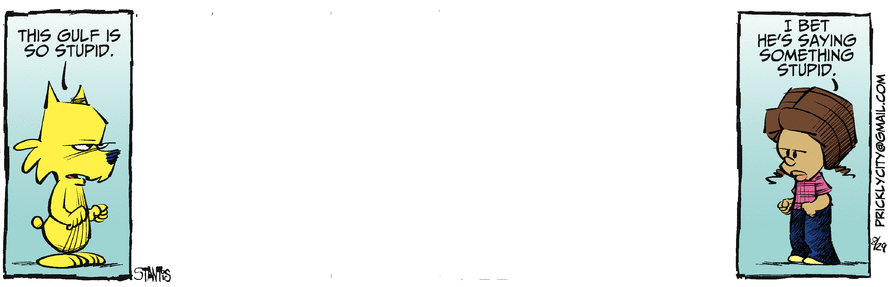
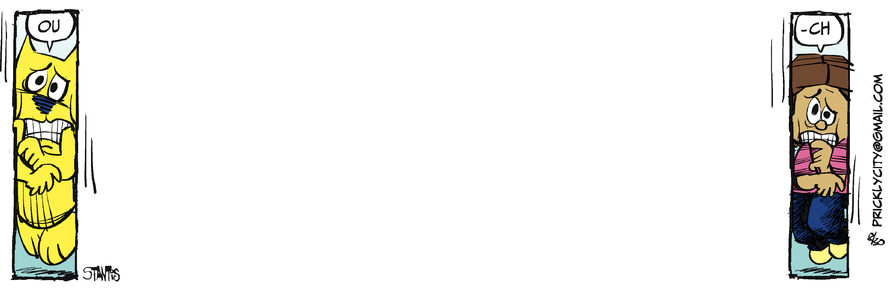


It's a brilliant use of the medium. Stantis makes his point about the breakdown of political discourse, and does so in a way that everyone can relate to. The villain isn't the character on the other side of the strip -- it's the white void of nothingness that's boxing them both in. 

The gutter is always there between the panels, just like political differences exist between people. Most times, we just don't notice it (either the gutter or the differences). But when it grows, neither side benefits -- either in the funnies, or in real life. That's the message I got from this sequence. How about you?


Tuesday, March 25, 2014

Prickly City's Puppy Cameos - Part 2

Scott Stantis' Prickly City riff on several other comic strips established a pattern in the first four sequences (see Part 1). Set the scene in the first panel, and bring in a dog from another comic strip in the second. But a good deal of humor comes from surprise. And after four days, things get interesting.

The fifth strip continues the pattern. (click on images to enlarge)


This time it's Shagg, from Peter Gurin's Ask Shagg that gets the boot ("asks too many questions").

Then the pattern starts again.... only this time it's not a dog at all.

 
It's Rat from Stephen Pastis' Pearls Before Swine. And one might think that's the end.

But there's one more.


We move from dogs to cats. And with Garfield the sequence stops.

Stantis provided some solid entertainment for comics fans throughout this series. Comics readers wanted to know who would appear next? Daisy from "Blondie?" Rover from Red and Rover? There were many other choices, but none as satisfying as the direction Stantis chose to take. For me, it put the "fun" back into the funny pages.

Tuesday, March 18, 2014

Prickly City's Puppy Cameos - Part 1

Scott Stantis' Prickly City recently used a comic situation to riff on several other comic strips -- and did so quite brilliantly. This somewhat political strip's current story arc has a Hillary Clintonesque bunny preparing to run for election. These sequences involve her choosing a potential running mate.

The first strip sets up the premise, and the remaining ones follow through, up to a point. (click on images to enlarge)


Notice how the punchline for each comments on a characteristic of the "guest star." Snoopy gets a "good grief" and an aside noting that he's a character in a zombie strip ("been out of work for longer than six months"). "I'm not that hungry" provides counterpoint for the ever-voracious Marmaduke. Poncho from Paul Gilligan's Pooch Cafe remains in character, spoiling for a fight. The canine from Scott Adams' Dilbert -- Dogbert --has his attitude being compared to another famous know-it-all.

It takes real draftsmanship to render characters drawn in another style convincingly. And Stantis is up to the task. Which is part of the reason these cameos are so effective.

After four days, the rhythm's established. Set the scene in the first panel, and bring in another comic strip dog in the second. And placing the strips together, it's easy to see the variations on the theme. But then everything changes -- as we'll see in Part 2.