Artist/writer James Allen has done great things to revive the Mark Trail comic strip. And normally, I'm on board with his storylines. But the odd turn in this February 2018 story arc almost lost me.
It starts with various characters in Lost Forest (where Mark Trail lives) spotting unusual animals -- tigers, elephants, etc. It took a while for them to believe what they were seeing (could there be something in the coffee?). And even a little longer to understand why African animals were suddenly roaming free.
Of course, most readers had already figured out that they had escaped from a nearby circus. Allen has the sheriff come by to explain things -- the circus train wrecked going around a curve near the Lost Forest. It explained where the animals came from. But then things get weird.
Gaah! Zombie clowns! Run! "Terrified?" Those children are probably traumatized for life. And why does Mark Trail look amused in the last panel?
Oh, but there's more:
The story then gets back to rounding up the escaped animals. But what a strange aside.
This was one bizarre sequence for sure. This is definitely not your father's Mark Trail. And that's fine with me.
I always enjoy comic strips that step outside their allotted spaces to make fun of comic conventions. In this case, two very different comic strips offered humor based on comic strip pacing.
The first comes from a sequence of Barney & Clyde originally published 4/18/17. This smartly-written (and drawn) strip by Gene Weingarten, Dan Weingarten, and David Clark has a long history of playing with comic strip conventions.
The second comes from the 2/5/17 Sunday edition of Beetle Bailey. From the outset, Mort Walker's strip was always a simple gag-a-day comic. Over the years, the strip has grown a little, though still within comfortable boundaries.
In both cases, the punchline arrives in the last panel -- which is also an integral part of the joke. It's interesting to me to see how the two creative teams handled the same concept. In Barney & Clyde, the punchline "you'll never know when you're in life's fourth panel" is humorous because, well, that's where it is.
At the same time, it's left unclear as to whether Cynthia and her teacher are aware that they're in a comic strip. That ambiguity also gives the line a little more weight.
I felt differently about Beetle Baily's take. There's nothing wrong with the joke itself, and it's certainly true. Comic strip (and animated characters) often hang in the air for an unrealistically long time for comic effect.
And yet, to me, this sequence just seems lazy. I suspect that if there had been an additional panel or two to fill, we would have seen Sarge and Beetle hang in the air even longer. I guess the difference is that Barney & Clyde use the observation to base the punchline one, while Beetle Bailey lets the observation be the punchline.
The border panel is a fundamental design element of the comic strip -- so fundamental that it's all but invisible to most readers. Not to Mark Tatulli, creator of Lio. He often brings this hidden element to the fore in his innovative strip.
Here are four recent examples, all featuring Eva Rose, the object of Lio's unrequited love.
The sequence from 3/20/17 plays with convention in two ways. Usually, each panel represents a different moment in time. In this case, though, all three panels represent the same instant.
The cannonball fired in panel one landed in panel three. The broken panels show the arc of the projectile. So instead of three traditional panels, we have a scene where the middle panel (room?) with two destroyed walls. But we still have a payoff for the gag in panel three.
The second, from 3/7/17, retains the idea of each panel representing the same scene at a different moment in time. In this case, though, the bottom of the panel has changed function. Now it covers an (apparently) bottomless pit. Note that Tatulli's bottom border only extends halfway down the allotted space for the strip.
The third example from 2/13/17 has a gag working on a number of levels. First, the entire strip is shown to be a flat surface that can be tied in a knot -- just as Eva Rose has tied Lio's heart in a knot. And though now tied, it also serves the role of a traditional three-panel sequence. In the first end is Lio, the middle (the knot), showing Eva Rose's action and Lio's emotion, and the third, Eva Rose walks away.
Sometimes when Mark Tatulli has his comic spill over into another's he manages to fit both into his space (see: ). In this case, it's enough just to imply the action. Lio's mortar apparently exploded in the comic strip above it. I'm guessing the news flash defines "local" as the strips surrounding Lio.
Four ingenious approaches to something most readers (and even comic artists) never seem to notice.
I love the way writer Francesco Marciuliano plays with the conventions of the daily comic strip. In Sally Forth, he's jumped ten years into the future to present adult versions of Hilary and her friends Faye and Nona. And in one instance, he had the Forth family meet their earlier counterparts (see: Sally Forth into the Funky Past).
In a sequence that ran in August 2016, this happened:
Notice how carefully it's framed. Is Hillary really conversing with her older self, or is it just her imagination? There are no other characters around to either ask who that person is she's talking to or why she's talking to the air.
We only know what we're shown. And that ambiguity, I think, is what makes the sequence work.
I like to think it's all in Hilary's mind. Because I really am not looking forward to Zootopia 3 in outer space.
It wasn't that long ago that I cited an example of Mike Curtis and Joe Staton bringing another comic strip into Dick Tracy's universe (see: Dick Tracy's Dream). The sequence below ran July 12-14, 2016 and brought another long-running comic strip character into the Tracyverse.
I'm not sure if this appearance is somewhat elliptical because of copyright restrictions, but it certainly fits with the character.
Long-time comic strip readers will recognize the Phantom in his Mr. Walker persona. Although the figure is never clearly shown, his upturned collar, low-slung fedora, and dark glasses provide more than enough clues. And the wolf is, of course, Devil as Tracy almost directly says.
In a way, this addition is a twofer. Both the Phantom and Mandrake the Magician were created by Lee Falk, and share the same universe (having appeared in each other's strips). So if Dick Tracy and the Phantom know each other, then Mandrake is part of the Tracyverse now, too.
And as part of the same story arc, another cameo was brought back. Deathany Denobia of Bill Holbrook's On the Fast Track was already established in the Tracyverse (see: Dick Tracy on the Fast Track). She returned in an early August 2016 sequence to provide information about the sidekick of Abner Kadaver, a horror show host turned hitman.
One-off cameos can be fun. Subsequent appearances by them can be even more so.
Lio creator Mark Tartulli is one of the newer generation of artists who seem to have a certain.. disdain for the venerable comic the Family Circus (see Lio and the Family Circus 1 and 2). And, as I've also noted, Tartulli likes to play with the fourth wall of the comic strip genre -- specifically, the outlines of the panel that generally go unnoticed by the reader (see: Lio and the Fourth Wall for other examples).
In his New Year's Eve strip for 2015, Tartulli brilliantly combined both. (click on image to enlarge)
Stephen Pastis recently completed a brilliant story arc in Pearls Before Swine. In addition to providing five strips of stand-alone humor, he also made some pointed commentary about some comic strips that are long since past their prime.
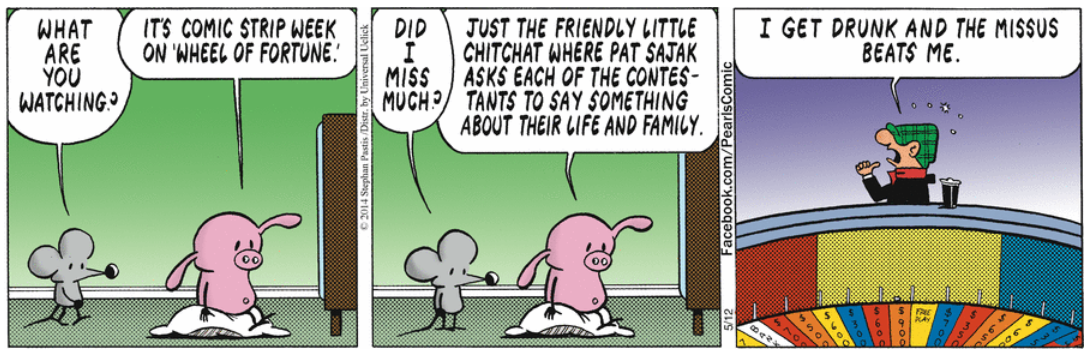
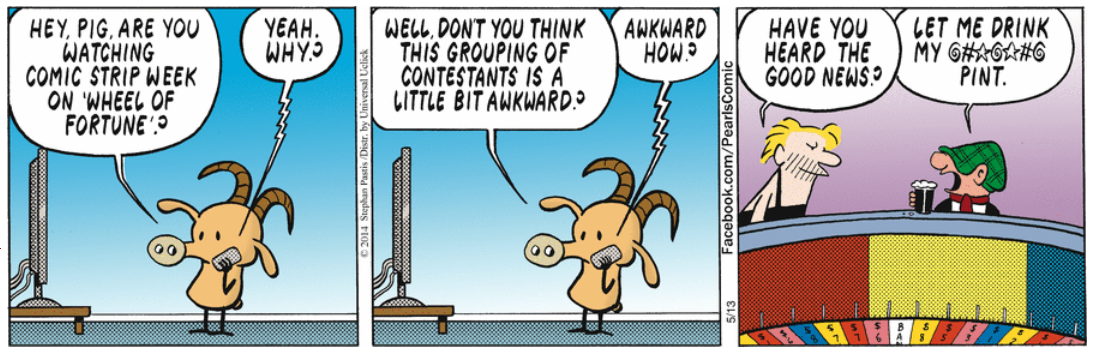
Monday's sequence sets up the premise: it's Comic Strip Week on Wheel of Fortune. And the first contestant to be introduced is Andy Capp. (click on images to enlarge)
Reg Smythe started Andy Capp in 1957, and even after his death in 1998, the strip shambles on. Pastis points out the obvious that readers seem to disregard in this "loveable" character. Capp never works, drinks constantly, and abuses his wife verbally and cheats on her as well. One has to wonder -- why is this strip still around?
Tuesday introduces the next contestant -- The title character from B.C. This is another legacy strip, started by Johnny Hart in 1958 and continued after his death in 2007.
Hart became a born-again Christian, and considered B.C. part of his
ministry. In the latter part of his life B.C. became increasingly
heavy-handed in its Christian messaging. B.C.'s opening remark nails the overt tone of Hart's latter strips perfectly.
Wednesday's sequence was something of a surprise. I didn't expect Pastis to introduce one of his own creations, but he did -- Larry the croc.
In retrospect, it was a perfect choice. There's a general perception that Wheel of Fortune contestants aren't always the brightest bunch (Jeopardy snags those). Having the dimmest character from the Pearls cast just reinforces that notion.
Thursday the game starts.
Andy Capp's too drunk to think, and B.C. tries to shoehorn Jesus into the answer. Both play out the worst traits of their respective characters.
Two important things happen in Friday's sequence. First is the obvious joke: Pastis is such a nobody that even with just one letter missing, Larry can't identify his creator.
But there's a more pointed commentary, too. Larry sets it up by mistaking Pastis for a homeless person. B.C., who's been proudly displaying his Christianity all week, immediately says he has no spare change. A mordant comment on the nature of B.C.'s (and by extension Hart's) faith.
There's no doubt in my mind which comic strips Lio creator Mark Tartulli likes -- and which ones he hates (see Lio and the Comics Commentary). Lio has featured characters from both likes (Calvin and Hobbes) and dislikes (Peanuts) several times. Sequences about the latter always seeming to have the same subtext: why doesn't this strip just die?
Take, for example. this panel from 4/22/13 (click on image to enlarge)
Bill Keene's "Family Circus." started in 1960, and has settled into some pretty comfortable tropes over the years. One of them is the wandering path, in which one or more of the children trace a dotted path through the cartoon to wind up at the end of the journey delivering a punchline.
And the same thing's happened here. Except in this case, the characters have wandered out of their own strip and into Lio's. But the end of the journey still has a punchline -- a special sale for witches -- and Tartulli's message for over-the-hill strips. Time for these characters to go -- if only in a witches' potion.
The current storyline in Dick Tracy is something of a tour-de-force, I think. Mike Curtis and Joe Staton are currently weaving three story lines together, and all three reference vintage comic strips in some fashion. In Part 1 I looked at how Al Capp's "Li'l Abner" was cited through a pastiche of Capp's "Fearless Fosdick," a comic-within-a-comic parody of Dick Tracy. Part 2 foreshadowed the arrival of Punjab and Asp from "Annie" (originally "Little Orphan Annie"), bringing Harold Gray's creations into Dick Tracy's continuity.
And in Part 3, another vintage comic character is referenced -- long forgotten by his strip, which still runs to this day. (click on images to enlarge). And be warned: if you just skim these panels, you'll miss half the fun.
The sequence starts at the racetrack. How seriously should we take all this? That first panel is a reference to Chico Marx's classic routine in the 1937 Marx Brothers film, "A Day at the Races."
And that tout in the second panel may ring a bell with comics fans. Rusty Riley was a comic strip by Frank Godwin that ran from 1948-1959. It featured an orphan who was a stable boy for a large horse-racing outfit. Stands to reason that many years later, he'd still be haunting the tracks!
One final reference: Quick-Draw McGraw was a Hanna-Barbara animated cartoon character from the early 1960's; a horse who was sheriff of a Western town.
The storyline is actually focused on one horse, though.
Sparkplug was originally owned by Barney Google, and the two were among the most popular comic strip characters of the 1920s. Billy DeBeck created the pair in 1919. Sparkplug (not looking as trim as he does in Dick Tracy) spawned many toys, books, games, and other licensed merchandise.
Then in 1934, DeBeck introduced Google's hillbilly cousin Snuffy Smith, and things began to change. By 1954, Barney Google had disappeared from the strip, and today many readers only know the feature as "Snuffy Smith," (currently drawn by John Rose).
The threads are beginning to come together. Vera Alldid, the artist of "Straightedge Trustworthy" (the "Fearless Fosdick parody), is working in same movie studio as the Moon Maid. Said studio is owned by Tabby McAngus, who also owns Sparkplug. Who seems to have trampled the crooked studio head to death. Or did he?
Meanwhile, Asp and Punjab are in transit to see a certain detective...
These are the things that make reading the daily funnies a true pleasure.
In the comic strip Dick Tracy, creators Mike Curtis and Joe
Staton have set three different story arcs in motion -- all of them related to other comic strips. The first involved a reference to Al Capp's "Lil Abner" (see The Comical Dick Tracy). The second, foreshadowed at the same time, brings back a character whose own strip ended with an unresolved storyline. (click on images to enlarge).
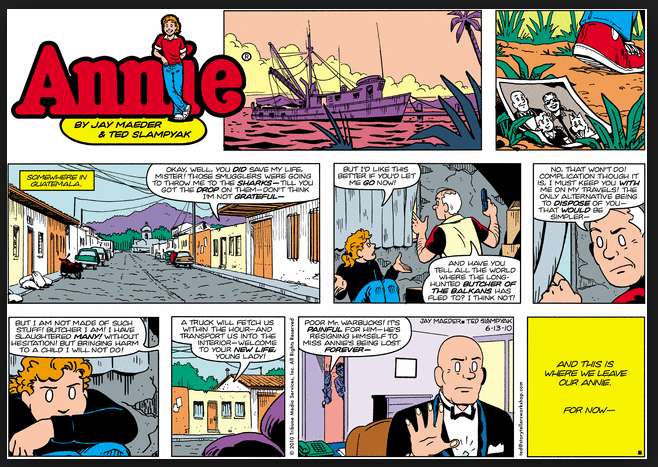
In the very first panel we see the logo for Little Orphan Annie. The actual comic strip, updated to just "Annie" was abruptly discontinued on June 13, 2010. Here's the final sequence:
And so it ended, with Annie being spirited off into the Guatemalan interior by a war criminal on the run -- fate unknown.
Then these sequences appeared in Dick Tracy, interwoven with other story lines:
Harold Gray's characters return -- not on the comics page where that first Sunday panel suggested, but actually in the world of Dick Tracy. Which, we hope, will mean that the saga of Annie will finally get the conclusion the strip deserved.
But there's yet a third comics-related storyline in the current sequence, as we'll see in Part 3.
Things have become more interesting in Dick Tracy recently, with several story lines woven together -- and all having to do with vintage comic strips. The first is a reinterpretation of an older gag. (click on images to enlarge). Creators Mike Curtis and Joe Staton set the stage with this Sunday spread:
The following Sunday reveals more, and lets us get a glimpse of the "Straightedge Trustworthy" comic strip. Bonnie's comment to her grandfather is funny, of course, in a meta sense -- since the reader knows that in fact she is in a comic strip.
But there's more. A weekly segment shows "Staightedge Trustworthy" parodying key elements of the Dick Tracy strip, including the grotesque villains with Dickensian names.
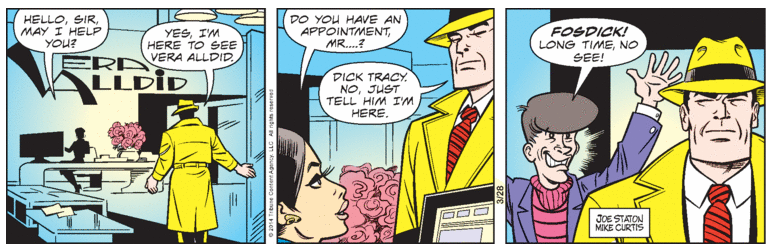
Behind it is Vera Alldid, a character Chester Gould created in 1969 as a mordant commentary on the state of newspaper comics. Note the last panel of the strip below:
Alldid calls Tracy "Fosdick," and that's significant. Because in 1942, Al Capp incorporated a parody of Dick Tracy in his own comic strip, "Lil Abner." -- it was called "Fearless Fosdick."
Although Chester Gould, the original creator of Dick Tracy was rumored to be unimpressed (at the least) with Capp's parody, it was popular with the public -- and with future writers and artists of the Dick Tracy feature.
In the current continuity, Tracy is quite unhappy with Alldid's depiction of him, and Mike Curtis may be using the two characters to stand in for Capp and Gould.
Whatever the reason, it's great fun all around -- especially for those who know some of the background of this long-running strip.
And there's something else -- note that in both Sunday sequences the logo for a discontinued comic strip appears prominently in the first panel.
It's just setting the stage for the second story line Curtis and Staton have introduced. as we'll see in Part 2.
Mark Tartulli's comic strip Lio often ventures outside the confines of the genre -- especially when it comes to the convention of comic strip panels (see Lio and the Fourth Wall) for other examples). In his 4/9/14 strip, Tratulli has Lio once again break the fourth wall -- this time painfully.
Tartulli's not just an imaginative cartoonist, but a gifted one, too. Consider: if you were going to draw this gag, where would you place the elements? Knowing that the eye reads left to right, Tartulli arranged them to maximize the humor.
First we see Lio -- what happened? Then we see the cannon (with the note "for outdoor use only") and then Lio's pet squid with the instruction sheet. Each element reveals another layer of what just happened, and adds to the humor.
Bill Waterson's ground-breaking comic strip Calvin and Hobbes ran for ten years (1985-1995), and remains a popular and well-known strip. There have been references and tributes to the strip before in other comics, but none quite like Stephen Pastis' sequence in Pearls Before Swine on 12/16/13.
If you examine it carefully, you'll see why. (Click on image to enlarge)
Waterson refused to commercialize his creation in the way cartoonists were expected to. Unlike, say, "Peanuts," there are no plush toys, no TV specials, no Hallmark ornaments, and no car stickers. That last is important because a bootleg stickers featuring Calvin urinating on an automobile logo became -- and remain -- quite popular. You can get them with either Ford or Chevy as the target logo -- for your Chevy or Ford pickup respectively.
And that's the genius of Pastis' sequence. He's the only cartoonist I know of who references that well-known but never talked-about use of Calvin's image. Note the sign's placement. It's on the far right of the panel, and halfway up -- ensuring it's the last thing the reader's eye will see as it tracks across the panel. The large joke is the grown-up Calvin hawking his childhood celebrity. The real punchline is the suggestion that he's behind those ubiquitous truck decals.
It seems Lio
creator Mark Tatulli and I share a mutual dislike of Love Is.. This overly-sweet (in my opinion) single-panel strip has been running since 1970, and despite a new artist taking over the reins, it still seems like an artifact from that era.
Tatulli's brought in characters from other strips before, with uneven results. This time, his take is note-perfect, capturing the look of "Love Is..." And he manages to include some subversive humor as well, suggesting that at least one of the character has had enough of the strip's cheap sentimentality. (click on image to enlarge)
Stephen Pastis, creator of Pearls Before Swine is one of the three nominees for the 2012 Reuben Award for “Outstanding Cartoonist of the Year.” Yes, it's the cartoonists' equivalent of the Oscars -- a an award recognizing outstanding achievement as selected by fellow professionals.
If you've followed Off Topic'd for any length of time, you'll know that -- just from the sheer number of "Pearls"-related posts -- I believe Pastis earned the nomination -- and then some. Part of what I like about his strip is its meta-humor. Sometimes the joke expands outward, the characters being completely aware that they exist inside a comic strip.
Take the following sequence, for example (click on images to enlarge):
Sometimes Pastis has coordinated with other cartoonists to create a cross-comic gag. I'm not sure that's true in this case, but it is interesting to see how neatly the two sequences from the same day line up.
Don't get me wrong -- Brian Crane (Pickles) and
Rick Kirkman (Baby Blues) are also worthy nominees. Their strips are consistently of high quality. Pastis, however, just goes past the boundaries -- which is why his strip gets more mention here that the other contenders.
Mark Tatulli seems to enjoy not just using his comic strip Lio to present his unique brand of humor, but to play with the very concept of comic strips itself. Today's single panel sequence is an excellent example of that.
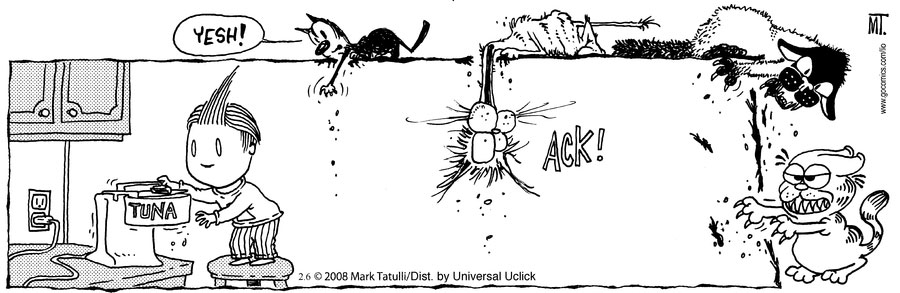
Lio opens a can of tuna, and attracts every cat in the neighborhood. And since Lio's neighborhood is the comics page of the newspaper, that's where the cats come from. (click on image to enlarge)
From left to right we see Mooch from Patrick McDonnell's Mutts, Bill the Cat from Berkeley Breathed's Opus, Bucky Cat from Darby Conley's Get Fuzzy, and finally Garfield from Jim Davis' eponymous strip. Strangely missing is Lio's pet cat -- but perhaps that's part of the joke.
Breathed created Bill the Cat as a satirical version of Garfield, so it's interesting to see them both in the same panel. And speaking of Bill, to call a character back from a retired strip -- that must be some powerful-smelling tuna!
Patrick McDonnell, the talented creator of the comic strip Mutts, draws in a distinctively retro fashion. His compact characters and loose lines seem more akin to George Herriman's Krazy Kat from the 1920s than contemporary humor strips.
McDonnell often references vintage pop culture in his strip (see: Mutts and Kings), especially the Sunday sequences. Yesterday's example was particularly brilliant, as the drawing served a double purpose. It not only referenced a past image, but the nature of that image set up the joke.
Here's the sequence: (click on image to enlarge)
That first drawing refers to a classic 1933 cover of The Shadow magazine at right). And that's the joke. A groundhog not just seeing his shadow, but being the Shadow on Groundhog's Day.
Thanks for another great visual quote, Mr. McDonnell.
What's the role of a humor strip in the face of tragedy? For many, it's simply to carry on. Regardless of what's happening in the real world, Dagwood will still be building huge sandwiches, Beetle Bailey will be hiding from Sarge, and Garfield will be dreading Mondays.
Sometimes events happen that affect an artist so deeply, they can't pretend it's business as usual. But how -- within the confines of a humor strip -- can a serious, heartfelt emotion such as grief be expressed?
Stephen Pastis successfully did just that with today's installment of Pearls Before Swine. (click on image to enlarge)
Broadway Bates, as depicted by Chester Gould in 1932.
Mike Curtis and Joe Staton have been breathing new life into Dick Tracy. Their imaginative blend of new, relevant stories and homages (but not slavish imitations of) the strip's rich past, as I've noted before. In the current continuity, one of Tracy's earliest villains returns.
Broadway Bates first appeared in 1932. He was also one of the first to torture the detective by applying a blowtorch to his bare feet. Over time, Tracy's foes would become increasingly outre in their appearance (like Pruneface and Flattop), and their torture methods would also become more exotic. (click on images to enlarge)
Curtis and Staton have brought the confidence man back in a story about costumed crimefighters and criminals coming to Tracy's city. And if you think Bates bears more than a passing resemblance to the Penguin, that's not an accident. There's been a strong suggestion in the strip that the Penguin is one of Bate's brothers (mentioned by first name only).
The other nice thing about this sequence is the reference to Fletcher and Collins. Artist Rick Fletcher and writer Max Allen Collins took over the strip from its creator, Chester Gould in 1977. The team continued working on the strip until Fletcher's death in 1983.
It's just a throwaway line in one panel -- and a nice nod to the past for Tracy fans.




 :
: