Showing posts with label contemporary classical music. Show all posts

Tuesday, May 03, 2022

Anders Eliasson symphonies present a unique voice

Anders Eliasson isn't as well-known outside of Scandinavia as he should be. This release should help remedy that. Eliasson had an epiphany when he attended the Royal Swedish Academy of music in the 1960s. 

As he wrote, "It was a time of unbearable self-denial. Metrical rhythms, melodies, even particular intervals were all taboo in contemporary music... I suddenly lost all contact with the music I had inside myself."

In the 1970s Eliasson forged his own path, like his colleagues Kaveli Aho and Alan Pettersson. He created a personal style that didn't ignore contemporary trends. But he wasn't beholden to them either. The result was a musical language both tonal and modern.

Eliasson's Symphony No. 3 for soprano saxophone was originally conceived as a concerto. And yet, in its final form, it's not. The soprano saxophone is always front and center. But it's closely integrated with the orchestra. Rather than soloist vs. orchestra, the ensemble has a different role. It seems to amplify and reinforce the saxophone in collaboration. 

Symphony No. 4 was completed in 2005. It's a more solidly tonal work than the Third Symphony, with a different aesthetic. In this symphony, Eliasson takes two- and three-note groupings as his building blocks. The music expands and develops those groups. Over the course of the work, they bloom into lush and complex harmonies melodies. 

Eliasson's friend Christian Lindberg commissioned the Trombone Concerto and performs it here. Eliasson reverses the traditional three-movement form, making it slow-fast-slow. Rather than rapid passagework, the soloist's challenge is long, sustained tones. Tones that require a great deal of musicality to reveal their beauty. And that's exactly was Lindberg does in this performance. 

All three works are exceptionally well-constructed. And, at least for me, this disc was successful in its mission. I now want to hear more from this extraordinary composer. 

Anders Eliasson - Symphonies Nos. 3 & 4
Anders Paulsson soprano saxophone; Christian Lindberg trombone
Gothenburg Symphony Orchestra; Johannes Gustavsson, conductor
Royal Stockholm Philharmonic Orchestra; Sakari Oramo, conductor
BIS 2368 SACD


Thursday, April 28, 2022

Hans Werner Henze: Nachtstücke und Arien worth exploring

Even when he was the darling of the Darmstadt avant-garde, Hans Werner Henze was his own man. In time he moved away from the aggressive modernism of that school -- literally and musically. 

Werner settled on an island in the Gulf of Naples, where he became a neighbor of William Walton. At the same time, he moved towards a more lyrical form of expression. 

But as this release shows, Henze's conception of lyricism wasn't a return to the Romantic Era. At the 1957 premier of Nachtstücke und Arien, Pierre Boulez, Luigi Nono, and Karlhenz Stockhausen stormed out after the first few minutes. They should have stuck around. Henze's music has a strange beauty to it. It's both restless and grounded, nervous yet lethargic. 

Los Caprichos, composed five years later shows Henze's development. This fantasia for orchestra was inspired by a series of nightmarish prints by Goya. Henze's use of tonality is more firmly rooted in this work. It provides a critical frame of reference for the out-of-kilter melodies. Like Goya's images, the music has a slightly disturbing quality to it. 

The final version of Englische Liebeslieder for cello and orchestra premiered in 1998. Here all the rough edges of Henze's barely tonal style are smoothed out. But that doesn't mean this is pretty music. Henze's score sublimates the dissonances. There's an emotional ambivalence here that never quite resolves. Which is sort of the point. 

Maestro Marin Alsop has a clear sense of how these works should unfold. Her direction provides structure to Henze's fever dreams. The ORF Vienna Radio Symphony Orchestra responds to her direction. It makes for some thrilling moments. Soprano Juliane Banse and cellist Narek Hakhnazaryan also deliver some fine performances. 

Henze's music isn't easy to perform -- or to listen to. These artists provide a compelling reason to make the effort, though. And for the intrepid listener, the rewards are great. 

Hans Werner Henze: Nachtstücke und Arien
Los Caprichos; Englische Liebeslieder
Juliane Banse, soprano; Narek Hakhnazaryan, cello
ORF Vienna Radio Symphony Orchestra; Marin Alsop,conductor
Naxos 8.574181

Tuesday, April 12, 2022

Solomiya Ivakhiv - Poems & Rhapsodies original and beautiful

In my previous review of Solomiya Ivakhiv's releases, I praised her playing and her programming. I have to do the same here. 

Poems & Rhapsodies is a showcase album, but a refreshingly original one. Mercifully absent are Ravel's "Tzigane," and Massenet's "Meditation from Thais." Yes, those are masterworks, but everybody's recorded them. 

Ivakhiv mixes some familiar works with some that deserve a wider audience. Her performances show that Ivakhiv connects with these compositions on a deeply personal level. 

The familiar works include Ralph Vaughan Williams' "The Lark Ascending," and Camille Saint-Saens' "Poeme symphonique." The lush lyricism of these pieces gives Ivakhiv an opportunity to shine. And the results are ravishing. 

The album starts with Saint-Saens' "La muse et le poete" for violin, cello, and orchestra. A showcase album that beings with two soloists sharing the spotlight. Now that's innovative programming! 

Cellist Sophie Shao is a colleague of Ivakhiv at the University of Connecticut. There's an easy exchange between these performers. To me, it suggests that Ivakhiv and Shao play together often.

"American Rhapsody" by Kenneth Fuchs is another welcome surprise. Fuchs writes in an accessible style full of right harmonies and engaging melodies. Oh -- and imaginative orchestrations. Another great choice.

The real showpieces for me were the compositions by Ukrainian composers. Myroslav Skoryk and Anatol Kos-Anotolsky.  Western audiences are just now discovering Myroslav Skoyrk's music. Kos-Anotolsky is still awaiting his due. 

Both works draw on Ukraine's rich musical heritage for inspiration. And what we hear are inspired performances. 

The National Orchestra of Ukraine musicians know these pieces well. The Ukrainian conductor Volodymyr Sirenko knows these pieces well. And Ukrainian violinist Solomiya Ivakhiv intimately understands these works. 

I had never heard Kos-Anotolsky's "Poem" before. Its unexpected beauty was breathtaking. Skoryk's "Carpathian Rhapsody" sifts Ukrainian folk traditions through a classical filter. 

For this work to succeed, the performers need to understand the folk styles Skoryk references. They do. Ivakhiv's wild and energic playing had my foot tapping and head bobbing. 

Highly recommended for the performances and the repertoire. For her showcase album, Ikvakhiv didn't play the pieces she had to -- she played the music she loves. I heard that love in every track.

Poems & Rhapsodies
Solomiya Ivakhiv, violin
National Symphony Orchestra of Ukraine; Volodymyr Sirenko, conductor
Sophia Shao, cello
Centaur CRC 3799


Wednesday, March 30, 2022

Paul Lansky Angles -- great chamber music

This is volume 17 of Bridge's Paul Lansky series. It presents four recent compositions by Lansky. And it's an album I really like. The works vary in forces and show this composer at the top of his game. 

"Four's Company" (2018) was composed for David Starobin's guitar class. The work takes four very simple concepts and creates an engaging -- and complex -- movement out of each. The interplay of the lines and development of those simple concepts makes this an engaging listen

The Weis, Kaplan, Stumpf Trio perform Lansky's "Angles." They commissioned the work, and play it with authority and energy. Lansky once again uses simple concepts to build his music. The work is mostly tonal. When the hard-driving rhythms kick in, it almost sounds minimalist. But it isn't. Lansky's ideas develop too quickly and dramatically.

"Springs," for percussion quartet was composed for the artists who perform it here -- the So Quartet. According to Lansky, the music builds up kinetic energy before springing into action. So Percussion is one of the best percussion ensembles in the world. This is a first-rate performance. And speaking as a percussionist, I think the music is first-rate, too.

For the "Color Codas" Lansky presents three works that can be performed individually or as a group. Red, purple, and blue are the inspirations. Lansky composed the work for the Quattro Mani, who perform it here. To me, it sounded like the piano duo was having fun. And why not? 

Lanksy wrote these works in his seventies. But there's nothing old-fashioned about them. To me, they sounded fresh, and in a way, timeless. This volume was a pleasure to explore.

Paul Lansky: Angles
Various Artists
Bridge Records

Thursday, March 17, 2022

Robert Trevino upgrades the repertoire with Americascapes

Maestro Robert Trevino is certainly adventurous. It's not enough for him to program an album of four American composers. No, he had to choose four composers who are seldom programmed. And he also goes even further and programs works that are rarely recorded -- even for these composers. Bravo.

La mort de Tintagiles is one of Charles Martin Loeffler's best-known works. Yet it has only been recorded once before. Loeffler was fascinated with the viola d'amore. He wrote several works for it, including this one. 

"La mort" sounds to me like a blend of Wagner and Debussy. And an exceptionally beautiful one at that. Hearing this piece alone is worth the price of admission. 

The only work I had previously heard by Carl Ruggles was Suntreader. It's his signature piece and has been recorded just five times. Evocations is even more obscure. 

This marks its second recorded appearance. The 1942 work straddles the line between tonality and atonality. It has the angry power of "Suntreader," but here it's bubbling under the surface. Evocative, indeed -- and a little unsettling.

Howard Hanson is well-represented in recordings (relatively speaking). His 1920 tone poem Before the Dawn receives its recorded world premiere here. 

Hanson's post-romantic lyricism is in full force. The work flows from one exquisitely beautiful section to another. Why did we have to wait so long to hear this?

Henry Cowell is another American composer still waiting for his due. The Variations for Orchestra has only one previous recording, and that's a shame. Cowell was an early adapter of many avant-garde techniques. And he always adapted them for his own purposes. 

Cowell wrote Variations in 1956.  But they compare favorably to today's post-tonal compositions. 

The Basque National Orchestra has an impressive sound. I especially liked their ensemble balance (as recorded). 

Robert Trevino isn't presenting a set of musical curiosities here. His interpretations bring out the inherent musicality of these works. And his direction shows the beauty of their construction. 

If I had my way, every orchestral conductor in the United States would get a copy of this release. There is so much more to American music than Appalachian Spring.

Americascapes: Loeffler, Ruggles, Hanson, Cowell
Basque National Orchestra; Robert Trevino, conductor
Ondine ODE 1396-2

Monday, February 21, 2022

George Crumb Metamorphoses -exceptional in every way

The announcement of George Crumb's death came from Bridge Records. It showed the intimate relationship the label -- specifically David and Becky Starobin -- had with the composer. 

This release is the twentieth volume of Crumb's music released on Bridge. And most of it, like this recording, do so in collaboration with the composer. 

The two works featured here are recent. Crumb completed Metamorphoses Book I in 2017, Book II in 2020. Both books include "Ten Fantasy-Pieces (after celebrated paintings)" for amplified piano. 

Crumb acknowledges the inspiration of Mussorgsky's "Pictures at an Exhibition." But while Mussorgsky tried to convey the images he saw in his music, Crumb had a different focus. According to the liner notes Crumb responded: "to the ethos, the characteristic tone of the painting, and often to the title as well."

These works were composed for a piano using extended techniques. Some have become common, such as strumming the strings or placing objects on them. But Crumb continues to innovate. There's a passage for toy piano. The performer sings, barks, and chants. 

Every work is different, and each one exists in its own soundscape. A soundscape that works within its own self-contained logical framework. 

Marcantonio Barone is an exceptional pianist. In this collection, he excels. His performances bring out the underlying logic of each piece. He brings together the traditional and unconventional sounds Crumb uses into a cohesive whole. 

Credit should also go to the Bridge Records recording team. In my opinion, they're among the best for solo piano recordings. They make the piano sound natural. 

Every note (or sound) is clean and clear, with just the right amount of resonance. And in this case, that's crucial. Crumbs packs many details into incredibly soft passages. Passages that could just be a smear without careful recording. 

This is an exceptional release. It shows a composer as creative and innovative in his nineties as he ever was. I hope Bridge recorded more with George Crumb before his passing.

George Crumb: Metamorphoses Books 1 & II
Marcantonio Barone, piano
Bridge 

Wednesday, February 16, 2022

Xiaogang Ye - Road to the Republic truly epic


Xiaogang Ye is an important composer both in China and in the world. He does more than just blend Chinese traditional music with Western classical forms. 

He's also an innovator, pushing past the limits of tonality. But doing so in a way that sounds both natural and logical

This is the third release of Ye's music by Naxos. Jia Lu, who conducts the Road to the Republic, led the Macau orchestra on one of those releases. 

Deutsche Staatsphilharmonie Rheinland-Pfalz and Franck Ollu appeared on the other. These are conductors who are familiar with Ye's aesthetic.

The Road to the Republic commemorates China's 1911 Revolution. It overthrew the Qing dynasty ending over two thousand years of imperial rule. The republic that formed became an important part of Chinese identity. And it's an event that China still celebrates yearly.

Ye composed "The Road to the Republic" to mark the 100th anniversary of the event. And it's appropriately epic. 

"China was weak from constant poverty, 

But should not, even for a moment,

forget unselfishness,

And be afraid of power." 

Ye uses the framework of the Western cantata to build an impressive sound structure. Atonal passages denote the angst and uncertainty of the chaotic times. As the work progresses, the music gradually transforms, adopting Chinese scales and rhythms. Like China, the work seems to take Western concepts and adapt them. 

In my opinion, the "Cantonese Suite" is an extraordinary tour-de-force. The Guangzhou Symphony Orchestra commissioned Ye for a composition with a unique challenge. The orchestra wanted a work using folk melodies of the Guangdong province. But the melodies could not change. 

Ye obliged. And in the process, he created a suite that flows naturally. The melodies are intact. But their orchestration and phrasing make them sound fluid and spontaneous. And the harmonies and counterpoint are all Ye's. 

This was the first recording of Ye's music that I've auditioned. I'll be seeking out those other two Naxos releases now. 

Xiaogang Ye: The Road to the Republic (Cantata); Cantonese Suite
Liping Zhang, soprano; Guang Yang, mezzo-soprano; Yijie Shi, tenor; Chenye Yuan, baritone
China National Symphony Orchestra and Chorus; Beijing Philharmonic Choir; Jia Lu, conductor
Deutsche Staatsphilharmonie Rheinland-Pfalz; Franck Ollu, conductors
Naxos 8.579089


Tuesday, December 21, 2021

Singular music from Kalevi Aho

The subtitle for this release is "Seven instrumental solos by the Finnish symphonist." And that's significant. Kalevi Aho seems to naturally think in orchestral terms. To date, he's composed 17 symphonies and almost 40 concertos for a wide variety of instruments. 

That experience comes into play with his series of solos. Aho's collaborated with many performers creating his concertos. 

Those collaborations gave him a deep understanding of what the instruments could do. It also gave him an understanding of what the artist could do, too. 

This release presents five of Aho's solos (works for solo instruments). Some are played by the performer Aho wrote the piece for. A symphonist has many resources to create with. And sometimes interesting tonal color can mask weak ideas or even construction. 

The solos here demonstrate Aho's musical mastery and imagination. Single line instruments, such as the oboe or clarinet lay bare Aho's technique. And it's impressive. 

Each one of these works organically grows from the instruments. The notes, the phrasing, the technical challenges are all unique to the instrument. Every solo has a different character -- as do the instruments. 

I don't know if these works are staples in their respective instrumental repertoires. But they should be. They may be challenging to play, but they're also rewarding to listen to. 

BIS states this is the start of a series. I would very much like to hear all Aho's solos. 

Kalevi Aho - Solo, Volume 1
Sharon Bezaly, flute; Piet Van Bockstal, oboe; Marie-Luise Neunecker, horn; Samuli Peltonen, cello; Simon Reitmaier, clarinet; Hiyoli Togawa, viola;  Bram van Sambeek, bassoon
BIS-2446 SACD


Tuesday, October 26, 2021

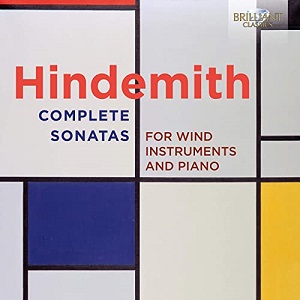
Filippo Farinelli steers Hindemith Sonatas for Wind Instruments and Piano project

To my knowledge, this is the first time all Paul Hindemith's wind sonatas have been released as a group. Pianist Filippo Farinelli collaborated with several well-known Italian instrumentists for this project. 

Having the same pianist throughout the set provides a degree of performance continuity. The album was also recorded in the same studio with the same production team for all eleven works. So the sound is consistent throughout the program.

And what a program. Collectively, the sonatas show the breadth of Hindemith's imagination. And they also demonstrate the mastery of his craft. 

Hindemith was an accomplished chamber musician as a pianist, violinist, and violist. He well understood the conversational nature of the genre. In each of these sonatas, both performers stand on equal footing. 

Hindemith also understood the instruments he was writing for. He tailored the music to the wind instrument he wrote it for. The capabilities of the instrument shape the melodic outlines. And sometimes they even determine the style. 

Filippo Farinelli and his colleagues are all fine performers. These are top-notch readings for these sonatas.

This is a great collection for anyone interested in 20th Century music. Hindemith was a practical-minded composer. He wanted to give every instrument its own sonata. He wanted those sonatas to be rewarding to play. And most importantly, he wanted the sonatas to be music audiences wanted to hear.

This collection shows he succeeded on all counts.  

Paul Hindemith: Complete Sonatas for Wind Instruments and Piano
Filippo Farinelli, piano; various artists
Brilliant Classics 95755
2 CD Set

Monday, September 13, 2021

Christopher Gunning Symphony 5 and String Quartet 1 an interesting pairing

Signum Classics continues their survey of Christopher Gunning's music with a mix. This release features an orchestral and a chamber work. But there is a connection. Both works show Gunning's growth as a composer. And they show his willingness to challenge himself. 

Gunning composed his fifth symphony as his sister's health declined. She was to die before he completed the work. According to Gunning, the symphony represents "one's journey from birth to death." 

The symphony is dedicated to the memory of his sister. Hers seems to be the life journey Gunning was portraying. 

And that's what makes this recording is so compelling for me. Gunning is conducting a first-rate orchestra, and he knows exactly what he wants. And the Royal Philharmonic responds to his direction. 

This is an intricately constructed symphony. It works when everything aligns properly. And when everything hits with just the right intensity and articulation. And in Gunning's hands, it does.

The journey is more intellectual than emotional, but it's a satisfying one, nevertheless. 

The String Quartet No. 1 showcases Gunning's ability to fully exploit the potential of his material. In this case, it's three notes -- C, D, and G. The twenty-four-minute work grows out of those three pitches. Gunning explores the relationship between these notes and their implied harmonies.

It's a modern-sounding string quartet, but not a modernist one. The Juno Quartet delivers a fine performance. Their playing brings out the music's emotional rather than intellectual content. And that's how it should be. 

Christopher Gunning
Symphony No. 5- Royal Philharmonic Orchestra; Christopher Gunning, conductor
String Quartet No. 1 - Juno String Quartet
Signum Classics

Thursday, August 19, 2021

Hendrik Andriessen Orchestral Music a Welcome Reissue

Hendrik Andriessen was one of the Netherland's most important composers of the early 20th Century. His sons, Jurriaan and Louis Andressen would continue the tradition and become major composers of the late 20th Century. 

This release presents two albums previously released by NM Classics. And I'm glad to see them back in print. 

Disc one is a re-release from 1991. Roberta Alexander performs Andriessen's orchestral song cycle "Miroir de peine." 

Andriessen was an organist as well as a composer. He cited Cesar Franck (who was the same) as his inspiration. This cycle shows that influence, although Andriessen's spiritual mysticism has its own character. 

Disc one also includes two shorter selections sung by Alexander and two of Andriessen's most popular short orchestras. works. The Variations and Fugue on a Theme by Kuhnau shows Andriessen's mastery as an orchestrator. The Variations on a Theme by Couperin transform the original Baroque melody into an Impressionistic watercolor. 

The second disc, originally released in 1999, features works for solo instruments and orchestra. It includes his Concertino for Cello and Orchestra, the Concertino for Oboe with String Orchestra, and the Concerto for Violin and Orchestra. 

These postwar works show Andriessen at the top of his game. The pieces have a more angular quality to them than his prewar compositions (like the Miroir de peine). But all are still very much tonal, and all are quite beautiful.

The Netherlands Chamber Orchestra performs on both discs. The 1991 release is conducted by David Porcelijn, the second by Thierry Fischer. There's a little bit of difference in sound quality between the two discs, but hardly any in musical quality. Andriessen's works are performed by musicians who know and understand his music.

If you're not familiar with this patriarch of Dutch music, this is the release to start with. It's some of Andriessen's best compositions. I hope this isn't the only treasure Brilliant Classics releases from NM Classic's vaults. There's a lot more Andriessen waiting to be rediscovered.  

Hendrik Andriessen: Miroir de Piene, Orchestral Works & Concertos
Roberta Alexander, soprano
Netherlands Radio Chamber Orchestra; David Porcelijn, Thierry Fischer, conductors
Brilliant Classics
2 CD set

Thursday, July 29, 2021

Say Hello to Vítězslava Kaprálová with "Waving Farewell"

Vítězslava Kaprálová is considered one of the Czech Republic's greatest female composers -- and with good reason. She was a student of Vítězslav Novák and Bohuslav Martinu. 

She conducted performances of her works with both the Czech Philharmonic and the BBC Orchestra. She wrote over fifty compositions, several of which won awards. And she was dead at age 25.

This release features live performances from the Kaprálová Festival in Michigan. Kenneth Kiesler conducts the University of Michigan Symphony Orchestra in some enthusiastic and firey performances.

Kaprálová's music bristles with youthful energy, dazzling with brilliant orchestral colors. But there's substance here, too. These are well-crafted works that one might expect from a composer in a mid or even later career.

I could hear echoes of both Novák and Martinu in passages of Kaprálová's music. But I think those were the Czech elements that colored the sound of all three composers. In terms of organization and orchestration, Kaprálová was very much her own woman.  

Pianist Amy I-Lin Cheng does the 1935 Piano Concerto justice. Her playing melds Romantic expressiveness with an edginess that seems in keeping with Kaprálová's character. 

Another standout is the title track, "Waving Farewell." Kaprálová wrote 33 songs, only a few given orchestral accompaniment. The music swirls around the text, conveying the roiling emotions it suggests.

This recording presents five of Kaprálová's fifty compositions. I don't know about you, but I'd like to collect them all. 

Vítězslava Kaprálová: Waving Farewell
Sad Evening; Piano Concerto; Prélude de Noël; Military Sinfonietta; Suite en miniature
Nicholas Phan, tenor; Amy I-Lin Cheng, piano
University of Michigan Symphony Orchestra;  Kenneth Kiesler, conductor
Naxos 8.574144


Wednesday, July 21, 2021

Grazyna Bacewicz Piano Music in Good Hands With Joanna Sochacka

Pianist Joanna Sochacka is a woman on a mission. And that mission is for Grazyna Bacewicz's compositions to receive the performances they deserve. 

Bacewicz is already recognized as one of Poland's musical geniuses. She was both a virtuoso violinist and pianist. Her compositions won numerous awards and critical acclaim. And yet, sixty years after her death, most of her catalog remains under-recorded.

Sochacka thoroughly researched Bacewicz's solo piano music. Her program supports her assertion that this is music that needs to be heard. 

Bacewicz's Piano Sonata No. 2 is her most-recorded solo piano work. Bacewicz had extraordinary technique and often used the full range of the instrument with Liztian abandon.

This sonata is one long thrill ride, especially as performed by Sochacka. She has all the skills necessary to pull off this sonata, both technically and musically.

Bacewicz felt her first sonata, along with her Two Etudes for Piano weren't worthy of publication. This despite the fact that both won the Fryderyk Chopin Composers’ Competition!

Sochacka performs both from the manuscript. The etudes are challenging works for the performer, but quite appealing to the ear. The first sonata isn't quite as complex as the second, but it's still a densely composed work. And one I'd like to see enter the repertoire.

Sochacka also includes Bacewicz's earliest sonata from 1930. Written when she was 27, it's a fascinating post-Romantic work. I heard passages that reminded me of Rachmaninov, albeit with more complex harmonies (really). The double fugue in the final movement is a real tour-de-force.  

Why haven't more pianists programmed these works? I'm hoping it's just unfamiliarity. Because that's something this recording can remedy. Highly recommended.

Grazyna Bacewicz: Piano Music
Joanna Sochacka, piano
DUX 1689


Thursday, July 15, 2021

Peteris Vasks - Music for Strings deeply spiritual

In recommending music, I often say that if you enjoy Arvo Part, you should listen to Pēteris Vasks. Both composers come from the Baltic States, and both infuse their music with deep spirituality. Vasks' music, like that of Part's, ignores the "isms" of the 20th Century. 

What matters is the emotion the composer's articulating. And though Part and Vasks may have similar styles, you won't mistake one for the other. Vasks uses tonality when it suits, but never in a traditional fashion. 

This release presents four works for string orchestra. Three of them express a single mood. The Musica Serena spins out step-wise melodies that seem to float over a layer of ever-shifting chords. 

Vasks composed the Musica Dolorosa while dealing with the death of his sister. Its somber tones give voice to that grief. The strings gradually rise as the work progresses, ending with a feeling of tentative hopefulness.

Musica Appassionata is passionate indeed! Long passages that pile dissonant intervals one atop another ramp up the tension. Then the clouds break and the orchestra dances lightly through the next section. 

The Cello Concerto No. 2 is an elegiac work that uses accompanying strings to amplify and reinforce the gestures of the soloist. Cellist Uladzimir Sinkevich delivers the emotional intensity of the work, making this a powerful close to the program.   

The Munchner Rundfunkorchestrer has a clear, lean ensemble sound. Ivan Repušić effectively directs the orchestra, getting to the heart of Vasks' compositions. The very large heart of Vasks' compositions. 

I recommend this release not only to fans of Arvo Part but to anyone who wants to be truly moved by music.  

Peteris Vasks: Musica Serena; Musica Dolorosa; Musica Appassionata; Klatbutne
Uladzimir Sinkevich, cello; Anna-Maria Palii, soprano
Munchner Rundfunkorchestrer;  Ivan Repušić, conductor
BR Klassk 900336

Wednesday, June 30, 2021

Louis Karchin - Five Compositions

The five compositions by Louis Karchin featured in this release include his chamber symphony, and four smaller chamber works. 

In the liner notes Karchin says, "While writing the Chamber Symphony, I realized why the genre is such an appealing one for composers working today. Contemporary music revels in the discovery of new sounds and instrumental combinations, and seems to prioritize the virtuosic and flexible nature of solo lines."

And that pretty much sums up the effect of Karchin's Chamber Symphony. The stripped-down ensemble (only 14 players) combines and recombines in extraordinary and interesting ways. 

With the exception of violins and percussion, there's only one player per instrument. So virtuosic and flexible solo lines are in abundance. 

The Washington Square Ensemble, under the direction of the composer, fully realizes the potential of the score. While the shifting tonal colors beguile, the music has a clear sense of direction and purpose. 

Rochester Celebration is a pianistic homage pianist Barry Snyder. Snyder's interest in 19th Century thematic transformation suggested the path the piece should take. Former Snyder student Margaret Kampmeier performs the work with sensitivity and feeling. 

The other standout work for me was the Baracole Variations for flute and harp. The commissioning artists, Renée Jolles (violin), and Susan Jolles (harp) perform. The variations are not merely ornamented versions of the theme.

Rather, they seem to be deconstructions of the theme. Each variation reassembles the elements in new and interesting ways, complemented by the innovative interplays between the two instruments. 

If you're not familiar with Louis Karchin, this disc can provide a good introduction to his chamber music. 

Louis Karchin: Five Compositions (2009-2017)
Chamber Symphony  - The Washington Square Ensemble; Louis Karchin, conductor
Rochester Celebration - Margaret Kampmeier, piano
Postlude - Sam Jones, trumpet; Han Chen, piano
Quest - Alice Teyssier, flute; Ashley Jackson, harp
Barcarole Variations -  Renée Jolles, violin; Susan Jolles, harp

Thursday, June 10, 2021

Pál Hermann's music revived, thanks to Toccata Classics

When I saw the title for this release, I thought I might want to review it. When I read the subtitle, I knew I had to review it. I'd never heard of Pál Hermann, and I'm always looking for new composers to discover. But "Complete Surviving Music?" What did that mean? What did it survive? I had to know more. 

It turns out that Pál Hermann was a virtuoso cellist. And he also composed music -- and not just for his instrument. Hermann studied composition with his fellow Hungarians Béla Bartók and Zoltán Kodály. 

Because of his Jewish background, he tried to stay one step ahead of the Nazis. In 1934 he was forced out of the faculty of Berlin's Musikschule Paul Hindemith Neukölln. He relocated to Brussels, and then in 1937, as the German army built up along the border, he moved to France.

And that's when his luck ran out. He was in southern France. When the Nazis overran the country, that area became Vichy France, a puppet state of Germany. Pál Hermann was deported to an extermination camp in Lithuania, where he presumably died.

Only two of Hermann's works were published during his lifetime. It's a miracle that any of his manuscripts survived at all. 

Almost all the works received their world recording premieres with this release. Most important, I think, is the Cello Concerto. There are no recordings of Pál Hermann's playing. But the demands he puts on the cellist in this concerto can give us a fair idea of the scope of his talent and technique. 

The 1925 concerto was left incomplete at Hermann's death. Italian composer Fabio Conti was commissioned to reconstruct and complete the work. In the liner notes the project is called a collaboration between two composers. It is, and it works. Hermann fully orchestrated only the first movement. Conti's orchestration of the other four movements matches it perfectly. 

To my ears, Hermann's style sits somewhere between his two teachers. His harmonies are more conservative than Bartók's while his melodies and structures are leaner and more modernist than Kodály. 

This is an important release. Hermann's music is original and beautifully crafted. Pál Hermann vanished from history. His music deserves a better fate. Highly recommended. 

Pál Hermann: Complete Surviving Music, Volume One
Sofia Soloviy, soprano
Kateryna Poteriaieva, violin, Clive Greensmith, cello
Alina Shevchenko, Roman Machenko, pianos
Lviv International Symphony Orchestra; Theodore Kuchar, conductor
Toccata Classics TOCC 0443

Tuesday, March 16, 2021

Eleanor Alberga - Wild Blue Yonder is exceptional

This Navonna release is the follow-up to Alberga's String Quartet album. And it solidifies her reputation in the realm of chamber music. The four compositions in the program span about twenty-two years, and an equally wide range of subjects. 

The disc opens and closes with works for violin and piano. The performers are Eleanor Alberga, piano, and her husband Thomas Bowes, violin. The chemistry between the two adds depth to their performances. 

"No-Man's Land Lullaby" (1997) references World War I. As the title suggests, this is a disquieting lullaby. The harmonies waver with interment tonality, and the melody is a subtly distortion of Brahms' tune. Effective and evocative.

The second piece for violin and piano "Wild Blue Yonder" was written two years later. Alberga's voice seems stronger, developing the rhythmic elements that are a major part of her style. 

The other two works are for string quartet plus one. For "Succubus Moon" (2007), that's the oboe. For "Shining Gate of Morpheus" (2012), it's a horn. 

Succubi are a seductive nocturnal manifestation of evil. Alberga's melodies for the oboe have a seductiveness to them. "Shining Gate of Morpheus" is, by contrast, a more calming work. Instead of agitation, we get pleasant bustling. Morpheus is the god of sleep. It seems like he's inviting the listener to rest a spell and have a pleasant dream.  

This is a good companion release to Alberga's string quartet album. Now what I'd really like to hear is some of her large-scale works.

Eleanor Alberga: Wild Blue Yonder
Thomas Bowes, violin; Richard Watkins, horn; Nicholas Daniel, oboe; Eleanor Alberga, piano
Ensemble Arcadiana
Navonna NV6346

Wednesday, September 02, 2020

Michael Daugherty evokes Woody Guthrie -- and more

I've said in previous reviews that Michael Daugherty is a national treasure. And this release adds credence to that argument. Daugherty regularly reinterprets aspects of American life and culture in his music. The works are complex yet accessible, blending classical and traditional music. They sound as American as Aaron Copland, yet as far removed from that composer as possible.

In this case, Daugherty's inspiration is "the life and times of Woody Guthrie." The orchestra, Dogs of Desire, comprises members of the Albany Symphony. The stripped-down ensemble sounds as if it was created by whatever instruments were on hand.

Annika Socolofsky, soprano, and John Daugherty, baritone sing in a style that seems to blend classical tradition, Broadway, jazz, and Americana. Daugherty effectively creates a Depression-Era Cabaret.

This is music for the hard times -- be it Guthrie's Great Depression of the early 1930s or the Crazy Years of the early 2010s. Sometimes Daugherty uses Guthrie's melodies (usually just individual phrases). Sometimes he sets the words to new music. And sometimes it's something else.

My favorite track is "Hot Air." Here Daugherty takes Guthrie's attitude towards radio preachers and gives us a current take. "I am a radio talk show host, spinning my lies from coast to coast."

Daugherty perfectly evokes the spirit of Woody Guthrie in this work. It calls out injustice, indites economic inequality, and even if it doesn't quite kill fascists, it does rough them up. And it sounds, well, distinctively American.

Michael Daugherty: This Land Sings
Inspired by the Life and Times of Woody Guthrie
Annika Socolofsky, soprano; John Daugherty, baritone
Dogs of Desire; David Alan Miller
Naxos

Wednesday, July 22, 2020

Gloria Bruni Ringparable symphony delivers powerful message

To say Gloria Bruni is talented would be an understatement. She's a renowned soprano, violinist, and composer. Her experience as both a vocal and instrumental performer seems to inform the choices she makes as a composer.

Her Symphony No. 1 was premiered in 2012 and has nothing to do with Wagner. "Ringparabel" refers to a story told in a play by 18th Century author Gotthold Ephraim Lessing.

In the parable, a father promises a precious ring to each of his three sons. He has two perfect replicas made, and when he dies, each son gets a ring. The three quarrel over who has the original (and therefore the most valuable). It turns out the original ring was lost long ago -- all three are replicas. The true value of the rings comes from how the sons live their lives.

The three rings in the parable represent the three Abrahamic faiths: Judaism, Christianity, and Islam. Bruni weaves together texts and musical quotes from these faiths in her work.

Just as the three rings in the story have equal value, Bruni seems to give equal weight to her sources of inspiration. The symphony is a wonderful blend. Listening with my Western/Christian background, the work sometimes seemed very familiar, at other times strangely exotic.

Perhaps the same might be true for audiences from different traditions -- although they may disagree with my opinion of what is exotic.

Bruni's music is very rhythmic. Her beefed-up percussion section reminded me of those found in contemporary film music. Her orchestration is quite imaginative, with some very interesting choices for chord spellings.

The Radio Symphony Orchestra Minsk performs with energy and commitment. Deborah Humble and Andrej Morozow deliver solid performances, too. It's an exciting work with a message we need today.

Gloria Bruni: Symphony No. 1 "Ringparabel"
Deborah Humble, mezzo-soprano; Andrej Morozow, bass
Radio Symphony Orchestra Minsk; Wilhelm Keitel, conductor
Rondeau Productions ROP6177

Wednesday, September 18, 2019

Leshnoff: Symphony gives voice to the VIOLINS of HOPE

Jonathan Leshnoff is a  talented composer. And his fourth symphony is a well-constructed work. It has engaging themes, nicely shaped melodies, and a fresh take on tonality. But for me, it didn't have the desired effect.

The liner notes explain the concept of the work in great detail. The project Violins for Hope refurbishes instruments that survived the Holocaust -- even when their owners did not. These instruments that were once heard in concentration camps now ring out in concert hall. That's a concept that can stir powerful emotions.

Leshnoff's symphony was composed for the Nashville Symphony playing the Violins of Hope. Logically, Leshnoff draws on Jewish culture for his work. The liner notes carefully delineate all the Hebrew references and inspirations in the symphony.

On paper, it's a beautiful and inspiring concept. But I didn't hear any of it. The Violins of Hope, despite their history, are just violins - and they sound like any other violin. Leshnoff's symphony, despite all the Hebrew-inspired elements, doesn't sound especially Jewish.

I liked the symphony, and the Nashville Symphony performs it well. But I would have had the same reaction even if I hadn't read the liner notes.

The recording also includes two additional works by Leshnoff - the Guitar Concerto and his short orchestral work Starburst. Neither has an elaborate backstory, and neither needs one.

Jason Vieux plays the concerto with fire and spirit. I especially enjoyed his rapid passage-work and the ringing quality of his held notes.

In the end, it's not the extra-musical elements that matter, only the sound. And based solely on the sound, I can recommend this recording.

Jonathan Leshnoff: Symphony No. 4 "Heichalos"
featuring the VIOLINS of HOPE
Guitar Concerto; Starburst
Jason Vieaux, guitar
Nashville Symphony; Giancarlo Guerrero, conductor
Naxos