Showing posts with label modern music. Show all posts

Wednesday, August 16, 2023

Frederck Septimus Kelly Chamber Music

The First World War took the lives of about 20 million people. And among them were several composers. These were young men, caught up in the idea of gloriously fighting for King (or Kaiser) and Country. George Butterworth, Rudi Stephan, and Frederick Septimus Kelly died before fulfilling their potential. 

This release features three chamber works by Frederick Septimus Kelly. This Australian was not only a talented composer but a fine athlete. As part of the British sculling team, he won a gold medal in the 1908 Olympic Games. 

Kelly composed his Violin Sonata No. 1 in D minor in response to his father's death. It's an introspective and moving work. To my ears, it sounded like a bittersweet contemplation of a life.

Violinist Laurence Jackson leans into the sonata. His warm tone and richly expressive playing convey the intent of the work. 

Kelly composed the Serenade for Flute in 1911,  on a voyage back to Australia. The original version is for flute, horn, and orchestra. This one is for flute and piano. This is a much lighter work and seems fun to play. At least, that's the impression flutist Michael Waye's performance conveys. 

The 1905 piano trio hints at what Kelly might have achieved had he survived the war. It's a big work, with each instrument showcased in turn. The expansive phrases have a lush, Romantic sound. But at the same time, I could hear Kelly pushing the boundaries. The West Australian Piano Trio gives this work a great performance. 

The liner notes hint that Toccata Classics may release at least a second volume of Kelly's music. I hope they do. 

Frederick Septimus Kelly: Chamber Music
Serenade for Flute and Piano; Violin Sonata No. 1; Piano Trio
Michael Waye, flute; Laurence Jackson, violin; David Wickham piano
The West Australian Piano Trio
Toccata Classics TOCC0702


Tuesday, July 25, 2023

A Left Coast - British Columbia Composers Showcased

I don't understand the absence of Canadian classical music in this country. Canada has a wealth of talented composers (both living and dead). Their music compares favorably to that written in the U.S. 

And yet recordings -- never mind performances -- of Canadian classical music are hard to find.

This release is accurately titled "A Left Coast." It refers to British Columbia which, like California, borders on the Pacific Ocean. Tyler Duncan and Erika Switzer present a strong program of art songs. And not just songs by Canadian composers, but Canadian composers in British Columbia. 

Many have some association with the University of British Columbia.  But this music is far from academic. Most impressive to me was the sheer variety of styles presented. 

Imam Habbib's selections draw on the tradition of German lied. The late Jocelyn Morlock's "Involuntary Love Songs" are beautifully crafted modal tunes. Yet they have just a hint of darkness. "Snowflakes" by Melissa Hui blends Debussy Impressionism and First Nations musical traditions.

Some of the composers used Canadian poets in their texts. Jean Coulthard set the poetry of fellow UBC colleague Louis MacKay. Her music has a decidedly contemporary -- but tonal -- sound. Leslie Yueda used poems by Lorna Crozier. "Plato's Angel" is aggressively chromatic and is sometimes atonal.

Tyler Duncan sings two works he commissioned. "Something Like That" by Stephen Chatman sounds like art song meets musical theater -- to the benefit of both genres. Jeffery Ryan's "Everything Already Lost" was co-commissioned by Duncan and Switzer. It's a strangely evocative and haunting work.

Duncan and Switzer are strongly invested in this music. And that comes through in their performances. Just about every track made me want to further explore the composer I was listening to. And there's a lot to explore. Although it might not be readily available. 

Highly recommended to anyone who appreciates Lieder or just darned good music.

 A Left Coast
Tyler Duncan, baritone; Erika Switzer, piano
Music by Iman Habibi, Jean Coulthard, Jocelyn Morlock, Stephen Chatman, Leslie Uyeda, and Jeffrey Ryan
Bridge Records


Tuesday, July 11, 2023

Talivaldis Kenins Symphonic Cycle Finishes Strong

This release concludes Ondine's traversal of Talivaldi Kenins symphonies. It features his second, third, and seventh symphonies.

Latvian organist and composer Kenins studied with Oliver Messiaen in the 1940s. When the Soviets overran Latvia, Kenins knew he couldn't return. He emigrated to Canada, where he remained the rest of his life. 

Toronto has a vibrant Latvian community, and soon Kenins felt at home. The community gave him the cultural base he needed for inspiration. 

And the wider cultural landscape soon bore the imprint of this talent. Kenins is credited with introducing many European concepts to Canadian composers. In the process it steered them away from British styles.

Kenin's own style was influenced by his time with Messiaen, as well as the heritage of Latvian music. But he also drew from Canadian sources. His Symphony No. 2 "Sinfonia concertante" has a neo-classical form. And it uses a lullaby of the Mi'kmaq First Nations people. It's an interesting blend that works surprisingly well.

The Symphony No. 7 also has neo-classical leanings. Kenins wrote the work in the form of a passacaglia. In essence, a passacaglia is a set of continual variations over a repeating bassline. Kenin obscures that bassline, but its outline is often hinted at throughout the work.     

Kenins wrote his third symphony in 1970. It was a commission from the Canadian Latvian Song Festival. The Festival is one of the events that reinforces Latvian cultural identity. Kenins delivers a masterwork of counterpoint and polyphony. And he does so with an underpinning of Latvian musical culture. There's not another work like it. 

Andris Poga and the Latvian National Symphony Orchestra understand Kenin's music.  -- both what it is and the culture it springs from. This has been an exceptional cycle of recordings. If you're familiar with the previous volumes, then I don't need to say anymore. If Kenins is unknown to you, give this release a listen. There are revelations to be found.  

Tālivaldis Ķeniņš: Symphonies Nos. 2, 3, & 7
Latvian National Symphony Orchestra; Andris Poga, conductor
Ondine 


Tuesday, April 25, 2023

Eugene Zador - Celebration Music Release cause for celebration

This release is the seventh in Naxos' Eugene Zador series. And it's an album comprised entirely of world premiere recordings. 

Zador was for many years the top film orchestrator at M-G-M Studios. In the 1950s he worked closely with fellow Hungarian Miklos Rozsa. They collaborated on several classic films like Ben Hur, Quo Vadus, and King of Kings. 

But Zador was more than a talented journeyman. In Hungary, he was an important composer. His career derailed in 1939 when he fled the Nazis and emigrated to America. And while he worked in a dream factory by day, he kept his own dreams alive. 

Zador's name never appeared in the credits of any film. He reserved it for his serious music, which he continued to compose. This release presents a sampling of those works, mainly from the latter part of his career. 

The 1931 Chamber Concerto hints at the direction Zador might have taken without the war. It's a sparsely orchestrated piece, somewhat resembling Bartok mixed with Stravinsky. This was definitely contemporary music. 

The remaining works from the 1960s and 1970s tell a different story. The music is more tonal, although it's a very free-form tonality. Occasionally I could hear passages that reminded me of his film work. But this isn't film music. 

Zador's themes are deceptively complex. It's only as the work unfolds that the complexity begins to resolve itself.

Eugene Zador: Celebration Music
Chamber Concerto; Suite for Horn, Strings, and Percussion
Budapest Symphony Orchestra MAV; Mariusz Smolij, conductor
Naxos 8.574262

Wednesday, September 14, 2022

Niklay Shugaev excels with underrated 20th Century cello works

The three works have one thing in common. They're all works for cello and orchestra, composed by Italians in the mid-20th Century. And that's about all they have in common. 

Gian Malipiero's work is a full-blown cello concerto. Giorgio Ghedini's is a neo-classical composition for two cellos (and orchestra). Alfredo Cansala's is an unassuming Notturne e Tarantella

Niklay Shugaev is the principal cellist for all three works. He plays with a rich, singing tone. Sugaev adapts his playing to the style of the composer, emphasizing their differences. 

Dmitri Prokofiev joins him for the Ghedini work. His playing style is different than Shugaev's yet complimentary to it. And it fits perfectly with the intent of the music.

"L'Oment" (The Elm Grove) represents two herbs that appear to grow separately. Yet underneath the ground their roots intertwine, nourishing each other. The two cellos -- as the herbs -- do just that. Their lines intertwine, harmonizing and supporting each other. Shugaev and Prokofiev blend while retaining their individuality. 

Malipiero's brother was a renowned cellist. And that's who this concerto was written for. Shugaev plays the work with aggressive exuberance. It left me with the impression that this music was both fun and rewarding to play. It certainly was to listen to. 

Gian Francesco Malipiero: Cello Concerto
Giorgio Federico Ghedini: L'Omenta
Niklay Shugaev, cello
Dmitrii Prokfiev, cello
Rostov Academic Symphony Orchdestra; Valentin Uryupin, conductor
Naxos

Thursday, January 02, 2020

Raphael Wallfisch continues cello concerto cycle with Ben-Haim, Korngold, and Bloch

This installment of Raphael Wallfisch's innovative series features three very different composers. "Cello Concertos by Jewish Composers in Exile" is in its fourth volume. All three composers were Jewish, and all were forced from their homes. But not every work on this album is a concerto (sort of).

The outlier is Ernest Bloch, represented by some transformed works. Included are two movements the Baal Shem Suite. Originally written for violin and piano, It's heard here in orchestration for cello and orchestra, and work quite well in this version.

His major work is the Symphony for Violoncello and Orchestra. This 1954 work (symphony, not concerto) was composed for solo trombone and orchestra. The piano reduction noted the solo part could be played by either trombone or cello. And so we have the version on this release.

The Symphony (not concerto) is a wonderful work. Although he didn't count it as one of his Jewish works (such as Schlomo), there's no escaping one's roots. The melodies, particularly as played by Wallfisch have echoes from Jewish musical culture.

Paul Ben-Haim was one of the early immigrants to Britsh Mandate Palestine (later Israel). His work is strongly influenced by Eastern Mediterranian music. Those influences are easy to hear in his 1972 Cello Concerto.

Erich Wolfgang Korngold fled Austria ahead of the Nazis. He found a new life (and career) in America, transitioning from composing concert music to film scores. But he never completely left classical music, nor his Viennese roots behind.

His Cello Concerto in C major recycles themes from his score for "Deception." A cellist and a composer are opposite points of a love triangle (with a pianist!). Part of the drama involves a concerto the composer has written for the cellist, snippets of which are heard in the movie.

Korngold takes his movie cues and develops them into an organic if compact, whole. The thirteen-minute concerto never completely shakes its Hollywood origins. Because Wallfisch takes the music seriously, though, those traces recede in the background.

Overall, Raphael Wallfisch delivers some beautiful performances. He adapts his playing to the character of the music. For Bloch's music, he plays with a rich, rounded tone, while in the Korngold his cello seems to have a steely edge to it.

This release is a diverse collection of composers and styles. But it's unified in the quality of the playing, both by Wallfisch and the BBC National Orchestra of Wales.

Paul Ben-Haim; Ernest Bloch; Erich Wolfgang Korngold: Cello Concertos
Cello Concertos from Exile, Vol. 4
Raphael Wallfisch, cello
BBC National Orchestra of Wales; Lukasz Borowicz, conductor
CPO 555 273–2

Saturday, October 27, 2018

Villa-Lobos Symphonic Cycle Ends at Beginning

Naxos completes their cycle of Villa-Lobos symphonies by starting at the beginning. This final installment features Symphonies Nos. 1 and 2. Both are early works, and both are strongly influenced by Vincent d'Indy.

Villa-Lobos studied in France and used d'Indy's book on composition as a guide. His first symphony, completed in 1916 bears a strong resemblance to d'Indy's symphonic writing. And yet there's something unique here.

Villa-Lobos was trying to express something cosmic with this work. As he wrote, "the soul of the artist, with the blaze of his own light that emanates from him - glimpses, through a subtle and ethereal crystal, a vast landscape."

He mostly succeeds in expressing this vision. The music has a light, ethereal quality to it. The third movement actually reminded me a little of Holst's "Mercury" movement from "The Planets" with its quick splashes of orchestral color.

Villa-Lobos composed his second symphony before hearing his first performed. Nevertheless, the style of the work seems more mature. There's still a French element to the work, but Villa-Lobos's own voice is stronger. The title "Ascensão" (Ascending) refers to the opening four-note upward-pointing motif. Villa-Lobos builds the entire work on that motif. The symphony is a tightly-woven whole, a work that logically progresses from start to finish.

Great music knows no borders. I think, though, that the São Paulo Symphony Orchestra brings something special to the music of their countryman. That shared heritage gives these symphonies an extra lift.

With this release, all of Villa-Lobos' surviving symphonies are available in first-rate performances. Collect them all.

Heitor Villa-Lobos
Symphony No. 1 ‘O Imprevisto’; Symphony No. 2 ‘Ascensão’
São Paulo Symphony Orchestra; Isaac Karabtchevsky, conductor
Naxos

Wednesday, October 10, 2018

Edmund Rubbra BBC Broadcasts - Flawed Musical Treasures

This release features three live performances broadcast by the BBC in the 1960s. the recordings are from the Richard Itter collection; professional-grade recordings of radio broadcasts.

Some of the Lyrita releases of this material have had amazing sound quality. In these performances, though, the sound seems somewhat lo-fi and closed in.

But the quality of the performances more than makes up for any deficiencies of the audio. Edmund Rubbra gives authoritative performances in two of the three works on this release.

Rubbra performs his Prelude and Fugue on a theme of Cyril Scott and one of Scott's own compositions in a 1967 broadcast. His playing clearly delineates each line of counterpoint, while keeping all the strands together in a cohesive whole.

Rubbra's Sinfonia Concertante for piano and orchestra was written in 1934-36, and revised six years later. The work isn't about technical fireworks, but rather lyrical expressiveness. Rubbra performances with both delicacy and power as the music demands. And in the process provides a model for how this work should be performed (and why it should be more often).

The recorded broadcast of the Violin Concerto is from 1960, a year after Rubbra completed the work. Ednré Wolf's interpretation infuses the music with his Hungarian heritage. And it works. This is a thrilling performance that brings out the melodic strengths of Rubbra's music.

Edmund Rubbra
Sinfonia Concertante - Edmund Rubbra, piano; City of Birmingham Symphony Orchestra; Hugo Rignold, conductor
Prelude and Fugue on a theme of Cyril Scott, Op. 69 - Edmund Rubbra, piano
Violin Concerto, Op. 103 - EdnréWolf, violin; BBC Symphony Orchestra; Rudolf Schwarz, conductor
Lyrita

Wednesday, September 12, 2018

George Lloyd Symphonies in Definitive Live Performances

This release presents two live performances of George Lloyd symphonies. What performances -- and what symphonies!

George Lloyd was a rising star before the Second World War but was largely ignored afterward. Conductor Edward Downes became a champion of Lloyd's music.

 Symphony No. 6, written in 1956, is heard in its world-premiere broadcast from 1980. It's a quintessentially Britsh work, strongly reminding me of William Walton's "Crown Imperial." But it's a superficial similarity.

Lloyd's modestly-scored symphony features some wonderfully inventive melodies.  Fans of William Walton, Arthur Bliss -- and even Benjamin Britten -- will find much to like in Lloyd's score.

Lloyd's Symphony No. 7 is subtitled "Proserpine." According to Lloyd, Proserpine's story "seems to tell us something about the human condition of having one foot on this earth and another somewhere else – wherever that may be."

 The music is equally ambivalent. The first movement is light and cheerful, representing the maiden Proserpine dancing in the sun. The somber middle movement depicts Proserpine, now the wife of Hades, in the underworld. The turbulent finale seems to be a struggle between her worlds of light and darkness.

Lloyd used an expanded orchestra for this work and uses it to great effect. Downes leads the BBC Northern Symphony Orchestra in a compelling performance that makes the most of the tumultuous emotions embodied in this massive composition.

George Lloyd 
Symphony No. 6; Symphony No. 7 "Proserpine" 
BBC Northern Symphony Orchestra; Edward Downes, conductor 
Live performances 
Lyrita REM.1135

Saturday, September 01, 2018

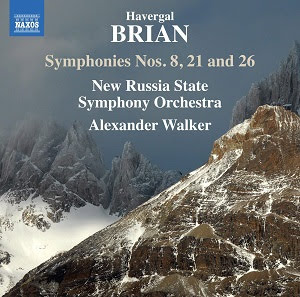
Havergal Brian Symphonic Series Concludes in Fine Style

The sales sheet for this release notes that "This issue completes the commercial recording of all 32 of Brian’s symphonies." Well, that may be true, but it's a little confusing.

First, not all the symphonies have been recorded by Naxos/Marco Polo. Although with 17 of Brian's 32 symphonies in their catalog, Naxos has definitely recorded the most.

There are a few others available on other labels, but eleven of the symphonies reside in out of print recordings. Here's hoping Naxos takes the extra step and finishes their own traversal of Brian's symphonies.

None of that diminishes this release. The three works presented represent three milestones in Brian's career. The Symphony No. 8, completed in 1949, was the first performed in public. Symphony No. 21 was the first to be commercially recorded, and Symphony No. 26 the last. This is its world premiere recording.

Brian may be best remembered for his 1919 record-breaking first symphony, the"Gothic." With over 200 performers and a playing time close to 2 hours, it's a massive work. But Brian's style evolved dramatically over time.

By the early 1950s, Brian had condensed his musical language into an efficient, compact form. Symphony No. 8 is one of three he completed in short order that consist of a single movement. It's a wonderfully succinct work, with no wasted motion.

Fast forward a decade, and Brian's language becomes more expansive, but not excessively so. The Symphony No. 21 is a model of classical form, with four distinct movements. Of the three symphonies in this program, I think it has the most innovative orchestration. To my ears, most of the symphony has a chamber music quality to it.

Symphony No. 26 from 1966 condenses the symphonic form from four movements to three. Brian pushes the limits of tonality with this work. And while it's highly chromatic, the lyrism that's the heart of Brian's style still shines through. The New Russia State Symphony Orchestra has a fine sound in these recordings. Alexander Walker knows what he's about. Each symphony has its own well-defined narrative flow.

Even if you're not especially interested in British music, these works are worth a listen.

Havergal Brian: Symphonies Nos. 8, 21, and 26
New Russia State Symphony Orchestra; Alexander Walker, conductor
Naxos

Saturday, August 04, 2018

Louis Glass Complete Symphonies Vol. 2 - Insightful Performances

Volume 2 of CPO's series present two Louis Glass works with a common theme. Both the works have strong theosophist elements. Glass found inspiration in the movement's mystical imagery.

The 1912 Fantasia for Piano and Orchestra bears this motto: "From the spirit’s eternal canopy tones calling man sound down. And man turns away from the world and remains alone in order to find peace."

That quote pretty much sums up the organization for the work. The Fantasy unfolds gradually, as an eternal canopy should. Glass uses very simple elements -- open fifths, diatonic arpeggios, repeated notes --  to set the stage. These building blocks pile up in increasing complexity, suggesting the busyness of the world. The piano finally takes control, resolving the work in calm, peaceful beauty.

Glass subtitled his Symphony No. 5, completed in 1919, "The Wheel of Life," after a key theophosit symbol. Each movement follows the progress of that wheel: Daily Life, Rest, Shades, Dawn. Bruckner and Franck are often cited as inspirations for Glass. In this work, I'm reminded of a few composers, too -- Arnold Bax, Carl Nielsen, and perhaps a little Richard Strauss.

As with the Fantasy, the musical elements Glass works with are quite simple. And yet he uses them in such imaginative ways! Even without known the program, the symphony works. The first movement (Daily Life) is tightly constructed, bustling allegro energico with a satisfying resolution. The second movement (Rest) is a restful andante tranquillo, and so on.

The Staatsorchester Rheinische Philharmonie have a warm, clean sound I find quite appealing (especially with this material). Glass was an exceptional pianist, and Marianna Shirinyan does justice to his writing in the Fantasy. Her performance is wonderfully expressive, without being overly so. It's the right tone for Glass, I think.

CPO isn't the first label to record Glass's symphonies. Danacord has a cycle with Nayden Todorov and the Plovdiv Philharmonic Orchestra. Marco Polo released the 5th and 6th symphonies with Peter Marchbanka and the South African Broadcasting Corporation National. These performances compare quite favorably with those, I think and offer slightly different insights into Glass' music.

Louis Glass: Complete Symphonies, Vol. 2
Symphony No. 5 in C major, Op. 57
Fantasy for Piano and Orchestra, Op. 47
Marianna Shirinyan, piano; Staatsorchester Rheinische Philharmonie
Daniel Raiskin, conductor
CPO 777 494-2

Saturday, July 28, 2018

Ruman Gamba Shows Dag Wirén More Than a One-Hit Wonder

I think it must be frustrating to be a one-hit wonder -- especially in the field of classical music. Swedish composer Dag Wirén wrote five symphonies, three concertos, five string quartets,  nine film scores, several ballets.

Yet most orchestras only program one of his works -- the Serenade for Strings.

The work was dashed off quickly, and in a good performance, that sense of spontaneity comes through. Ruman Gamba and Iceland Symphony Orchestra give the Serenade a good performance.

Gamba uses the full orchestral string section. The work is often recorded with a chamber orchestra, and the difference in sound is noteworthy.

While still light and breezy, the substance of the string sound makes it seem less of a throwaway piece. And -- for those of us who've heard the Serenade too often -- it offers a fresh take on this classic.

The Sinfonietta, Op. 7a started life as part of Wiren's second symphony. The symphony was withdrawn, and two of the movements were reworked into the Sinfonietta. It's an intense, compact work that with a strong sense of drama. Wiren's melodies may have echoes of Grieg and Scandinavia, but they're faint. The Sinfonietta seems to lean more towards Prokofiev than Nielsen.

Wiren withdrew his first symphony and completely rewrote his second. He seemed to hit his stride with Symphony No. 3. Wiren handles his material with confidence. The themes are memorable, and the entire work seems to flow organically from start to finish. There are a few passages where I could tell this was the same person who composed the Serenade. But I could also tell this was a composer who had grown in mastery.

Also included is Wiren's 1957 Divertimento. It's a more substantial work than the title suggests.

Ruman Gamba writes, "I was surprised that the music of Wirén was just as unknown
[in Sweden] as it was in the UK... Convinced that Wirén must have composed some other fine music [than the Serenade], I had the opportunity to suggest his Third Symphony for a concert... a performance which persuaded me to think about a whole CD of his music."

Gamba was right. Wiren did compose some other fine music.

Dag Wirén: Orchestral Works
Symphony No. 3, Op. 20; Serenade, Op. 11; Divertimento, Op. 29; Sinfonietta, Op. 7a in C major
Iceland Symphony Orchestra; Ruman Gamba, conductor
Chandos CHSA 5194
SACD

Wednesday, January 03, 2018

George Dyson's Early "Choral Symphony" Shows Composer's Promise

George Dyson's Choral Symphony is a remarkable rediscovery. The work was written for Dyson's Doctor of Music examination in 1917. It was dutifully evaluated (he passed), then filed away and forgotten with countless other such examination pieces. There it remained until Paul Spicer ran across it while researching Dyson's biography.

It's an impressive work for a student. Dyson had an early mastery of orchestration and a fascination with the sea. Both come together in this massive work.

The symphony is a four-movement setting of Psalm 107. I heard some influences of Elgar's "Dream of Gerontius" and Vaughan William's "Sea Symphony." But the music is Dyson's own.

Dyson writes from the English choral tradition, using the inherent drama of the text to great effect. This is especially true in the final movement, The text begins "They that go down to the sea in ships... these men see the works of the Lord and in wonders in the deep." The orchestra rises and swells, depicting the roiling sea. In the end, though, the storm cloud dissipates, and the work ends with calm assurance.

St. Paul's Voyage to Melita was commissioned by the Three Choirs Festival. Dyson conducted the 1933 premiere. This is a more mature work. It's not quite an oratorio and not quite an opera. Rather, it's a musical drama for choir, orchestra, and soloists. The choir sets the stand and comments on the action.

And what action! The apostle Paul is arrested and shipped off to Rome for trial. The vessel is engulfed in a storm, then shipwrecked. Only Paul's demonstration of faith saves him and the other prisoners.

Tenor Joshua Ellicott makes an effective Paul. At the center of the work, Dyson pares down the ensemble to just Paul, contemplating his faith. Ellicott's plaintive performance imbues that monologue with just a hint of self-doubt.

Large-scale works such as these can sometimes just lumber along. Conductor David Hill keeps the performances focussed and moving forward. Highly recommended for anyone who loves modern English music.

George Dyson: Choral Symphony; St. Paul's Voyage to Melita
Elizabeth Watts, soprano; Caitlin Hulcup, mezzo-soprano; Joshua Ellicott, tenor; Roderick Williams, baritone
The Bach Choir; Bournemouth Symphony Orchestra, David Hill, conductor
Naxos

Wednesday, December 27, 2017

László Lajtha: Orchestral Music, Vol. 6 - a Fine Finale

This release brings Naxos' reissue series of László Lajtha symphonies to a close. If you missed the 2000 pressings on Marco Polo, these reissues are worth the investment.

Lajtha finished nine symphonies before his death in 1963. His symphonic output seemed to alternate between despair and optimism, and his last two continue that pattern.

The Symphony No. 8, completed in 1959, continues the themes of Symphony No. 7. László Lajtha supported the 1956 Hungarian Revolution. The revolt failed to overthrow the communist regime, and the retaliation was brutal. Lajtha was stripped of his positions and his ability to travel abroad.

His Seventh Symphony, "Autumn" was written in reaction to those events. His Eighth Symphony further develops his themes of anger and despair mingled with hope. The orchestration is imaginative and mercurial. Solo instruments unexpectedly arise out of the ensemble then disappear again. Peaceful passages are disrupted by frantic outbursts. It's a powerful work that needs no program to deliver its emotional impact.

In his final years, the shadow over Lajtha was lifted, and he could travel again. Only then did he understand that, while silenced in his native Hungary, his symphonies had been performed regularly throughout Western Europe. His final symphony wasn't an Ode to Joy but was certainly joyful.

It's also a summation of Lajtha's style. the work includes Hungarian folk elements that were a constant inspiration to this ethnomusicologist. The jarring polytonalities of his previous two symphonies return, to be resolved in a reassuring fashion. The closing hymn is inspiring, yet at the same time has a calm assurance about it.

Another set of fine performances by the Pécs Symphony Orchestra and Nicolás Pasquet. I was especially moved by the quiet passages, such as the interludes in the finale of the eighth symphony. It's in the quiet, delicate moments that the true musicianship of this ensemble stands revealed.

László Lajtha: Orchestral Music, Vol. 6
Symphonies Nos. 8 and 9
Pécs Symphony Orchestra; Nicolás Pasquet, conductor
Naxos 8.573648

Wednesday, November 08, 2017

Tishchenko Symphony No. 8 transforms Schubert

In order to fully appreciate this release, you need to have another one cued up. Boris Tishchenko continually pushed the boundaries of Soviet music. His compositions, even when they stayed on the right side of the Soviet authorities, sounded like no one else's.

Listening to this release was my first encounter with Tishchenko's 8th Symphony. It strongly reminded me of late Shostakovich. Not surprising -- Tishchenko studied with him in the 1960s. But it wasn't until I listened to the work the way Tishchenko intended that I fully understood what the piece was about.

Tishchenko's 8th Symphony picks up where Schubert's ends. The themes of the closing movement start Tishchenko's work, and initially, it continues in Schubert's harmonic language. But then things begin to change. The music seems to slowly break apart. Harmonies dissolve, motifs become distorted. By the end of the work, the music has completely transformed into something wonderfully unique, and yet closely tied to Schubert's work.

The other major work on this release is the Concerto for Violin, Piano, and String Orchestra. This 2006 work features shimmering chord clusters and vast sweeping gestures. The violin and piano function more as a duo than two solo instruments. Violinist Chingiz Osmanov and pianist Nikolai Mazhara achieve that effect, performing as if in a conversation between old friends.

Yuri Serov leads the St. Petersburg State Symphony Orchestra in solid performances. Tishchenko's music can be somewhat quirky, moving from one style to another -- sometimes quickly.

I just have one complaint. They really should have included a recording of Schubert's 8th with this release. Hearing the same orchestra move from one symphony to the other would have been an ideal way to experience Tishchenko's artistic vision.

Boris Tischenko: Symphony No. 8
Concerto for Violin, Piano, and String Orchestra; Three Songs to Poems of Marina Tsvetayeva 
Mila Shkirtil, mezzo-soprano; Chingiz Osmanov, violin; Nikolai Mazhara, piano
St. Petersburg State Symphony Orchestra; Yuri Serov, conductor 
Naxos 83.573343

Wednesday, October 04, 2017

László Lajtha: Orchestral Works, Vol. 5 - A Revolutionary Symphony

Volume five of László Lajtha's orchestral series features but one symphony -- his seventh.

In some way's the 1957 "Revolution Symphony" is one of Lajtha's most honest works (not that he was one to dissemble). Lajtha wrote it in reaction to the Soviet suppression of Hungary's revolution the year before.

It's a dissonant, turbulent work that includes some big, heroic gestures. They reminded me somewhat of Shostakovich's fifth symphony.

Unlike that work, though, Lajtha's symphony seems designed to provoke rather than appease. "La Marseilles" is obliquely referenced, and the piece ends with an altered form of the Hungarian National Hymn, a mordant commentary on the New Order.

Nicolás Pasquet and the Pécs Symphony Orchestra seem to understand what Lajtha was trying to express. Their performance conveys a sense of urgency, as they breathlessly relate the birth and death of a revolution. And yet they also perform the quieter passages with restraint and sensitivity.

The emotional intensity of the Revolution Symphony is lightened by the other works on the release. Lajtha's Suite No. 3 reminded me a little of Vaughan William's "The Wasps" Overture, mixed with a dash of Prokofiev's "Love of Three Oranges."

Lajtha composed the work for the 100th anniversary of the Hungarian Philharmonic, and each section gets a turn in the spotlight. It's a beautifully orchestrated, light-hearted work that should really be performed more often.

Lajtha extracted an orchestral suite from his score to "Life on the Hortobágy." This 1937 film depicts the destruction of the Hortobágy Plainsmen's traditional life by the arrival of mechanization. The suite effectively depicts that conflict by mixing traditional Hungarian folk elements with daring modern dissonances.

László Lajtha: Orchestral Works, Vol. 5
Suite No. 3, Op. 56; Hortobágy Suite, Op. 21; Symphony No. 7, Op. 63 "Revolution Symphony"
Pécs Symphony Orchestra; Nicolás Pasquet, conductor
Naxos 8.573647

Thursday, September 07, 2017

Persichetti Harpsichord Sonatas - Appealingly Modern

If you only know the harpsichord as an 18th-century instrument, Persichetti's sonatas can be a little disorienting. The harmonies, the counterpoint, and the melodies are all mid-20th century. It sounds nothing like Bach.

And yet Persichetti managed to write music that's thoroughly idiomatic to the instrument. And Christopher D. Lewis, a specialist in modern harpsichord literature, gets the most out of that music.

The album includes five of Persichetti's nine sonatas written for the instrument (plus a serenade). The first sonata was composed in 1951. The others -- nos. 3, 5, 8, and 9 -- date from the 1980s.

These works from Persichetti's final decade are finely-crafted, indeed. Persichetti uses layered textures instead of volume to add emphasis. Chromatic melodies may have a tonal base, but not necessarily triadic.

Pan-diatonic chords and polytonality create textures at odds with the harpsichord's Baroque heritage. Nevertheless, it works. Lewis' phrasing and precise execution bring out the best in these works, clearly outlining Persichetti's musical structures.

I thoroughly enjoyed this collection of thoroughly modern harpsichord music.

Vincent Persichetti: Harpsichord Sonatas
Christopher D. Lewis, harpsichord
Naxos 8.559842

Wednesday, August 30, 2017

László Lajtha Orchestral Works, Vol. 3 - Darkness and Light

I somehow missed the original release of this László Lajtha series on Marco Polo. So I'm glad for another opportunity to discover this Hungarian composers' music through the Naxos reissues.

Volume 3 continues the traversal through Lajtha's symphonies with Nos. 3 and 4.

In 1947 Lajtha went to England to work on a British movie with Austro-Hungarian director Georg Hoellering. The production was T. S. Eliot's Murder in the Cathedral. Lajtha reused much of the thematic material for his third symphony, completed in 1948.

The symphony retains much of the film's (and original story's) atmosphere. A solo clarinet opens the work with an elegiac theme. Gradually the orchestra enters with ominous foreboding, inexorably building towards the finale.

The fourth symphony, written three years later, has an entirely different character. Titled "Spring," this is a light-hearted work that's full of energy. Lajtha was an ethnomusicologist as well as a composer. Folk elements abound in this work, coming to the fore in the last movement.

Also included is Lajtha's music for a 1943 ballet. Lajtha reworked the music into his Suite No. 2 for orchestra. The ballet lampooned fascist dictators, and that sharp humor comes through in Lajtha's suite. The angular music reminds me somewhat of Janacek crossed with Prokofiev.

Nicolás Pasquet and the Pécs Symphony Orchestra have a lock on this material. The ensemble has an expansive sound that gives Lajtha's music real emotional weight. Glad I didn't miss these recordings the second time around.

László Lajtha: Orchestral Works, Vol. 3
Symphony No. 4, "Spring", Op. 52; Suite, No. 2, Op. 38; Symphony No. 3, Op. 45
Pécs Symphony Orchestra; Nicolás Pasquet, conductor 
Naxos 8.573646

Thursday, July 13, 2017

Rachmaninoff: Complete Works and Transcriptions for Violin and Piano

Rachmaninoff wrote very little for violin and piano, but that didn't stop others from transcribing his music for those instruments. This recording collects Rachmaninoff's three violin and piano works, plus 17 transcriptions.

The earliest transcriptions by Konstantin Mostras and Mikhail Press are fairly straight-forward. Fritz Kreisler's transcriptions provide plenty of opportunity for expressive phrasing and long, lingering sweet tones - the hallmark of his style.

The transcriptions of Jasha Heifitz seem to encourage more robust performances by comparison. As with Kreisler, Heifetz arranged the music to suit his own style. There are portamento glides from one note to the next, and more than a few fast passages demanding a light and agile touch.

Though the transcriptions may favor a certain style over another, Annelle K. Gregory brings them all together in her performances. Gregory plays with a warm, rounded tone that nevertheless brings the notes into sharp focus.

Initially, I was hesitant to listen to what I considered to be an entire album of encore pieces. But the sheer musicality of Annelle K. Gregory and her accompanist Alexander Sinchuk won me over. Each work is presented not as a showpiece, but as an exquisite miniature to be savored. And so I did.

Sergei Rachmaninoff: Complete Works and Transcriptions for Violin and Piano
Annelle K. Gregory, violin; Alexander Sinchuk, piano
Bridge Records

Wednesday, May 03, 2017

British Tone Poems, Vol. 1 - Luminous English Idylls

I'll start with the bottom line. If you love the music of Ralph Vaughan Williams, Frederic Delius, and Gerald Finzi and want more of the same, buy this disc. The works may not be familiar, but they'll take you to that same idyllic English countryside as "The First Cuckoo of Spring" or "Egdon Heath."

This first installment of Chandos' British Tone Poem series presents a collection of works that all deserve a place in the repertoire. Rumon Gamba and the BBC National Orchestra of Wales received glowing reviews for their Overtures from the British Isles releases.

These performances are at the same high level. Under Gamba's direction, the orchestra's sound has a luminous sheen, ideally suited to these impressionistic works.

For me, the highlight of the release was Ivor Gurney's "A Gloucestershire Rhapsody." This piece I can only describe as a pleasing amalgam of Ralph Vaughan Williams and Gerald Finzi, with a charm all its own.

Speaking of RVW, the album ends with his work, "The Solent." It's an early work that's seldom performed. This quiet, introspective music rivals RVW's similar passages in his 5th Symphony and "Pilgrim's Progress."

Most of these tone poems were inspired by the English countryside, and share a certain sameness of character. Listen to this album from start to finish and you'll hear quiet, serene music with distinctively British harmonies throughout.

British Tone Poems, Vol. 1
Works by: Frederic Austin, Sir Granville Bantock, William Alwyn, Henry Balfour Gardiner, Ivor Gurney, and Ralph Vaughan Williams
BBC National Orchestra of Wales; Rumon Gamba, conductor
Chandos CHAN 10939