Showing posts with label romantic music. Show all posts

Wednesday, March 01, 2023

Sergio Gallo excels with Rubinstein

Anton Rubinstein was judged one of the greatest pianists of his age. And he was no slouch as a composer, either. He had well over 100 published compositions, including operas, symphonies, and piano concertos. But his style was cosmopolitan. And Russian nationalist composers were the taste-makers (in Russia). 

The historical narrative made the Mighty Five have heroes moving Russian music forward. And Rubinstein became a pianist who wrote derivative and therefore justly forgotten music.

But Rubinstein's actual compositions tell another story. As a pianist, he had phenomenal technique. And because he traveled widely as a soloist and a conductor he was exposed to a wide variety of music and cultures. His music reflects those influences and is more in line with Western European music.

But at the same time, it's also highly individualistic. Rubinstein knew how to construct and manipulate melodies. He used harmonies to create the frameworks for his ideas. And especially with his piano music, he used his talent to write music that very few others could.

This release presents two collections from his vast catalog of keyboard music. The Three Caprices, Op. 21 was completed in 1855. Rubinstein was in the midst of a four-year concert tour, one that would be a complete triumph.

The caprices aren't the most difficult pieces ever written. But they require talent to pull them off. Rubinstein wanted his students to think about what they were playing. To go beyond the notes. 

Pianist Sergio Gallo does just that. His phrasing masterfully shapes the music to reveal the depths of the compositions. He makes connections between motives, highlighting the cohesiveness of Rubinstein's compositions.

The Six Pieces, Op. 51 were published two years later. These are more advanced works. While the style is different, the thickness of the textures reminds me of Franz Liszt. 

But these aren't showpieces. Gallo keeps the focus on what's important -- the melody. Some of the passages are pretty impressive. But in the end, it's the melodies that kept me engaged with these pieces.

Anton Rubinstein: Piano Music
Three Caprices, Op. 21; Six Pieces Op. 51
Sergio Gallo, piano
Naxos

Monday, January 03, 2022

Carl Czerny Romantic Piano Fantasies -- entertaining if not elevating

In the early 1800s, Sir Walter Scott was a wildly popular writer. As wildly popular as J.K. Rowling would be in the early 2000s. His "Waverly" series started a new genre, historical fiction. Scott would write between 30-48 novels set in historic Scotland, all best-sellers.

Carl Czerny published a series of four piano duets inspired by these novels. Titled Romantic Fantasies, they musically interpret four of the Scott titles. And his most popular ones at that: Waverly, Guy Mannering, Ivanhoe, and Rob Roy. 

Scottish folk music was also a popular subgenre for piano. So Czerny incorporated distinctive elements like the Scottish snap into his duets. And he also quoted a tune or two. 

Pei-I Wang and Samuel Gingher are an exceptional piano duo. Their playing meshing seamlessly, and of one mind with their interpretation and phrasing. Wang and Gingher use their skill to make this music sound as good as it can be.

And that's sort of where the problem is. Czerny's a skilled composer -- especially for the piano. There are all kinds of interesting things going on here. The music has fugues, dances, chorales, lyrical solos, and more. But for me, it never quite gels. 

The Scottish themes and motifs don't seem fully integrated into Czerny's original material. And so when a folk tune surfaces, it's almost like switching to a different radio station for a moment. 

Czerny knew his audience and I'm sure these pieces are as enjoyable to play as they are to listen to. They're definitely great fun -- just not great art. 

And that's OK. If you know that going in, then you can take these pieces for what they are. And simply enjoy the artistry of Wang and Gingher. 

Carl Czerny: Romantic Piano Fantasies on Sir Walter Scott's Novels
Pei-I Wang and Samuel Gingher, piano duet
Naxos 8.579099

Thursday, September 23, 2021

Witold Maliszewski Symphonies -- Treasures from Two Nations

I think Witold Maliszewski qualifies as a national musical treasure for not one, but two countries. He made enormous contributions to both Poland and Russia. Not just as a composer, but also as a teacher, conductor, and administrator. It's a remarkable tale. 

As a youngster in Poland, Maliszewski studied with Russian composer Mikhail Ipplitov-Ivanov. He then went to Russia. There he studied orchestration with Nikolay Rimsky-Korsakov and musical forms with Alexander Glazunov. 

These composers provided Maliszewski with a solid foundation for his own work. But Maliszewski had another talent.  He was an able administrator and a passionate teacher. 

He moved to Odessa where he founded a music conservatory (only the fourth in Russia). There Maliszewski developed a thriving classical music scene within the city. He also taught, conducted, and managed to write a seminal textbook on harmony. 

It all came to an abrupt end in 1921. The Bolshevik's rise to power meant a rise in anti-Polish violence. Maliszewski returned to Poland, where he started over. He joined the Warsaw Conservatory and helped organize the Chopin Piano Competition. He also reorganized the State Music Conservatory system. Russia's loss was Poland's gain. He also taught Witold Lutaslawski, one Poland's greatest composers of the 20th Century.

And all the while Maliszewski composed. His music does credit to his teachers, as it does have a certain Russian quality to it. Yet Malieszweski shows an independent voice that goes beyond that foundation. 

Maliszewski's first three symphonies were composed in Russia. They're full-bodied late-Romantic works. And while one can hear the influence of Rimsky-Korsakov and Glazunov, there's more. Maliszewski's harmonies have a fresh, exotic, and decidedly un-Russian sound to them. 

His motifs are well-constructed, and the symphonies unfold in a straightforward manner. Maliszewski's last symphony, No. 4, is titled "To the Newborn and Recovered Homeland." It celebrates his Polish heritage.  Maliszewski uses his folk-inspired material in a sophisticated manner. It's a beautifully written work. And it stands in stark contrast to the three previous "Russian" symphonies. 

The Jozef Elsner Opole Philharmonic Orchestra gives these works some fine performances. The ensemble sound is big and robust. Maestro Przemyslaw Neumann keeps the energy level high. Under his direction,  Maliszewski's music maintains momentum and purpose. 

Also included are some of Maliszewski's shorter orchestral works. They show him equally at home with small-scale pieces.

I had not heard a note of Malieszewski's music before auditioning this release. I was hooked right from the opening of the first symphony. And that experience continued with the rest of Malieszewski's symphonies. A great collection by a dual-nation national treasure!

Witold Maliszewski: Symphonic Works
Opole Philharmonic Orchestra; Przemyslaw Neumann, conductor
DUX 1716-18
3 CD Set


Tuesday, May 19, 2020

A Fine Collection of Opéra-Comique Overtures

Michael Halász and the ORF Vienna Radio Symphony Orchestra deliver an attractive selection of French Opéra-Comique overtures. The genre evolved over time, from light, frothy entertainment to more serious and realistic subjects.

 But the overture was always a curtain-raiser. And that's just what we get. Maestro Halász keeps things moving. Orchestral contrasts are suitably dramatic, and the ensemble is light on its feet when it needs to be.

 The recorded sound is good, although I wished for a little more definition. Nevertheless, the ensemble blend is wonderful. The performances are good-humored, and even the serious passages don't sound all that dire.

 The program features a nice sampling of the genre. The earliest overtures are from the Revolutionary Era: Françle;ois-Adrien Boieldieu Le Calife de Bagdad (1800), and Etienne Mehul's Héléna (1803). And a few from the late 1800s, like Alexandre-Charles Lecocq La Petite mariée (1875).

Famous composers such as Jacques Offenbach are represented by lesser-known works (in this case) "Le mariage aux lanternes." The selections make the entire program sound fresh. These are buoyant feel-good curtain-raisers. And for me, it was just plain fun to listen to.

Opéra-Comique Overtures 
Works by Boieldieu, Delibes, Gounod, Halévy, Herold, Lecocq, Maillart, Méhul, Offenbach 
ORF Vienna Radio Symphony Orchestra; Michael Halász, conductor 
Naxos 

Tuesday, May 12, 2020

Henry Cotter Nixon orchestral series finishes strong

Toccata Classics have completed their Henry Cotter Nixon series. And I see the logic of their release schedule.

Nixon spent most of his career outside of Victorian London, and therefore in the margins of British music. He didn't have the resources available to his cosmopolitan colleagues and composed accordingly.

The first volume of his orchestral music is, I think, the strongest of the three. The works have a fresh, original sound to them (while still retaining a charming Britishness). And leading with your best material is the logical way to establish a series.

Volume two had (in my opinion) Nixon's less-successful orchestral works. They were well-written but suffered in comparison with the quality of volume one's selections. This concluding volume gathers together Nixon's remaining works, many in various stages of completion. 

Only the Concert Overture No. 1 could be performed unedited. Paul Mann, the conductor, and driving force behind the series explains "everything else has been reconstructed, completed, or newly orchestrated from incomplete sources." And, I think, Mann did an excellent job doing so.

Comparing the music across the volumes I didn't hear anything uncharacteristic in Mann's realizations. And the works he rescued are wonderful. I love the excerpts to Nixon's uncompleted comic opera "The Gay Typewriters." It has the light-hearted humor of Gilbert and Sullivan,  yet still in Nixon's distinctive voice.

The Coronation March, written for a competition in 1902, is everything it should be. The music uplifts and inspires in a dignified fashion appropriate to the occasion.

Henry Cotter Nixon: Complete Orchestral Music, Volume Three
Kodaly Philharmonic Orchestra; Liepaja Symphony Orchestra
Ana Török, violin
Paul Mann, conductor
Toccata Classics TOCC 0523


Tuesday, January 07, 2020

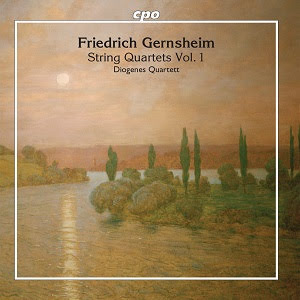
Friedrich Gernsheim string quartet cycle off to a solid start

The musical influences of Friedrich Gernshiem are easy to hear; Robert Schumann, Camille Saint-Saëns, and Johannes Brahms. The latter is perhaps the strongest. Gernsheim was a friend and colleague of the famous composer.

Like Brahms, Gernsheim only wrote a handful of string quartets. The Diogenes Quartett launches a traversal of those five works with this release. Featured in this recording are Gernsheim's first and third quartets.

The first quartet was written when Gernsheim was 33. While it's not exactly a youthful work it does have a certain energy about it. Gernsheim's melodies have a Schubertian grace about them. And they're supported with lush Romantic harmonies that almost seem self-indulgent.

I especially enjoyed the final movement with its rapid accelerando. It was a frantic race to the finish that ended the work with a flourish.

Gernsheim's third quartet was composed over a decade later. It's the work of a more mature composer. Here the melodies are more fully formed, and sweetly romantic. The harmonies give the work a somewhat sentimental character (at least to these 21st Century ears).

The Diogenes Quartett plays with commitment and authority. Gerhsheim was a skilled composer, and the quartet makes the most of the material. Their ensemble blend is quite smooth -- an asset with Gernsheim's thick harmonies.

This is a solid start to what promises to be an interesting series. I look forward to volume two.

Friedrich Gernsheim: String Quartets, Vol. 1
String Quartet No. 1 in C minor, Op. 25
String Quartet No. 3 in F major, Op. 51
Diogenese Quartett
CPO 777 3872

Thursday, August 15, 2019

Bruckner: Complete Piano Music Complete Surprise

May I use the word "revelatory?" It most accurately describes my reaction to this release of Anton Brucker's piano music.

Bruckner's reputation (rightly) rests on his symphonies. But those were far in the future of the young student who wrote these piano pieces.

All of the works recorded were composed as student pieces and composition exercises. One of the more interesting aspects of these works, I think, is their brevity.

The longest piece (the Sonata in G minor) barely tops seven minutes. Most are between one and two minutes long. They're short and to the point.

Still, Bruckner shows his talent even in these oh-so-brief pieces. There are quadrilles, waltzes, and polkas. They're light, breezy little tunes that encourage your feet to move.

There are more serious works; theme and variations, andantes, and fantasias. These hint at the depth Bruckner would bring to his later work.

Francesco Pasqualotto treats these works as fully realized compositions. He thoughtfully phrases the melodies to give them dramatic shape. And yet he plays mostly with a light touch, befitting the modest ambitions of these student pieces.

My only quibble is with the recorded sound of the piano. Room ambiance was kept to a minimum, and yet the piano has a somewhat boomy sound. A minor flaw for an otherwise interesting and enjoyable release.

Anton Bruckner: Complete Piano Music
Francesco Pasqualotto, piano
Brilliant Classics, 956119


Tuesday, August 13, 2019

Friedrich Gernsheim Piano Series Begins at Beginning

Friedrich Gernsheim was a talented pianist and composer with two strikes against him. He was a contemporary of Johannes Brahms, who overshadowed him during his lifetime. And he was a German Jew, so his legacy was (temporarily) erased by the Nazis.

The 21st Century seems to be kinder to Gernsheim, given the number of recent recordings devoted to his music. Toccata Classics launches a survey of Gernsheim's piano music beginning right at the beginning.

Pianist Jens Barnieck performs two of Gernsheim's juvenile sonatas and his Op. 2 set of preludes.

Gernsheim started composing at age seven. The two sonatas Barnieck's carefully reconstructed from manuscripts were written when Gernsheim about 14. The sonatas were written as composition assignments, but there is nothing academic -- or juvenile -- about them.

The sonatas show a composer strongly influenced by Beethoven, but not imitative of him. Gernsheim's harmonies seem to look forward to Schumann, giving these works their own voices.

The Six Preludes come much later, written when Gernsheim was 25. He was teaching at the Conservatory at Saarbrücken, working under Ferdinand Hiller. Gernsheim's preludes superficially resemble Chopin's, though differences soon become apparent.

Like Chopin, Gernsheim wrote to his pianistic strengths. Throughout the six preludes, there are cascading arpeggios, syncopated cross-rhythms, and large, knuckle-busting chords. And there are quiet, simple passages of great beauty.

Jens Barnieck performs with solid technique and real authority. He knows these works and understands Gernsheim in a way few modern pianists do. That understanding makes these works come alive. And makes me look forward to the rest of this series.

Friedrich Gernsheim: Piano Music, Volume One 
Piano Sonata No. 2 in E-flat major; Piano Sonata No. 3 in D minor; Six Preludes, Op. 2 
Jens Barnieck, piano 
Toccata Classics TOCC 0206

Wednesday, May 29, 2019

Tasmin Little Plays a Favorite

In a Violin Channel interview, Tasmin Little named Brahms as her favorite composer. I think that affection is evident in this release. There's an easy familiarity in these performances I find quite appealing.

The Violin Sonata No. 1 was developed from two earlier songs by Brahms. The lyrical nature of the material is at the forefront of Little's performance. She lovingly draws out the melodic lines with warm, singing tones.

That singing quality is used to even greater effect in the Violin Sonata No. 2. Little plays with a delicate sweetness that charms the ear. Which is not to say these are superficial, pretty performances.

Quite the contrary. Tasmine Litte gets below the surface of these works. Her phrasing illuminates the fundamental structure of each movement, sometimes making connections between them.

The third sonata is the most technically challenging, but Tasmin Little (and Piers Lane) take it all in stride. There's a cohesive vision informing the performances that keep the focus on the music, not the fireworks.

Tasmin Little and Piers Lane have worked together for years. Both are in complete agreement with their playing, making these truly pleasurable performances to listen to.

There are hundreds of Brahms violin sonata recordings. What makes this one stand out? Tasmin Little is performing the music of an old friend with an old friend. It's a subtle difference that's hard to describe -- but easy to hear.

Johannes Brahms: The Three Violin Sonatas
Tasmin Little, violin; Piers Lane, piano
Chandos CHAN 10977

Wednesday, March 20, 2019

Albert Lortzing Opera Overtures - Light-hearted Enjoyment

At one time, Albert Lortzing was one of the most-performed opera composers in Germany. His light-hearted Spieloper (light opera) scores were standard fare in the 19th Century.

Lortzing's style bridges the gap between Carl Maria von Weber and Franz von Suppé. These overtures have the clarity of Weber's writing and the bustling energy of von Suppé.

These overtures show real skill in creating memorable tunes that instantly appeal to the ear. Most of Lortzing's output was comedic, with two notable exceptions. "Undine" is a romantische Zauberoper (romantic fairy-tale opera). Its overture sounds somewhat darker and more serious, befitting the lengthier drama.

"Regina" was not performed during the composer's lifetime. The opera revolves around an impending strike by factory workers. It was a subject that hit too close to home in 1848, the Year of Revolution.

There's nothing revolutionary about the music, though. The overture to "Regina" show that Lortzing had the talent to write serious as well as comic opera.

The Malmö Opera Orchestra, directed by Jun Märkl hit the mark with their performances. The comic opera overtures sound as light and frothy as a beer's head. And the more serious operas are played with an appropriate amount of gravitas and drama.

If you enjoy von Weber, Meyerbeer, von Suppé, or Offenbach, give Lortzing a listen. This release is a delight from start to finish.

Albert Lortzing: Opera Overtures
Malmö Opera Orchestra; Jun Märkl, conductor
Naxos 8.573824

Wednesday, November 21, 2018

Emilie Mayer Orchestral and Chamber Works - Music Worth Knowing

If you're not familiar with Emilie Luise Friderica Mayer, this release provides an excellent introduction. Mayer studied composition with  Carl Loewe in the 1840s. Mayer was prolific, and her works were often performed in her lifetime.

After her death, Mayer's music fell into obscurity. A renewed interest in women composers of the past has brought them back to life.

Mayer had a unique compositional voice. It blended common practices of the day with a forward-looking treatment of harmony. The 1847 Symphony No. 4 in B minor seems to draw on Beethoven for inspiration. But it's no pale imitation.

Mayer's orchestration is somewhat transparent in the fashion of Mendelssohn. Her lengthy themes are quite expressive, at times sounding like transcribed songs.

The Piano Concerto in B-flat major was written three years later. It's for a small orchestra and has a certain Mozartian elegance to it. The solo piano part is active, but not showy. Mayer seems more concerned about the melodic expressiveness of the instrument rather than its pyrotechnic possibilities.

The String Quartet in G minor, Op. 14 is the first of seven she composed. This work reminded me of the quartets of Mendelssohn and Schumann. There's clarity in the ensemble writing (like Mendelssohn) and complexity in the harmonies (like Schumann).

To me, the Piano Sonata in D minor sounds like a cross between early Beethoven and early Liszt. And that's not a bad thing. The themes are easy to follow, awash in rich harmonies. There's a flow to the sonata that's similar to those of Liszt's, although the emotional outpouring is somewhat contained.

Emilie Mayer, like many of the early Romantic composers, was still influenced by the Viennese School. And like her more successful colleagues, she soon figured out what elements to embrace and which to discard.

The four works on this release form a good representation of Mayer's output. There's a lot to like here. And the music is of a quality that one has to wonder why it's taken this long to reemerge.

Emilie Mayer: Symphony No. 4, Piano Concerto, String Quartet, Piano Sonata
Ewa Kupiec, Yang Tai, pianos; Klenke Quartett; Neubrandenburger Philharmonie; Stefan Malzwew, conductor
2 CD Set
Capriccio C5339  

Sunday, November 11, 2018

Arnold Mendelssohn: Complete Piano Music

Arnold Mendelssohn is just beginning to be rediscovered. Recordings such as this will help immensely.

Mendelssohn was the great-nephew of Felix and rose to prominence at the turn of the 20th Century. He was an accomplished organist and held several Protestant church positions. He was a colleague of Hugo Wolf and counted Paul Hindemith among his students.

As a composer, Mendelssohn was philosophically close to Brahms. He was quite comfortable with traditional classical forms and felt music should be abstract rather than representational.

The few works he composed for piano have strong similarities to those of Schumann and Brahms. The shorter pieces, such as the Federzeichnungen (Pen and Ink Drawings), and the Albumblatt are finely crafted miniatures.

They reminded me of similar works by Schumann. The music is full of inventiveness and technical challenges, with perhaps a bit more restraint than Schumann's.

The Piano Sonata in E minor is a full-blown Brahmsian sonata. Mendelssohn's late-Romantic harmonies reinforce the resemblance. His melodies are memorable and developed logically in a standard sonata-allegro format.

Mendelssohn wasn't entirely satisfied with his sonatina and second piano sonata. They remained unpublished at the time of his death. Listening to them now, I think they're fine works. Mendelssohn seemed to be pushing the limits of the forms. At the same time, the harmonies sound sparser and perhaps more taciturn.

Mendelssohn may not have liked these pieces, but I do.

Pianist Elzbieta Sternlicht has a solid foundation in the repertoire of the early 20th Century. She's also recorded three albums of Fanny Mendelssohn-Hensel's piano music. Her performances bring out the late-Romantic nature of Mendelssohn's music.

I especially enjoyed her performance of the two sonatas. Sternlicht brought out the underlying structure of the works, giving the motifs the context they needed.

If you like Mendelssohn (Fanny or Felix), Schumann, or Brahms, you'll hear a kindred spirit in these works.

Arnold Mendelssohn: Complete Piano Music
Elzbieta Sternlicht, piano
Hanssler Classics HC17088
2 CD Set

Saturday, September 08, 2018

Ignaz Brüll - Orchestral Works; Brahms' Friend in the Spotlight

Moravian composer Ignaz Brüll (1846-1907) moved to Vienna in 1856. He was an accomplished composer and pianist and was well-known for both talents. Brüll was a close friend of Brahms. Brahms' symphonies were often first heard in two-piano arrangements -- with Brahms and Brüll at the keyboards.

Although quite successful during his lifetime, his music declined in popularity after his death. Because of his Jewish background, the Nazis tried to erase Brüll from music history altogether. Only recently has his music enjoyed renewed interest and performances.

So what's it like? This adventurous collection from Cameo gives a fair representation. The shorter works are perhaps the most successful. The "Macbeth" Overture of 1884 is a thrilling eight-minute work that conveys the turbulent nature of the drama.

The Serenade No. 1 Op.29 was Brüll's first hit (as it were). This 1877 work is chock-full of appealing melodies, orchestrated in light textures. It reminded me somewhat of Mendelssohn's music.

The second serenade in E-flat major is equally delightful. The harmonies are a little thicker than the first. But that hint of Mendelssohn remains. keeping the music light and charming.

The large-scale works show some Brahmsian influence, I think. Although that influence is more along the lines of structure, rather than sound. Brüll's Symphony in E minor is laid out in proper four-movement form. Brüll uses his material effectively, developing ideas in logical, easy-to-follow lines.

For me, the best work was the Violin Concerto. It was written for Johann Lauterbach, who must have been a ferocious talent, judging by the solo part. While there are plenty of fireworks, there's also some solid music-making here, too. The slow movement is so poignantly beautiful, I'm surprised it's not played more often.

Violinist Ilya Hoffmann delivers a wonderful performance. His playing has an expressiveness to it that's pure Romanticism. His performance of the middle movements matches the beauty of the music. And that's saying something.

Both the Malta Philharmonic Orchestra and the Belarusian State Symphony perform well. The audience for the BSS was a little noisy, but not terribly so.

An excellent collection of an overlooked composer. And, judging by the quality of the compositions, an unjustly overlooked one at that.

Ignaz Brüll: Orchestral Works
Overture "Macbeth," Serenades Nos. 1 and 2, Violin Concerto, Symphony in E minor
Ilya Hoffmann, violin; Malta Philharmonic Orchestra; Belarusian State Symphony Orchestra; Marius Stravinsky, Michael Laus, conductors
Cameo Classics CC9103
2 CD Set

Tuesday, June 26, 2018

Wenzel Heinrich Veit String Quartets, Vol. 2 - As Good as Vol. 1

When I reviewed Volume 1, I said I was very much looking forward to this release. I'm not disappointed. The Kertész String Quartet perform to the same high standard they established with the first volume.

On the whole, this period-instrument quartet has the same warm, rich sound I enjoyed before. This time, though, I detected a slight edge to the ensemble, especially when the violins were in the higher register. A difference in mastering, perhaps? It's not a major difference, just one I noticed.

As far as the music goes, if you liked Veit's first two quartets, you'll certainly enjoy his remaining two. The third quartet (1838) and fourth quartet (1840) follow the models of Beethoven and Spohr.

The fourth quartet is the most adventurous. There's more chromatic motion and the harmonies sound deliciously complex.

It's a shame Veit abandoned the genre in 1840. He lived for another 26 years. One can only imagine how much further his quartet writing would have developed had he continued composing in the genre.

At least we have these four quartets. Thanks, Toccata Classics!

Wenzel Heinrich Veit
Complete String Quartets, Vol. 2
Kertész Quartet
Toccata Classics TOCC 0409

Wednesday, April 25, 2018

Robert Fuchs Works for Cello - Ready for Revival


Talent will out. But a little hustle helps. Gustav Mahler, Erich Wolfgang Korngold, and Alexander Zemlinsky all worked to get their music before the public. Their teacher, Robert Fuchs did not. Fuchs preferred the life of quiet academia -- although he wrote music of exceptional quality, he was indifferent to its fate.

The collected cello works of this self-effacing composer show a rare talent and one that can still surprise.

Fuchs was active at the tail end of the Romantic period, living into the mid-1920s. While his music remained mostly tonal, his works -- such as the cello sonatas here -- could be quite adventurous in their harmonies.

Brahms was a keen admirer of Fuchs. The Cello Sonata No. 1, Op. 29 suggests that admiration was mutual. This 1881 work starts out with a broad, Brahmsian theme that swiftly moves off in its own direction. There's no way to mistake this for Brahms. The phrasing and harmonic motion are all Fuch's own.

The second cello sonata, written in the 1910s, is much more sophisticated. Compared to the first sonata, the texture is thicker, and the structure much more compact. Fuchs says what he needs to more efficiently. And while the texture is thick, the harmonies seem leaner. Fuchs was an academic, but he wasn't out of touch.

Rounding out the release are his Phantastasiestucke, Op. 78 for cello and piano. These seven little works can be enjoyed individually, or in a single sitting. The pieces are organized in an arch - pieces 1 and 7 are complementary, as are 2 and 6, and so on.

Martin Ostertag and Oliver Triendl make a good team. At times the cello and piano seem to blend together. Occasionally, Ostertag's playing has an edge to it. But overall, I found these performances well-suited to the music. And I can only hope this recording may encourage other cellists to consider these beautiful works.

Robert Fuchs: Complete Works for Cello and Piano
Martin Ostertag, cello; Oliver Triendl, piano
One Note Music TXA 16078

Wednesday, March 28, 2018

Carl Czerny Symphonies No. 6 & 2 - Better than expected

Pianists the world over are familiar with Carl Czerny -- or at least his keyboard exercises. But Czerny, a student of Beethoven, also composed many other types of works, including symphonies. Unlike Beethoven, though, Czerny could produce, and produce quickly.

Pianist John Field wrote about Czerny's system after visiting with him:
A large cabinet served [Czerny] as a receptacle for models of all kinds of passage work, figurations, etc., which were immediately available as required. 
In the adjoining room assistants worked on what the master had assigned to them... pieces were produced section by section and inserted during the copying process. Thus, the difficult-to-negotiate development sections could also be produced with ease. One just had to fit the passages together correctly, and already the next sonata-form movement was finished.
So what do these paint-by-number symphonies sound like? Actually, they sound pretty good.

Czerny's Grande Symphony No. 2 is a model of late-classical/early romantic construction. This four-movement work is big, with big motifs and grand gestures. And yet it's also somewhat unassuming and matter-of-fact. To my ears, it seemed to resemble Schubert or Mendelssohn more than Beethoven.

The 1854 Symphony No. 6 receives its world premiere recording here. The score remained in manuscript and (presumably) unperformed until recently. The work is leaner and more tightly organized than Symphony No. 2. It also seems to be a more personal work, somehow.

The conductor Grzegorz Nowak has researched Czerny and was responsible for the first concert performance of the Sixth Symphony. These are knowledgeable, unapologetic performances of these finely-crafted works.

Make no mistake: Czerny isn't about to knock Schubert or Beethoven off their pedestals. But these are compelling symphonies that can both excite and delight. And they definitely deserve to be heard.

Carl Czerny: Symphony No. 6 in G minor; Grande Symphony No. 2, Op. 781
SWR Rundfunkorchester Kaiserlautern; Grzegorz Nowak, conductor
SWR Music SWR19419CD

Wednesday, January 10, 2018

Julius Beliczay, Composer and Railroad Man

This disc was originally released by the Hungarian State Railroad in 1995 and for good reason. It marked the 150th anniversary of the service, and the recording was by the railroad's own orchestra.

Yes, the Budapest Concerto Orchestra MÁV is an arm of the state railroad. And the choice of composer for this special release makes sense as well.

In addition to being a composer and teacher, Julius Beliczay was also a railroad engineer. Despite his day job, Beliczay was one of the most prominent composers in Hungary in the late 1800s.

Beliczay's First Symphony premiered in 1888. Beliczay was an admirer of Wagner and Bruckner, but this work leans more towards Brahms. Beliczay's orchestrations are well-crafted if a little conservative. In many ways, it reminded me of Dvorak's first symphony, in that it never colors outside the lines. But within those lines, Beliczay's written an attractive work.

I particularly like the slow movement, which spins out a simple and beautiful melody. It's here that the Hungarian folk influence is strongest.

The companion piece shows has an even stronger nationalist flavor. The 1875 Serenade is more relaxed, with some clear borrowings from Hungarian folk music. At no time, though, does it go as far as Brahms' Hungarian Rhapsodies. Beliczay's style is mostly cosmopolitan. There are some interesting chord progressions toward the end, though, that hint of Wagner.

Beliczay is cited as paving the way for the next generation of Eastern European composers, such as Antonin Dvorak. And that also is fitting. Dvorak was an avid trainspotter.

I found these works well-written and appealing. Even if you're not a train buff, there's plenty of reasons to give Beliczay an audition.

Julius Beliczay 
Symphony No. 1 in D minor, Op. 45 Serenade in D minor, Op. 16
Budapest Concert Orchestra MÁV; Tamál Gál, conductor

Thursday, December 28, 2017

Tatjana Ruhland Elevates Reinecke

Sometimes it isn't the music so much as the performer.

The music is by Carl Reinecke, whose legacy lives on more through his pupils than his music. During his academic career, he taught Edvard Grieg, Leoš Janácek, Isaac Albéniz, Felix Weingartner, and Max Bruch, to name but a few.

Of all his 300+ compositions, he's best remembered for only one -- his flute sonata "Undine."

Reinecke himself studied at various times with Felix Mendelssohn, Robert Schumann, and Franz Liszt. It's easy to hear the influences of all three in his work.

Reinecke was a more than a competent composer. He simply had the misfortune of being very good while being surrounded by greatness.

Tatjana Ruhland brings out the best in Reinecke's music. Her committed performances and flawless technique made me want to seek out more of Reinecke's oeuvre. Ruhland plays with a velvety tone that can turn to cold steel when necessary. The flute sonata "Undine" has been recorded many times, but Ruhland makes it sound like a new work.

The Flute Concerto in D major is another high point of the release. This is Reinecke-as-Mendelssohn, and Ruhland's playful interpretation adds to the fun. Ruhland is also the solo flutist for the ensemble that accompanies her. That relationship seems to give the concerto and the Ballade in D minor some additional chemistry.

Truly great performances of some very good music.

Carl Reinecke: Flute Concertos, Flute Sonatas
Tatjana Ruhland, flute
Radio-Sinfonieorchester Stuttgart des SWR; Alexander Liebreich, conductor
CPO 777 949-2

Wednesday, November 29, 2017

Henry Cotter Nixon: Complete Orchestral Music, Volume Two

I loved the first installment of this three-part series. This, the second, I have a few reservations about. Henry Cotter Nixon spent most of his professional life at the edges of the English musical world. Although his music won awards, his career outside of London hampered performances.

This volume features a variety of works that, to my ears, sound uneven in quality.

Among the best is the Concert-Stück (sic) for piano and orchestra. Perhaps modeled on the Konzertstück of Weber, this lyrical work is an expressive journey of beauty. The liner notes point out that some of the piano passages are harder to play than they sound.

I wouldn't know. The music seems to simply flow from Ian Hobson's fingers. His committed performance is a pleasure to experience.

The Concert Overture "Anima et Fide" is also an engaging work. The second of three concert overtures, "Anima" shows the influence of Schumann, especially in Nixon's harmonies. Still, it's a well-crafted work that holds up very well on its own. I especially enjoyed the rousing finale -- this would make an excellent opener for a concert.

The 1889 Dance of the Sea Nymphs is a pizzicato work for string orchestra. It's a light and lightweight composition. The music advance in a fairly predictable fashion. Since it was something of a novelty piece (and a short one at that), I gave it a pass.

The May Day Scherzo strongly resembled Mendelssohn. And perhaps because of that, I thought it sounded a little old-fashioned. After all, Mendelssohn died 37 years before Nixon wrote this work.

The release opens with the Prelude to the Witch of Esgair (1889), a romantic opera that (apparently) was never produced. It's packed with tunes and there's a major part for solo euphonium. I couldn't help but think of Gilbert and Sullivan. The solo euphonium also conjured up images of Sunday band concerts in the park.

And there you have it. If you like classic Victoriana, then you should enjoy every track. Even if you don't, the Concert-Stück and the Concert Overture No. 2 are both worth a listen. If you're in the latter camp, purchasing digital tracks a la carte may be the solution.

Make no mistake, though, I'm still looking forward to Volume Three.

Henry Cotter Nixon: Complete Orchestral Music, Volume Two
Kodály Philharmonic Orchestra; Paul Mann, conductor
Ian Hobson, piano
World Premiere Recordings
Toccata Classics 0373

Thursday, November 16, 2017

Wenzel Heinrich Veit String Quartets, Vol. 1 - an individual voice

Robert Schumann had this to say of Wenzel Heinrich Veit's music:

The form of this quartet contains nothing unusual, there is no boldness or originality, but it is proper and shows a well-trained hand. Both the harmony and the individual voices are worthy of high praise.

I think the first part of that assessment's a little harsh, but I do agree with the second.

This initial installment of Veit string quartet recordings starts at the beginning, with quartets Nos. 1 and 2.

Wenzel Heinrich Weit (1806-1864) was a Czech composer heavily influenced by Beethoven, Mendelssohn, and Schubert. His music laid the foundation for the next generation of Czech composers, which would include Dvorak and Smetana.

The 1834 String Quartet No. 1 in D minor was completed when Veit was 28 and is a relatively early work. Stylistically, it reminded me of the Op. 18 quartets of Beethoven with a dash of Schubertian harmonies. The third movement features the melody "God Save the Tzar.;" a nod, perhaps, to Russia's alliance with Czechoslovakia during the Napoleonic Wars.

Veit's second string quartet completed a year later, shows some growth. This is a much more dramatic work, with a thicker texture and darker character. To me, it sounds somewhat closer to Schumann's quartets. Perhaps that's what appealed to Schumann in his review.

I wouldn't say these works aren't original. True, Veit doesn't stray far from Haydn's string quartet model. But his melodies are interesting and the overall sound of the quartets is quite appealing.

Also appealing are the performances by the Kertész String Quartet. This period-instrument quartet has a wonderfully rich, warm ensemble sound. I am very much looking forward to volume two.

Wenzel Heinrich Veit: Complete String Quartets, Volume One
String Quartet No. 1 in D minor, Op. 3; String Quartet No. 2 in E major, Op. 5
Kertész String Quartet
Toccata Classics TOCC 0335