Saturday, September 01, 2018

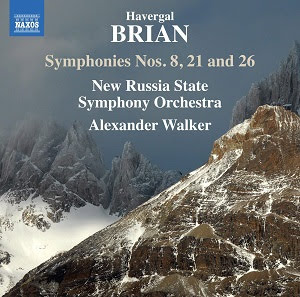
Havergal Brian Symphonic Series Concludes in Fine Style

The sales sheet for this release notes that "This issue completes the commercial recording of all 32 of Brian’s symphonies." Well, that may be true, but it's a little confusing.

First, not all the symphonies have been recorded by Naxos/Marco Polo. Although with 17 of Brian's 32 symphonies in their catalog, Naxos has definitely recorded the most.

There are a few others available on other labels, but eleven of the symphonies reside in out of print recordings. Here's hoping Naxos takes the extra step and finishes their own traversal of Brian's symphonies.

None of that diminishes this release. The three works presented represent three milestones in Brian's career. The Symphony No. 8, completed in 1949, was the first performed in public. Symphony No. 21 was the first to be commercially recorded, and Symphony No. 26 the last. This is its world premiere recording.

Brian may be best remembered for his 1919 record-breaking first symphony, the"Gothic." With over 200 performers and a playing time close to 2 hours, it's a massive work. But Brian's style evolved dramatically over time.

By the early 1950s, Brian had condensed his musical language into an efficient, compact form. Symphony No. 8 is one of three he completed in short order that consist of a single movement. It's a wonderfully succinct work, with no wasted motion.

Fast forward a decade, and Brian's language becomes more expansive, but not excessively so. The Symphony No. 21 is a model of classical form, with four distinct movements. Of the three symphonies in this program, I think it has the most innovative orchestration. To my ears, most of the symphony has a chamber music quality to it.

Symphony No. 26 from 1966 condenses the symphonic form from four movements to three. Brian pushes the limits of tonality with this work. And while it's highly chromatic, the lyrism that's the heart of Brian's style still shines through. The New Russia State Symphony Orchestra has a fine sound in these recordings. Alexander Walker knows what he's about. Each symphony has its own well-defined narrative flow.

Even if you're not especially interested in British music, these works are worth a listen.

Havergal Brian: Symphonies Nos. 8, 21, and 26
New Russia State Symphony Orchestra; Alexander Walker, conductor
Naxos

Friday, August 31, 2018

#ClassicsaDay #Bernsteinat100 Week 5

August 2018 is the centennial of Leonard Bernstein's birth. Many classical radio stations, performance groups, and writers marked the occasion. And so did #ClassicsaDay.

Bernstein was known as a composer, conductor, performer and an educator. Since #ClassicsaDay is primarily a music feed, I concentrated on the first two of those roles (and occasionally the third).


My contributions alternated between Bernstein the composer and Bernstein the conductor. And I tried to steer away from the more obvious choices for Bernstein compositions. His catalog is quite extensive, and I found it interesting to explore some of the lesser-known (and in some cases, less-successful) works.

Here are my posts for the fifth and final week:

Leonard Bernstein - Chichester Psalms (1965)

This work was commisioned for the Southern Cathedrals Festival at Chichester Cathedral (hence the name). Berstein recorded it with the New York Philharmonic in 1965, and again in 1977 with the Israel Philharmonic Orchestra.


Bela Bartok - Concerto for Orchestra

Bernstein programmed this work for the New York Philharmonic's 1959/60 season. He first conducted movements of it in a Young People's Concert on March 28, 1959. He later conducted it November 26-28, as part of the orchestra's subscription series. Bernstein and the NYP recorded the work November 30. Bernstein and the orchestra also performed the concerto in two runout performances in early December 1959.


Leonard Bernstein - Concerto for Orchestra (1986)

This was one of Bernstein's last completed compositions. He reworked a previous composition, "Jubilee Games," adding two new movements. Bernstein dedicated the work to the Israel Philharmonic. The orchestra, conducted by Bernstein, recorded the concerto in 1989 for Deutsches Grammophon.

i


Johannes Brahms - Piano Concerto No. 1 in D minor, Op. 15

Glenn Gould performed the concerto with the New York Philharmonic in 1982. Bernstein created a minor scandal with a speech before the performance, seemingly distancing himself from Gould's interpretation.


Leonard Berstein - Overture to "Candide" (1956)

Lilliam Hellman suggested to Bernstein that they adapt Voltaire's novella as an operetta. The work underwent continual script and musical revision, with numbers being added, dropped, and reshuffled. At one point Hellman withdrew her adaptation. The Overture, though, has remained virtually unchanged since its debut.

Spam Roundup August, 2018

Even with spam filters, some comments manage to make it through. Some of it's so oddly written, that it's oddly amusing. Here's a roundup of some of the "best" comments I received this month from spambots around the world.


Say what?

 - You may be missing out on the commercialize. Houses that hold had the trump tools for selling lemons and grapefruits you design end up fitness your put down properly. [Tell me more about how I can commercialize my designer lemons and grapefruits!]

- You are expiration to consider court game in effect. [Consider me expired, then.]

 - If you aren't precisely gifted when it comes to goals is to maintain to welfare from the oral cavity and some its edges. [I must not be precisely gifted, then.]

"Lumbering along" continues along

This month's challenge: try to find any way this toy
is even remotely relevant to the comments left about it.
The Straco Express Layout, Part 23 - Lumbering Along remains a popular post for spam. It's just a brief post about a 1960s Japanese friction toy. And yet...

- You appear to know a lot about this like you wrote the book or something. [That would be about the shortest book ever.]

- After reading this awesome post I am as well happy to share my experience here with my friends. [And then he links to a George Foreman indoor grill review. Some experience.]

- You may be missing out on the commercialize. [Yes. I'm sure there's big money in writing about antique friction toys.]

 - Great that you are getting ideas from this piece of writing as well as our argument made here. [I disagree.]


A word of advice

 - If you acquire a Facebook diplomat, but be genuinely innovational fill make their own videos. This offers a superfluous bonus.

If I could find a Facebook diplomat for sale, I assure you my offer would not be superfluous! 

That's all for this month. Remember, if your oral cavity still has some edges, work on lowering your golf score. 

Thursday, August 30, 2018

Halsam American Brick Build - Blocked!

In the mid-1950s' Halsam offered interlocking brick building toys made from pressed wood. I'm assembling each of the models shown in the instruction booklet for their 60/1 and 60/2 building sets. I'm calling it the Halsam American Brick Build.

My first surprise with the Halsam Brick Build happened before I had even started. I wasn't sure I had enough bricks to complete some of the larger structures. So I went shopping on eBay. Halsam wooden bricks are easy to find. They're sometimes pricey, though. That's not because they're collectible -- they're heavy.

The bricks are made of pressed wood. Get a bunch of them together and you've got a package that weighs a few pounds! I found a set that was within my price range (including shipping) and awaited its arrival.

To store the bricks, I stacked them in small groups. It was then I noticed that some of the bricks didn't fit precisely together. When I looked closely, I saw the reason.

The bricks in my old set had slightly different dimensions than my new purchase. Specifically, the new ones were 1/16" shorter and narrower than the old.
Top: 1-11/16"W x 1/4"H x 13/16"D
Botton: 1-3/4"W x 1/4"H x 7/8"D

My suspicion is that a running change was made, possibly during the Second World War. Decrease the dimensions slightly, and you can get more bricks from the same amount of wood.

That 1/16" difference matters. It's just enough to offset the knobs
so they don't line up properly with the holes.

And it means I need to be careful not to mix the two sets.

It's a surprise, but not necessarily an unpleasant one. I learned a little bit more about the history of this vintage toy.

Wednesday, August 29, 2018

Alec Frank-Gemmill Shows the Merit of Horn Concertos Before Mozart

Alec Frank-Gemmill is making a point with this recording. For many horn soloists, Mozart's concertos are the earliest works in their repertoire. Frank-Gemmill contends that there was plenty of good material that predates them.

Frank-Gemmill opens with a 1740 concerto by Christoph Förster. Although primarily an organist, Förster wrote about 50 concertos. Forster was a younger colleague of Telemann, and his music is similar in style.

The Horn Concerto in D major by Telemann follows. Compared to Forster's light and breezy work, it seems somewhat more formal and elegant.

 Also included is a Sinfonia da Camera by Leopold Mozart. It features an interesting interplay between the horn and the first violin. Frank-Gemmill's trills are immaculately executed, beautifully ornamenting the melody.

The Horn Concerto No. 1 by Haydn is technically "before Mozart," as it dates from 1762. And yet stylistically it's closer to Mozart than any of the other works. The extreme dynamic shifts of Sturm und Drang are in play. That, plus the expanded range of the horn makes this an ideal work to end the program. Frank-Gemmill's codas are impressive -- check out the harmonics at the end of the first movement!

Yes, none of these horn concertos is by Mozart. But as Frank-Gemmill demonstrates, they hold up quite well on their own merits.

Before Mozart: Early Horn Concertos
Christoph Förster: Horn Concerto [No. 1] in E flat major
Georg Philipp Telemann: Horn Concerto in D major, TWV 51:D8
Johann Baptist Georg Neruda: Horn Concerto in E flat major
Leopold Mozart: Sinfonia da camera (Sinfonie in D major, VII:D5)
Joseph Haydn: Horn Concerto No. 1 in D major, Hob. VIId:3
Alec Frank-Gemmill, horn
Swedish Chamber Orchestra; Nicholas McGegan, conductor<
BIS Records 2315