Thursday, November 30, 2023

House of Belonging - Award-worthy Music

As I write this, "House of Belonging" is up for Best Choral Performance for the 66th Grammy Awards. No wonder. 

Craig Hella Johnson has sculpted his vocal ensemble into a wonderfully expressive instrument. Conspirare can sing with delicate transparency and stentorian authority. Their vocal blend is truly seamless. And there's often a luminous quality to the sound as well.

The album features twelve new choral works (out of seventeen tracks). Collectively they explore the possibilities of expression with the human voice. There are four (or more)-part harmony, wordless humming, vocal sound effects, and more. 

And while the music is new, it's never too academic. Every work can be enjoyed at some level on first hearing. And many yield new insights each time they're revisited. And there's a variety of styles, too. 

Contemporary composers are well-represented. Kevin Puts, Shara Nova and Alex Berko are just a few. And earlier composers such as Margaret Bonds and Ross Lee Finney also fit nicely in the mix. For me, the knockout track was "Reaching" by Craig Hella Johnson. Phenomenal.  

The Miro Quartet joins Conspirare for some works and plays alone on a couple of tracks. They're the perfect match for Conspirare. They, too, have a warm luminous ensemble sound.

This is an album of extraordinary beauty. Beautiful, insightful music sung by master musicians. Oh yes. This one deserves a Grammy nomination (if not the Grammy itself).   

House of Belonging
Conspirare
Miro Quartet
Craig Hella Johnson, director
Delos DE 3601

Wednesday, November 29, 2023

Jauchzet Gott: Cantatas by Bach, Graupner, and Zelenka

For me, three things blend very well. They are the soprano voice, the clarion trumpet, and Baroque sacred cantatas. Apparently, I'm not alone, as Accent has released an album of just that. 

When done well, the soprano voice and Baroque trumpet complement each other. Both have about the same range. Plus the valveless trumpet sounds best in the high register.

This is a great album. Soprano Magdalene Harer sings with a smooth, honeyed tone. Her performances give the music a sense of the ethereal. 

Hannes Rux' instrument also favors a smoother tone. It doesn't have the edge of a modern trumpet, which is just fine. 

The Harmonie Universelle plays with both precision and energy. And that keeps the excitement level high throughout these works. And what a selection!

Christoph Graupner, Jan Dismass Zelenka, and Johann Sebastian Bach. All three were contemporaries. And all three were among the best composers of the late Baroque. 

Also included are two instrumental selections. Graupner's Concerto for Two Violins in E-flat major GWV 319 features the ensemble's co-directors. Monica Waisman and Florian Deuter have real chemistry, making this an engaging listen.

Bach's Sinfonia in D major, BWV 1045 is the sole surviving section of a much larger celebratory work. It provides a nice contrast between the cantatas. At the same time, it maintains the overall tone of the album. 

As I say -- these types of cantatas work for me. And these performances really make them work. Highly recommended.

Jauchzet Gott: Bach, Graupner, Zelenka
Magdalene Harer, soprano; Hannes Rux, trumpet
Harmonie Universelle; Florien Deuter and Monica Waisman, directors
Accent

Tuesday, November 28, 2023

Marc Ponthus' Masterful Beethoven and Stockhausen

I'm of two minds about this release. The playing -- and the recording -- is first-rate. Marc Ponthus' skill and musicality deliver performances full of vitality. 

Beethoven's Hammerklavier Sonata is a Mount Everest for pianists. It's incredibly challenging to play. And it's almost as challenging to make sense of. There is an underlying structure and logic to the work. But it's not readily discernable as it is in, say, a Mozart sonata. 

The same can be said for Stockhausen's Klavierstücke X. It's derived from a number square Stockhausen developed. This square controls various aspects of the composition process. In this work, he also used a system of seven: chord clusters of 1-7 notes; action/rest durations, note values (1-7), etc.

Both are quite complex pieces. Ponthus has invested a great deal of time in the study and analysis of these works. And it was time well spent. I was particularly struck by his performance of Klavierstücke X. Ponthus instilled a sense of purpose in his playing. 

Superficially the work can sound wild and chaotic. But Ponthus is in control. He knows the function of every note, and how it fits into the structure of the work. With repeated listening, I began to hear hints of that structure, too. 

The Hammerklavier is the more traditional Ultimate Piano Sonata. Many virtuosi have performed and recorded it. Ponthus' interpretation goes beneath the surface. He makes connections between motives that are sometimes surprising. But logical in retrospect. 

I enjoyed this recording very much. But the liner notes, not so much. I appreciate Ponthus for trying to explain how he arrived at his interpretations. And I know it's difficult to talk about music in a non-musical setting (like text). 

But the entire essay is filled with sentences like this: 

"These two works are so concentrated and charged with deeply organic forces that they stand on their own. relatively detached from their creators, as they demand a level of engagement from both performer and listener that results in experiences of appropriation and unanticipated significance, in taxing perceptions and effects, and in the breakthrough into metaphysics."

Holy moly. That's a lot baggage to saddle any piece of music with. Sorry, these performances were thrilling. But I never broke through into the metaphysical world. I'm sympathetic to what Ponthus was trying to articulate. But my advice is this. Play the album, don't read the booklet. These works can speak for themselves.       

Ludwig van Beethoven: Hammerklavier Sonata Op. 106
Karlhenz Stockhausen: Klavierstücke X
Marc Ponthus, piano
Bridge Records 9584

Friday, November 24, 2023

#ClassicsaDay #ClassicalFam Week 4

November means Thanksgiving when families gather together. The Classics a Day team decided to make families the theme. For the month of November, the challenge is to post video performances of musical family members. Post on any social media channel you like. 

What constitutes a musical family? Felix and Fanny Mendelssohn (brother and sister) both composed. As did many in the Bach family tree. 

For my part, I decided to follow the family connections from post to post. Here are my posts for the fourth week of #ClassicalFam.

11/20/23 Wilhelm Hieronymus Pachelbel (1686-1794): Fantasia super Meine Seele, lass es gehen

Wilhelm's father was Johann Pachelbel, whose fame has grown significantly since his death. Wilehlm's younger brother Charles Theodore was also a composer. Only seven works by Wilhelm survive.


11/21/23 Charles Theodore Pachelbel (1690-1750): Magnificat

Charles was brother to composer Wilhelm Hieronymus, and both were sons to composer Johann Pachelbel. Charles emigrated to America in 1733. He settled in Charleston, SC where he organized concerts and started a singing school.


11/22/23 Leopold Mozart 1719-1787): Sinfonia Burlesca

Leopold was father to Wolfgang Amadeus, and grandfather to Franz Xaver Mozart, both composers (of differing abilities) In his day Leopold was renowned for his treatise on violin technique -- a work still in use today.


11/23/23 Wolfgang Amadeus Mozart (1756-1791): Violin Sonata No. 26 in B-flat major, K. 378

Wolfgang was the son of composer Leopold Mozart. Two of his sons survived infancy. The younger, Franz Xaver was also a composer.


11/24/23 Franz Xaver Mozart (1791-1844): Piano Concerto No. 1 in C major, Op. 14

Franz was the youngest son of Wolfgang Amadeus Mozart. He studied composition with Antonio Salieri and enjoyed a modestly successful career as a pianist and composer. His older brother Karl was also a pianist but did not compose.


Wednesday, November 22, 2023

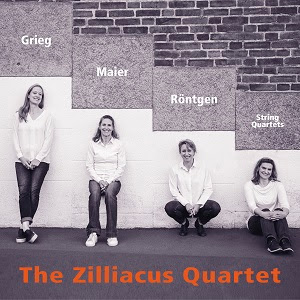
Zillacus Quartet Present Collaborative Masterworks


This is a fascinating release of interconnected composers. Edvard Grieg was a close family friend of the Rontgens -- Julius and his wife Amanda Maier. Rontgen would eventually publish a biography of his friend in 1930. And he did more than that.

Grieg had started a string quartet in 1891 and set it aside. He had completed only the first two movements. Rontgen. Rontgen composed two final movements based on Grieg's notes and sketches. 

The completed quartet was performed in the Rontgen home with an all-star lineup. Harold Bauer played the first violin. Pablo Casals played the second violin and his wife played the cello. Julius Rontgen played the viola. His second wife, Abrahamina, was the sole audience member. 

The Grieg/Rontgen quartet was then put aside. It receives its world recording premiere here.

Rontgen's first wife, Amanda Maier was an accomplished violinist and a skilled composer. Her early death at age 41 left her own string quartet unfinished. It would remain so until 2018.  That's when Swedish conductor and composer Bengt Tommy Andersson completed it.

Rounding out the release is Rontgen's own work, his String Quartet No. 12.

Violinist Cecilia Zilliacus has recorded several of Maier's works. And she's specialized in Scandinavian string music. She has a deep understanding of this music.

And that understanding comes through in this recording. The Zilliacus Quartet has a warm, clear ensemble sound. They bring out the emotional content of this music, but never to excess. 

Instead, we're treated to some exciting, well-executed quartet playing. And that playing breathes life into these works. The origins of the music don't matter. The Grieg/Rontgen and Maier/Andersson quartets sound like seamless and organic masterpieces.

The Zillacus Quartet
Grieg, Maier, Rontgen: String Quartets
DB Productions