Showing posts with label choral music. Show all posts

Wednesday, March 05, 2025

Baltic Echoes: Choir and Strings in Perfect Harmony


There's something about the Baltic region. Something that has inspired native composers in the 20th Century. Something that has inspired deeply spiritual works of contemplation.

Dalia Dedinskaite (violin) and Gleb Pysniak (cello) are a powerhouse duo. And they know this music well. They're from Lithuania and intuitively understand the Baltic aesthetic. 

On this release, they're joined by the Vilnius Municipal Choir JAUNA MUZIKA, directed by Vaclovas Augustinas. (Vilnius is the capital of Lithuania if you didn't know.)

One of the standout works on this album of masterpieces is "Ave Maria." it's set by Lithuanian composer Jurgis Juozapaitis. Soloists, choir, conductor, and composer are all in sync. It's a luminous work highlighted by string obbligottos. 

Estonian composer Arvo Part is internationally known. Some consider him one of the founders of this ethereal, clouds-of-sound choral writing. But actually, British composer John Tavener came first. His interest in Eastern Orthodox hymnody laid the foundation. Both composers are represented in this release. 

The album also includes music by Latvian Peteris Vasks and Norwegian Ola Gjeilo. They're among the most-performed and most-recorded choral composers today. 

The choir has a warm, transparent sound. There's enough room ambiance to give the voices a soft focus, but not enough to muddy the sound. It's the perfect sound for these compositions. And Dedinskaite and Pysniak are at the top of their games. 

The album concludes with a heart-rending version of "The High Pass: Melody." Myroslav Skyork's tune has become the symbol of Ukrainian resistance. This version for choir and strings is gorgeous, yet full of melancholy. Not to be missed.

Baltic Prayer
Dalia Dedinskaite, violin; Gleb Pysniak, cello
Vinius Municipal Choir JAUNA MUZIKA, Vaclovas Augustinas, conductor
Stradivarius STR 37322

Thursday, February 27, 2025

Colonna's Two-Choir Psalms: A Feast for the Ears


This release features words for two choirs. And it's a live recording from the St. Petronio Basilica. So we get to hear the music composed in the space Colonna intended it for. And that makes a difference. 

Colonna expertly mixes textures, ranging from solo voice to full unison. And the space is treated as an instrument. The reverberations are an integral part of the sound. Echoes harmonize with each other and with the performers.

The full, robust choruses are thrilling. They foreshadow those of Handel's oratorios. Michele Vannelli masterfully leads his musicians. These are terrific performances. The singers fill the space. And the instrumentalists provide the proper amount of support.

Colonna's counterpoint isn't as complex as Bach's. But it does point towards Handel's. It's clean and clear, even with the rich acoustic of the basilica. 

Glorious music, beautifully performed. It's one of the best Baroque choral albums I've heard in a while.

Giovanni Paolo Colonna: Caro Ardore Scro Amore
Concerted Psalms for Two Choirs and Orchestra
Coro e Orchestra Della Capella Musicale di S. Petronio
Ensemble Vocale "Color Temporis;" Michele Vannelli, maestro di cappella
Dynamic CDS8044

Wednesday, January 08, 2025

Palestrina Revealed: World Premiere Recordings


This is an aptly titled release. "Palestrina Revealed" features five world premiere recordings. So it reveals more of Giovanni Luigi da Palestrina's artistry to the world. 

Second, director Graham Ross had the Choir of Clare College, Cambridge record standing in a circle. These perfectly blended yet perfectly balanced performances reveal the artistry of Palestrina's polyphony.

Ross also chose to intersperse contemporary British choral works into the program. These reveal Palestrina's influence on English composers. They also show his influence on British choral traditions.

Missa Memor esto verbi tui a 5 was first published in 1972. Missa Emendemus in melius a 4 was published in the Missarum liber septimus (1594). Both are models of Palestrina's art. The text is always clearly declaimed and easily understandable. And that holds true no matter how complex the polyphony becomes.

I was most impressed by the performances recorded here. There's a luminous quality to the choir's blend that suits this music. Yet each line was easy to follow throughout. There was also a nice balance of room ambiance. It made the voices sound full, without muddying the sound.

Well executed on every level.

 
Palestrina Revealed
Palestrina, Byrd, White, Mundy
Choir of Clare College, Cambridge; Graham Ross, director
Harmonia Mundi HMM 905375

Wednesday, November 13, 2024

Handel's Jephtha a Modern Triumph


Most people I know who say they "love Handel," really mean "I love Messiah."  And that translates to "I love the choruses of "Messiah." And if you drill down further, "I love the 'Hallejuliah Chorus' from Messiah." 

And that's frustrating to me. Because Handel wrote more than one oratorio, and all have thrilling choruses. And many of them have -- like "Messiah" -- incredibly beautiful arias. 

I always encourage those "Handel lovers" to explore further. Who wouldn't want to hear more of the music they love? I'll be adding this recording of "Jephtha" to my recommendation list. This live performance has an immediacy and energy about it I really like.

This was Handel's final oratorio, completed in 1751. As presented in the Bible, it's a problematic story. The Israelites ask Jephtha to lead them against the pagan Ammonites. If he succeeds, he'll become ruler of Israel. Jephtha asks for God's help. He promises to sacrifice whatever first greets him upon his return home. And not just sacrifice but make a burnt offering to God. 

The Ammonites are defeated with divine help. And Jephtha's daughter is the first to greet her victorious father. He's devastated, but his daughter persuades him to keep his word. 

He grants her two months to mourn in the hills with her friends. Then she returns, and the Bible vaguely says "he did to her as he had vowed." Yikes!

Over the centuries the story's been tweaked somewhat. Handel's libretto, written by Thomas Morell eliminates the fatal ending.  The daughter, now named Iphis, gets a back story. Hamor (sung by a countertenor) is in love with Iphis. When Iphis greets Jephtha, she invokes the vow. 

Iphis submits to be sacrificed. But at the last minute -- as in the story of Abraham and Issac -- an angel appears. Iphis is spared to dedicate her life to God, but she can never marry. Hamor is heartbroken, though glad Iphis lives.

This new version allows for a mostly happy ending sung by the principal characters. And it ensures a rousing choral finale, as only Handel can write them. 

Dame Jane Glover conducts from the harpsichord, as Handel would have. Under her direction, we get a performance that's both authentic and engaging. The choruses are clean and precise, letting us marvel at Handel's counterpoint. The soloists are first-rate. I particularly enjoyed countertenor Aryeh Nussbaum Cohen. His delivery was both warm and expressive. 

Lauren Snouffer, soprano, also delivers an exceptional performance. She sings with a rich, crystalline tone that conveys the full emotional weight of Iphis.

That's not to slight the other soloists. This is a solid performance through and through. The recording has a nice ambiance. The performances are close-mic'ed for clarity. But there's still enough space for smooth ensemble blends -- and to let the music breathe.

High recommended -- and not just to those who claim to "love Handel."    

George Frideric Handel: Jephtha
David Portillo, tenor; Lauren Snouffer, soprano; Clara Osowski, mezzo-soprano; Aryeh Nussbaum Cohen, countertenor; Neil Davies, bass-baritone; Katelyn Lee, soprano
Music of the Baroque Chorus and Orchestra; Dame Jane Glover, conductor and harpsichord
Reference Recordings FR-755
2 CD Set

Thursday, November 07, 2024

Andre Campra: Messe de Requiem and the Masters of Notre-Dame

The cathedral at Notre Dame has always been an influential center of church music. This was especially true in the late 1600s.  The Pope elevated the Bishopric of Paris in 1622. 

The now metropolitan archbishopric ruled over the other French bishoprics. This made it the center of Catholic worship in France. In the 1640s, the Notre Dame archbishop developed new liturgies and new music with it. 

This release features the music masters of Notre Dame who set those new standards. The centerpiece of the album is the Messa de Requiem by Andre Campra. Campra wrote both religious and secular music, specifically opera. 

His Messa de Requiem was written in the 1720s. The choruses are lushly harmonized, and almost operatic. Yet there's a clarity to this music I found refreshing. 

Contemporary sacred music written at Versailles is grandiose. After all, it was written to the glory of the king as well as to the glory of God. Campra's Requiem is less florid and more focused. This is music written to inspire contemplation in the vast space of Notre Dame.

The style of the other composers follows the same aesthetic. Francois Cosset and Jean Veillot were Notre Dame choir masters. They were a generation before Campra. Their harmonies seem a little simpler, while the ensemble sounds thicker. But this is still music for worship (and not of the king). 

The Ensemble Correspondaces has a beautifully crafted ensemble sound. It's warm, yet detailed. The instrumental ensemble is mostly strings, with a few wind instruments and organ. They provide understated accompaniment to the choir.

My impression of French 17th-century sacred music came from the Versailles composers.  Hearing the music created in the spiritual -- rather than the political -- center of France was enlightening, indeed.  

Andre Campra: Messe de Requiem
and the Masters of Notre-Dame, Paris
Ensemble Correspondances: Sébastien Daucé
Harmonia Mundi

Wednesday, November 06, 2024

Žibuoklė Martinaitytė Choral Works Uniquely Beautiful

This release was my introduction to the music of Žibuoklė Martinaitytė. This Lithuanian composer has built a following among contemporary music audiences. Martinaitytė's music is all about atmosphere. And in these vocal works, it's expressing emotion beyond words.

The opening track "Aletheia" was composed in 2022 for the Latvian Radio Choir. The shock of the Russian invasion of Ukraine inspired the work. There's no text. We hear sighs, whispers, moans, and other disquieting -- but very human -- sounds. 

Imagine Gyorgy Ligeti's "Atmosphères" crossed with the thick textures of Eric Whitacre. It's a powerful work, and one of disturbing beauty. 

Chant des Voyelles (2018), or, Incantation of Vowels is just that. Here Martinaitytė subtly shifts long, held tones. Overtones move, changing the character of the sounds in unobvious ways. The music seems suspended in time. And yet it's continually evolving and moving forward. 

Martinaitytė writes that her work "Ululations" portrays "mourning women whose men... are at war fighting and dying." The ululations of the female voices provide the motivic structure of the work. And from those sounds the choir builds in quiet intensity. 

The Blue of Distance is the earliest work on the album, dating from 2010. But it's mature Martinaitytė. The wordless chorus creates a sensuous cloud of sound. One that continually swirls about itself, creating new combinations of tones and overtones. 

The Latvian Radio Choir commissioned one of the works on this release. And their performance of "Aletheia" is nothing less than authoritative. And their singing on the other pieces even more so. This is a capella music -- no instruments to lean on. And the music continually has tones a half-step apart. Their dissonances create sonic beats that are as much of the score as the written notes. 

It takes singers of extraordinary skill to sing this music. If I was told they all had perfect pitch, I wouldn't be surprised. For Martinaitytė's music to deliver its full effect, every note must be sung perfectly. And that's what we get on this release. Four perfectly-sung performances. And they create four soundscapes of exceptional beauty. 

Žibuoklė Martinaitytė: ALETHEIA
Choral Works
Latvian Radio Choir; Sigvards Klava, conductor
Ondine ODE 1447-2

Wednesday, October 30, 2024

Maria Rosa Coccia - Sacred Music from 18th Century Rome

Maria Rosa Coccia was a composer and harpsichordist acive in the late 1700s. Her career is almost a case study in the "separate but equal" concept. Coccia showed talent at an early age. 

By 13 she had written six harpsichord sonatas. She'd also composed an oratorio "Danielli." The work was performed in the Oratory S. Fipllo Neri -- an event women were barred from attending. 

Her talent couldn't be denied, though. Anyone practicing music in Rome at the time had to enter the Accademia di Santa Cecilia. They also had to pass an exam to be a Maestro di Capella. 

Coccia did both at age sixteen. But because of her gender, she was never allowed to direct a choir. 

Fortunately, that didn't prevent her from composing music for choirs. This release features five sacred works by Coccia and two of her instrumental works. The program includes works by her contemporaries: Stane Pesci, Giovanni Battista Casali, and Sebastiano Bolis. 

Coccia writes in the clean, elegant style of the middle Classical period. If you enjoy the choral works of Haydn and Mozart, you'll find a lot to like in Coccia's music. Her clarity of line ensures the text is always readily understandable. Yet her interplay between voices shows real imagination. And she has solid contrapuntal skills. 

The Cardiff University Chamber Choir has a warm, transparent sound. Their acapella singing is assured, and their phrasing is fluid. It gives the music a supple energy I quite enjoyed. Based on the quality of Coccia's work here, I would love to hear her oratorio and large-scale cantatas. But this is a great start. 

Maria Rosa Coccia: Sacred Music from Eighteenth-Century Rome
Cardiff University Chamber Choir; Peter Leech, director
Robert Court, chamber organ
Toccata Classics TOCC 0359


Wednesday, September 04, 2024

Cappella Romana: A Ukrainian Wedding

One of the root issues between Russia and Ukraine is cultural identity. From the time of Catherine the Great, Russia has sought to absorb Ukraine. 

But Ukraine has its own language, its own artistic and folk traditions, and even its own brand of Eastern Orthodoxy. All of which Czarist Russia and later Soviet Russia actively suppressed. 

And yet it all survived. This release features traditional wedding music from across Ukraine. The country has distinctive wedding traditions. And these traditions vary from region to region. 

Nadia Tarnawsky has assembled wedding music from across the country. It jointly celebrates the diversity of the regions and the unity of Ukraine's culture. 

Ukrainian weddings are a week-long affair. The couple's engagement is officially announced. Items are made for the wedding (gifts, decorations, clothing). Food is prepared. And each activity has its own traditional song, usually sung by the women doing the work. 

Folklorists Inna Kovtun and Hanna Tishchenko join the Cappella Romana for this recording. The women have a rich full-bodied sound. Most of this music is celebratory, and the choir communicates that effectively. They sing with gusto and sometimes even abandon. 

The music for the ceremony is liturgical, and therefore of a different character. Here the sound is quieter and more reflective. If you're familiar with Eastern Orthodox chant (read: Russian), you might be surprised. Ukrainian sacred music has a very different character and a very different sound.

This album isn't a faithful representation of an average Ukrainian wedding. Rather, it's a composite look at the varied musical traditions of the country. And bringing them all together provides an invaluable musical gift to the world.

A Ukrainian Wedding
Cappella Romana; Nadia Tarnawsky, director
Cappella Records, CR431


Wednesday, August 14, 2024

Rautavaara and Aho -- Joy & Asymmetry, Indeed!

This release features the music of a teacher and his pupil. Finnish composer Einojuhani Rautavaara was the teacher. Kalevi Aho was the student. And he learned well. Rautavaara's mature style featured clouds of sound that continually intersected in unusual ways. 

Aho's style has a similar underlying aesthetic but takes a different form. If Rautavaara's music is in soft focus, then Aho's is crystal clear. This contrast is clearest when listening to two works from 2010. 

Unsere Liebe by Rautavaara is primarily homophonic. Its shimmering harmonies obscure the tonal center. Yet they also effectively color the melody, providing emotional context to the work. 

Kolme laulua Mawlana Rumin runoihin was also composed in 2010. Like Rautavaara's work, the rhythmic pulse is weak. Here though, the single-line melody builds as it develops. A harmonic line splits off. A chorus intersperses answering motifs throughout the work. 

Different in style, but somehow similar in intent. These are choral works meant to evoke an atmosphere. Both composers have very subtle contrasts. Both demand the full attention of the listenr. 

And I suspect both composers demand much from the singers. The Helsinki Chamber Choir does an outstanding job. Their intonation is precise, and their vocal blend is seamless.

This is an SACD release. If you purchase a digital download, make it the highest resolution available. On a good playback system, you will hear a difference. Aho and Rautavaar use silence as much as sound. And often very quiet sounds at that. The more details you here, the more the artistry of these two composers comes through.  

Joy & Asymmetry
Einojuhani Rautavaara, Kalevi Aho
Choral music
Helsinki Chamber Choir; Nils Schweckendiek, conductor
BIS 2892 SACD

Tuesday, June 25, 2024

Stephen Dodgson: Canticle of the Sun

Stephen Dodgson was an important British composer. He enjoyed considerable success after the Second World War. Dodgon wrote a variety of classical music, from orchestral works to solo songs. This release focuses on his choral music. 

When I read that Gerald Finzi highly regarded Dodgon's music, I knew I had to give this album a listen. 

The works on this release sound deceptively conventional. Dodgon's music is tonal. Furthermore, he writes idiomatically for the human voice. Melodies are constrained to relatively easy-to-sing intervals. There's some chromaticism, but it's more a spice than a main ingredient. 

Conventional four-part 20th Century choral writing -- but not quite. Careful listening reveals the rather complex harmonies that Dodgson uses. These harmonies provide subtle shading to the text. And while the melodies may be easy to sing, fitting together these vocal lines isn't.

Dodgson was a British composer. But these works fall outside the British choral tradition -- another deceptive characteristic. We don't get the high boy's choir sound. Or even the equivalent vocal lines for sopranos. Rather all four voices contribute equally to the sound.

A few of the selections have religious texts. But in some, like "Tis Almost One," the religious references are oblique rather than direct. The rest of the album is strictly secular. And that's another subtle difference. This is music for the concert hall than the cathedral. 

Sonoro is a superb vocal ensemble. They hit every note exactly on the pitch singing a capella. And they create a wonderful ensemble sound in the process. And while they have a smooth blend, Sonoro's articulation is clear and accurate. It's easy to follow the texts without having to follow along with the booklet.

Well-crafted music sung by a top-notch ensemble. If you're a fan of choral music, this belongs in your collection. 

Stephen Dodgson: Canticle of the Sun
Sonoro; Neil Ferris, conductor
Katherine Bicknell, flute; Michael Higgins, organ
SOMM Recordings SOMMCD -0686

Tuesday, May 21, 2024

Peñalosa Ensemble Celebrate the Spanish Renaissance

The Peñalosa Ensemble celebrates its 25th anniversary with an album of Spanish Renaissance composers. One happens to be the ensemble's namesake, Francisco de Peñalosa. The other is Tomás Luis de Victoria. 

The Peñalosa Ensemble neatly divides the program into two halves. The first part presents the music of Peñalosa, the second Victoria's. Peñalosa was active in the late 1490s. He was the first Spanish composer to adopt the Netherlandish style of Josquin de Prez. 

Peñalosa composed before the age of printing. Through handwritten copies, his music spread throughout Spain (though not far beyond). Peñalosa had an affinity for counterpoint and was one of its most advanced proponents. 

Many of his works play with the melodies. Motifs are presented backward, upside down, and even "remixed" with other melodies. This release includes a sterling example of this:  the Missa O Magnum Mysterium. 

Tomás Luis de Victoria came two generations after Peñalosa. He represents the twilight of Rennaisance polyphony. Victoria was a contemporary of Palestrina, and nearly as influential. Unlike Peñalosa, Victoria benefitted from music printing. Victoria was well-known across Western Europe.

Victoria was inspired by Peñalosa (as were most Spanish composers). But his works look ahead to the thinner textures of the Baroque Era. In this release, the differences between Peñalosa and Victoria show in stark contrast.

Marian Music of Spain
Francisco de Peñalosa; Tomás Luis de Victoria
Peñalosa Ensemble
CPO 555 398-2

Thursday, January 18, 2024

Cappella Romana Deliver Arvo Pärt's Spirituality

The liner notes lay out the goal of the Capella Romana. "The mission... is to experience and understand the transcendent beauty of the sacred music of the Christian East and West, especially of Byzantium, cultivating heritage and sharing it worldwide." That's one heck of a long sentence. And one heck of a mission.

But that's what they do, and with this album, they succeed. "Transcended beauty" aptly describes Arvo Pärt's music. 

Pärt is a deeply spiritual composer and practices the Eastern Orthodox faith. His music is new, yet old. It's inspired by Medieval and Renaissance music, and by Eastern Orthodox chant. 

This release collects Odes of Repentance from various Pärt compositions. There are selections from "triodion." Kanon Pokajanen (Kanon of Repentance), "Zwei slawische Psalmen," and a few stand-alone works. 

The subject matter gives the program a stylistic cohesiveness. These are songs of penance. They are slow, quiet works. There's a hint of sorrow, but mostly introspection. And introspection is one of Pärt's strengths.

The Capella Romana delivers beautifully sung performances with hushed reverence. Director Alexander Lingas brings out Pärt's spirituality through the choir's singing.

When it's time to get off the merry-go-round of daily life, play this album. It can transport you to a world of quiet contemplation. And that's not a bad thing at all.  

Arvo Pärt: Odes of Repentance
Cappella Romana; Alexander Lingas, director
Cappella Records


Tuesday, January 16, 2024

Solid Choral Compositions from Richard Lambert

This release features twelve works given their world recording premiers. Choirs throughout the English-speaking world are familiar with Richard Lambert's work. This album exposes his music to a wider audience. 

The collection presents a good overview of the composer's style. Lambert has an engaging, accessible style. His music can be challenging, but it's always playable and listenable. And those are the two elements of success in the world of choral music. 

The album has what it calls a "Christmas Sequence." The Christmas carols in this section are all original Lambert compositions. Although they weren't originally conceived of as a whole. The earliest carol dates from 1995, the latest from 2021. The sequence is simply a collection of Lambert's carols. 

Still, it's a nice sequence. And the carols are real standouts. In many cases, Lambert takes a familiar text and creates a new melody for it. "Away in a Manger" and "The Holly and the Ivy" take on new meanings in these resettings. 

The most ambitious work on the album is "a plague o' your houses." I've not heard anything quite like it. Lambert composed the work during the Covid lockdown. A narrator, personifying different plagues, sets the stage. The choir articulates the feelings and impressions of those living in a plague zone. Lambeth augments the sound with a string quartet and percussion. 

The work has a disorienting quality to it. The mood it sets is somber, yet restless. Oppressive, and yet unsettled. I think "...a plague" is worth the price of admission (or download). Consider the other selections bonus material. 

Karolina Csáthy directs the Accordare Choir. They sing with feeling and precision -- two qualities for the success of "...a plague."    

Richard Lambert: Choral Music, Sacred and Secular
Accordare Choir, Karolina Csáthy, director
Toccata Classics TOCC 0713

Thursday, January 04, 2024

Emilio de'Cavelieri: Lamentations


Emilio de' Cavalieri was a major figure in the early Baroque. He's credited with writing the first oratorio in 1600. That same year he produced "Euridice" by Jacopo Peri, one of the first operas. 

Cavalieri was also one of the first to write in stile rappresentatvio, or monody. This was a radical departure from the thick textures of Renaissance choral music. 

Cavalieri was also an organist, a dancer/choreographer, and even a diplomat. He wasn't, though, very diplomatic about his rivals. Stile rappresentavio caught on quickly. 

And Cavalieri was quick to ensure his place in history. "Everyone knows I am the inventor of [this style]," he wrote, "and I said so myself in print."

At the very least, Cavalieri realized the expressive possibilities of the new style. This collection presents his settings of Jeremiah's "Lamentations." This text was traditionally sung during Lent, a time of penance. 

Cavalieri's music is wonderfully expressive, wringing the emotion from every phrase. His use of chromaticism can sound advanced even today. And his use of dissonance is superb.

The Profeti della Quinta has been researching this music for a decade. It's only now that they feel ready to share it with the world. Their performances are subtle and effective. It was worth the wait.

Today, Cavalaier's name isn't as well-known as Claudio Monteverdi's and Jacobo Caccini's. This is in part because so little of Cavalieri's music survives. But what remains shows a composer inspired by the possibilities of this new style.

Emilio de'Cavelieri: Lamentations
Profeti della Quinta
Pan Classics PC 10451

Thursday, December 28, 2023

Arte Minima Intimately Performs Francisco de Santa Maria

The ensemble Arte Minima specializes in Renaissance music from Portugal. This album presents the Missa "O beata Maria" by Francisco de Santa Maria. Santa Maria (1532/38-1597) was chapel master of the Monastery of Santa Cruz de Coimbra. He was a favorite of King Philip I of Portugal. 

The ensemble doesn't just present the mass. It begins with the Pedro Guerrero motet Santa Maria based the work on. It also includes three instrumental interludes, inserted into the mass. These provide contrast to the choral music and make for a more engaging program. 

Santa Maria was a master of counterpoint. His melodic lines are always clear. The counterpoint supports and enhances the melodies without obscuring them. Santa Maria had a unique compositional voice. I've not heard 16th-century choral music quite like this. It's a welcome addition to the recorded repertoire. 

The Alte Minima is an unusual ensemble. It has four vocalists and five instrumentalists. The instrumentalists play a variety of alto, tenor, and bass recorders. It's a warm, soft sound with a wonderful blend of the voices.

It's a sound I've not heard before. And it's music I've not heard before. So, win-win for me. And perhaps for you, too. If you're interested in Renaissance choral music, give this album a listen.

Francisco de Santa Maria
Missa "O beata Maria"
Arte Minima; Pedro Sousa Silva
Pan Clasics PC 10452

Thursday, December 21, 2023

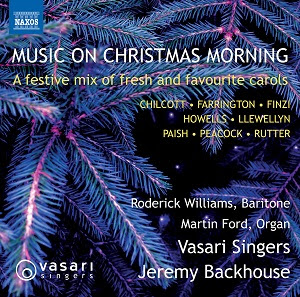
"Music on Christmas Morning" delivers on promise

The subtitle for this release is "A Festive mix of fresh and favourite carols." And it is that. As the spelling suggests, this is a British choral program. And one that delivers on the promise. 

The favorite carols include Herbert Howells' "A Spotless Rose." There are also arrangements of "Nova, Nova," Ding Dong! Merrily on High,"  and the Sussex Carol.  Contemporary British choral composers are also well-represented. 

John Rutter has three selections on the release. Bob Chilcott has two.  Roxanna Panufnik's gorgeous version of "Sleep, Jesus, Sleep" is also included. 

Just a mix of these shorter carols would make this a superior collection. But there's more. The release begins with Gerald Finzi's "In Terra Pax." Finzi's inspiration for the work was his memory of a Christmas Eve. He was standing on a hill as the snow fell, hearing the church bells ring out in the distance. 

The work captures the introspective nature of the scene beautifully. And the musicians perform with sensitivity and expression. Baritone Roderick Williams sings with a clear, warm tone. The smooth vocal blend of the Vasari Singers provides the perfect counterpoint.

The Vasari Singers have a traditional British choral sound. The ensemble has 19 sopranos, and only nine each of altos, tenors, and basses.  The sopranos provide a high-register sound that sounds both bright and warm.

This is not your typical Lessons and Carols British choral album. The subtitle is correct. There may be some favorite carols here, but to me, it all sounds pretty fresh. This one will be in heavy rotation at the Graves' house this season. 

Music on Christmas Morning
Chilcott, Farrington, Finzi, Howells, Llewellyn, Paish, Peacock, Rutter
Roderick Williams, baritone; Martin Ford, organ
Vasari Singers; Jeremy Backhouse director
Naxos

Thursday, December 14, 2023

Robin White: Light of the World

CD singles are common in many musical genres. But they're relatively rare in classical. So this one piqued my interest when it crossed my desk recently. I wasn't familiar with Robin Whit's work, so I was hearing this track with fresh ears. 

If you take "Light of the World" for what it is, you'll enjoy it. This is, quite simply, an unpretentious Christmas carol. It's not trying to push any stylistic envelopes. It doesn't offer any grand insights. It just celebrates the idea of Christmas simply and nostalgically.

In the liner notes White writes: "What can you say about Christmas that’s new? Nothing: that’s the whole point!" So he gives us a light classical choral work, set as a Viennese waltz. If I wasn't aware of its origins, I'd have guessed this to be a Victorian composition. 

No matter. It works. I can see this being a welcome addition to many a choral Christmas program. A bit of fun for the season. 

Robin White: Light of the World
Alban Voices; Royal Ballet Sinfonia; Robin White, conductor
Divine Art dds 29008
CD Single

Thursday, November 30, 2023

House of Belonging - Award-worthy Music

As I write this, "House of Belonging" is up for Best Choral Performance for the 66th Grammy Awards. No wonder. 

Craig Hella Johnson has sculpted his vocal ensemble into a wonderfully expressive instrument. Conspirare can sing with delicate transparency and stentorian authority. Their vocal blend is truly seamless. And there's often a luminous quality to the sound as well.

The album features twelve new choral works (out of seventeen tracks). Collectively they explore the possibilities of expression with the human voice. There are four (or more)-part harmony, wordless humming, vocal sound effects, and more. 

And while the music is new, it's never too academic. Every work can be enjoyed at some level on first hearing. And many yield new insights each time they're revisited. And there's a variety of styles, too. 

Contemporary composers are well-represented. Kevin Puts, Shara Nova and Alex Berko are just a few. And earlier composers such as Margaret Bonds and Ross Lee Finney also fit nicely in the mix. For me, the knockout track was "Reaching" by Craig Hella Johnson. Phenomenal.  

The Miro Quartet joins Conspirare for some works and plays alone on a couple of tracks. They're the perfect match for Conspirare. They, too, have a warm luminous ensemble sound.

This is an album of extraordinary beauty. Beautiful, insightful music sung by master musicians. Oh yes. This one deserves a Grammy nomination (if not the Grammy itself).   

House of Belonging
Conspirare
Miro Quartet
Craig Hella Johnson, director
Delos DE 3601

Wednesday, November 29, 2023

Jauchzet Gott: Cantatas by Bach, Graupner, and Zelenka

For me, three things blend very well. They are the soprano voice, the clarion trumpet, and Baroque sacred cantatas. Apparently, I'm not alone, as Accent has released an album of just that. 

When done well, the soprano voice and Baroque trumpet complement each other. Both have about the same range. Plus the valveless trumpet sounds best in the high register.

This is a great album. Soprano Magdalene Harer sings with a smooth, honeyed tone. Her performances give the music a sense of the ethereal. 

Hannes Rux' instrument also favors a smoother tone. It doesn't have the edge of a modern trumpet, which is just fine. 

The Harmonie Universelle plays with both precision and energy. And that keeps the excitement level high throughout these works. And what a selection!

Christoph Graupner, Jan Dismass Zelenka, and Johann Sebastian Bach. All three were contemporaries. And all three were among the best composers of the late Baroque. 

Also included are two instrumental selections. Graupner's Concerto for Two Violins in E-flat major GWV 319 features the ensemble's co-directors. Monica Waisman and Florian Deuter have real chemistry, making this an engaging listen.

Bach's Sinfonia in D major, BWV 1045 is the sole surviving section of a much larger celebratory work. It provides a nice contrast between the cantatas. At the same time, it maintains the overall tone of the album. 

As I say -- these types of cantatas work for me. And these performances really make them work. Highly recommended.

Jauchzet Gott: Bach, Graupner, Zelenka
Magdalene Harer, soprano; Hannes Rux, trumpet
Harmonie Universelle; Florien Deuter and Monica Waisman, directors
Accent

Wednesday, November 01, 2023

Giovanni Battista Casali Fills in Historical Gap

The liner notes for this release make a point. And on reflection, I had to agree with it. They assert that for many, the history of Roman Catholic church music has an arc.

The history starts with Medieval chant. It develops through the Renaissance with polyphony. And it stops with Palextrina in the early 1600s. 

At this point, we turn our attention to the Protestant church music of the North. And the presumption is that nothing further happened to church music in Italy.

But musical development didn't stop. Italian composers continued to innovate and experiment right into the Age of Enlightenment. Composers like Giovanni Battista Casali.

Casali was a contemporary of Mozart and Haydn and was choirmaster at the church of St. John Lateran in Rome.

One of the characteristics of Casali is his clarity. The text is sung in four-part harmony. There's a lot of homophonic singing, with clear enunciation of the text.

The internal lines are easy to make out. In fact, most of these selections have a clean, transparent ensemble blend. Counterpoint is present, but the interwoven melodies sound clear and easy to follow.

Casali was also an opera composer. To me, his sacred choral music bears a strong resemblance to opera choruses of the day. And that's not a bad thing.

The Constanzi Consort is directed by Peter Leach. The soloists are very good and sing in a straightforward manner. A welcome addition to our collective knowledge of the Classical Era.

Giovanni Battista Casali: Sacred Music from 18th Century Rome
Costanzi Consort; Peter Leech, conductor
Toccata Classics TOCC 0429