Sometimes it seems like the real challenge of the Consonant Classical Challenge is to find composers that fit the criteria -- and have enough music available to share. The former isn't that difficult. The whole point of the CCC is to demonstrate that there are living composers still writing original, interesting music that should appeal to both traditional and newer classical audiences.
The latter, though, has sometimes forced me to forgo adding a composer to the list. For this series I like to have at least three selections I can embed into the post. After all, hearing the music is the whole point. The samples let you determine how accurately I've characterized the composer's work. I also like offer recording recommendations, so if you like the composer, you can explore their catalog more thoroughly on your own. And those record/download sales can help the composer.
Jean-Claude Amiot (b. 1939) is right on the borderline. This French composer has enjoyed a long career, working with Dimitris Mitropoulos, Leonard Bernstein and Leopold Stokowski. He's composed two operas, plus works for orchestra, chamber groups, and even brass orchestra. But there are no recordings of his music available in the U.S., and to follow are all the examples I could find of his work.
Amiot writes in a clean, modern style similar (to my ears) to that of Leonard Bernstein's. His rhythms sometimes borrow from popular music, but at no time does Amiot write in a pop style. His melodies use dissonance and resolution to great effect.
Tour Eiffel (Paris des Lumières) is a good example of Amiot's style. The music has a cosmopolitan sound to it (like Bernstein's Broadway scores), with strikingly original orchestration. There's also a pronounced jazz influence in this score, though more Bernstein than Gershwin in character.
Tékédé is a ballet score that offers Amiot the opportunity to present many different moods and instrumental combinations. It's a work I'd certainly enjoy hearing live -- his use of open fourths and fifths is clever and effective.
Based on the few works I've heard by Jean-Claude Amiot, I'd like to hear more. There are no recordings or downloads available that I could find, unfortunately. His brass orchestra works are called out in his biographies -- an unusual ensemble, indeed. Will more Amiot be available in time? I certainly hope so.
Friday, June 07, 2013


Thursday, June 06, 2013
Carlos Chavez Piano Concerto: Muscular Music from Mexico


Jorge Federico Osorio. piano
Sinfonica National de Mexico
Carlos Miguel Prietro, conductor
Cedille
Cedille presents pianist Jorge Federico Osorio in an exciting program of Mexican composers. The centerpiece is Carlos Chavez's sole piano concerto. This massive work presents serious challenges to both soloist and ensemble, but the rewards are well worth the effort.
The work fairly crackles with energy, with mercurial changes in moods and timbres. Chavez had a unique compositional voice, one that doesn't neatly fit into the pigeonholes of 20th Century schools. So there are some spiky, atonal sections as well as some modernist tonality -- and running throughout (very subtly) the rhythm and pulse of Mexican traditional music.
This is a live performance by Osorio and the Sinfonica National de Mexico, and an extraordinarily clean one at that. The ensemble plays with pin-point accuracy, a must given the sudden changes and the percussive nature of the score. Osorio is in full command of the material. His phrasing gives logic and shape to the sea of notes before him, Osorio's restrained but heartfelt expressiveness in the slow movement is particularly moving.
The albums is filled out with solo piano works. Meditacion, an early work by Chavez, shows surprising maturity for such a young composer. Jose Pablo Moncayo's Muros Verdes is a spacious-sounding work that blends Mexican musical traditions with a Hindemith-like neo-classicism. Samuel Zyman's 16-minute Variations on an Original Theme is most contemporary work on the album -- both by creation date and sound.
Wednesday, June 05, 2013
Calvin and Lio
Yesterday I talked about how Mike Peters paid homage to Calvin and Hobbes
in his comic strip Mother Goose and Grimm (see: Calvin and Grimm). Around the same time, Mark Tatulli, creator of Lio,
launched a week-long sequence that also paid tribute to Bill Watterson's characters, but in an entirely different way. (click on images to enlarge).


Tatulli captures the maniac energy of Calvin, and even touches on one of the strip's tropes -- the Transmogrifier Gun. Notice how Tatulli, even in this flight of fancy, remains true to Watterson's vision. When only Calvin is sharing the panel with his tiger companion Hobbes, the latter is always a talking, moving creature of independent thought. Whenever anyone else enters the scene, Hobbes is depicted as a much smaller, inanimate stuffed toy.
Note how Tatulli plays out the sequence. Brought back to life, Calvin immediately sets out to rescue his friend from the zoo. But Hobbes isn't behind a cage -- he's in the gift shop with the other toys. And because the story is always told for Lio's point of view, Hobbes never comes to life.
One can admire Watterson's skillful command of the pen, or his witty dialogues. But Tatulli shows he understands the core of what makes "Calvin and Hobbes" work -- the friction between mundane reality and exciting imaginary worlds. "Lio" is a very different type of comic strip with a very different sense of humor. To do such a tribute in a way that's true to both comics is masterful, indeed.


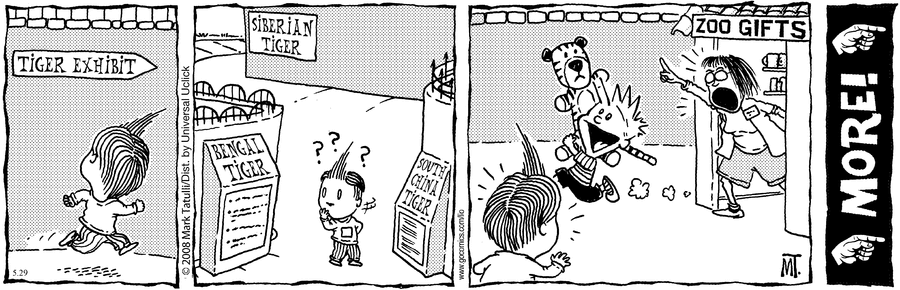


Tatulli captures the maniac energy of Calvin, and even touches on one of the strip's tropes -- the Transmogrifier Gun. Notice how Tatulli, even in this flight of fancy, remains true to Watterson's vision. When only Calvin is sharing the panel with his tiger companion Hobbes, the latter is always a talking, moving creature of independent thought. Whenever anyone else enters the scene, Hobbes is depicted as a much smaller, inanimate stuffed toy.
Note how Tatulli plays out the sequence. Brought back to life, Calvin immediately sets out to rescue his friend from the zoo. But Hobbes isn't behind a cage -- he's in the gift shop with the other toys. And because the story is always told for Lio's point of view, Hobbes never comes to life.
One can admire Watterson's skillful command of the pen, or his witty dialogues. But Tatulli shows he understands the core of what makes "Calvin and Hobbes" work -- the friction between mundane reality and exciting imaginary worlds. "Lio" is a very different type of comic strip with a very different sense of humor. To do such a tribute in a way that's true to both comics is masterful, indeed.
Tuesday, June 04, 2013
Calvin and Grimm
The comic strip Calvin and Hobbes may be gone, but its certainly not forgotten. Bill Watterson's brilliant work was beloved by comics aficionados and admired by comics creators. Calvin and Hobbes book collections remain in print and still sell briskly, though the strip finished its run eighteen years ago on December 31, 1995.
In a May 20, 2013 sequence, Mike Peters, in his strip Mother Goose and Grimm captures an essential part of the strip -- while making a very contemporary cultural reference. (click on image to enlarge)

Although Watterson seldom depicted the pair in such a static fashion, in my opinion the final panel is a lovingly rendered tribute to two great characters and their talented creator. Well done.
And yeah, I'd pay to see that movie.
In a May 20, 2013 sequence, Mike Peters, in his strip Mother Goose and Grimm captures an essential part of the strip -- while making a very contemporary cultural reference. (click on image to enlarge)

Although Watterson seldom depicted the pair in such a static fashion, in my opinion the final panel is a lovingly rendered tribute to two great characters and their talented creator. Well done.
And yeah, I'd pay to see that movie.
Monday, June 03, 2013
Holmboe: Concertos -- Unabashed neo-classical richness


Norrkoping Symphony Orchestra
Dima Sloboderiouk, conductor
Erik Heide, violin
Lars Anders Tomter, viola
DaCapo SACD
Danish composer Vagn Holmboe (1909-1996) remained true to himself, throughout his career, writing the music he wanted to with little regard for academic fashion. While generally neo-classical in style, his music has a distinctive individuality to it -- as this collection proves. These three concerti span a half-century, yet they collectively form a homogeneous program.
Holmboe's Concerto for Viola is a two movement work written in 1992. Holmboe relishes the rich warmth of the viola's lower register. Sprightly and spiky passages alternate with bursts of long, lyrical melodies. Lars Tomter's expressive playing adds tremendously to the emotional content of this work.
Holmboe takes a different tack with his 1929 Concerto for Orchestra than Bartok does. Unlike Bartok, Holmboe doesn't isolate the various sections of the orchestra. This is big, heroic music that revels in the blended sound of the ensemble. While there are some quiet sections that use just parts of the orchestra, they're not showcased. Rather, the focus remains on the virtuosity of the collective whole.
The Violin Concerto No. 2 (1979) is more aggressively modern than the other works on this release. It's not quite atonal. Rather, it's highly chromatic music with the violin leaping and skipping about in the opening and closing sections. But the heart of the work is in the slow sections, where Holmboe lets the violin sing -- and Erik Heide does indeed make his instrument do so.
While this release is available as a download, I highly recommend the SACD version -- especially if you have an SACD player. These performances were lovingly recorded by DaCapo, and the fullness of the sound adds an extra dimension to these appealing works.
Subscribe to:
Posts (Atom)