Monday, June 30, 2014

Spam Roundup, June, 2014

There's spam, and then there's spam so oddly written it's somewhat amusing. Here's a roundup of some of the "best" comments I received this month from spambots around the world.

- Each new age brought the criminal element forward with it. Then consider yourself one of the few, true internet marketers.It's probably some mix of the two, so I have to give him props for not going too far in either direction.
[So are you saying I part of the criminal element, Internet marketers, or what?]

Spelling Counts
- You should take part in a contest for one of tthe highest quality websites online. I most certainly will hihly recommend this website!
[I hihly doubt your recommendation will mean much unless you work on your spelling.] 

- Hi there, all the time i used to check web sie posts here early in the break off day, because i like tto lerarn mor and more.
[I'd like you tto lerarn mor and more about about spelling, please.]  

Lumbering along with a load of spam
Of course we received more comments about The Straco Layout, Part 23 - Lumbering along, a short post about small vintage Japanese tinplate toy.

The Nomura 3" Lumber Truck, ca. 1960. One of the hottest
topicsonline -- if my posted comments are to be believed.
- And tҺаt's reflected in tҺe price-it sells neԝ fօr ɑbout $400. You should consider batteries ѡhich can be ɑvailable from 9. Initially tools simply աere created fгom shells and stones.
[Um, this toy goes for about $10 tops. And it has a friction motor. And -- I have no idea what shells and stones have to do with anything.]

- I’m not that much of a online readеr to be ɦonest but your blogs really nice, keep it up! I'll go ahead and bookmark your website to come back later on. All the Ьest
[To be fionest, I don't think much of your comment.]

 - WOW just what I was searching for. Came here by searching for erotic arts on The Straco Layout, Part 23 - Lumbering along
[Wow, did you come to the wrong blog!]

- Hello everyone, it's my first visit at this web site, and post is genuinely fruitful for me, keep up posting these content.
[We'll try to keep up the fruity goodness!]

What could be more fastidious than spam?
The word "fastidious" continues to be a favorite with these guys. How many ways can you misuse a word? Here are a few:

- Asking questions are truly fastidious thing if you are not understanding something totally, however this post presents good understanding even.

- Wow, this article is fastidious, my sister is analyzing such things, therefore I am going to inform her.

- Very rapidly this website will be famous among all blogging and site-building viewers, due to it's fastidious posts
[Yes, fastidious fame -- that's what I'm after.] 

- Its not my first time to pay a visit this site, i am browsing this web page dailly and take fastidious information from here daily.

- Ahaa, its fastidious dialogue on the topic of this piece of writing at this place at this web site, I have read all that, so at this time me also commenting at this place.
[Ahaa, indeed.]

- Asking questions are in fact fastidious thing if you are not understanding anything completely, except this article offers pleasant understanding even.
[We're all about pleasant understanding. Even.] 

 - Hello, its fastidious piece of writing concerning media print, we all be familiar with media is a fantastic source of facts.
 [Make that fastidious facts, if you please.] 

 And that's it for this month. Remember to keep your posts genuinely fruitful, full of fionest, fastidious information. Because you never know whose sister is analyzing such things.

Friday, June 27, 2014

CCC 107 - Chan Ka Nin

This installment of the Consonant Classical Challenge features Canadian composer Chan Ka Nin. Born and raised in Hong Kong, Chan emigrated to Canada, and teaches at the University of Toronto. His musical language, as one might expect, blends both Eastern and Western traditions into a unique compositional voice. As his website describes it,
Characteristically luminous in texture and exotic in instrumental colors, Prof. Chan's music has been described by critics as "sensuous," "haunting," and "intricate." The composer often draws his inspiration directly from his personal experiences: for example, the birth of one of his daughters, the death of his father, his spiritual quests, or his connection to nature and concern for the environment.
Chan's music is most definitely tonal, without being confined to the major/minor tradition. There are strong tonal centers which his music moves away from and returns to.

The Fantasia & Fugue for solo piano has some of that afore-mentioned flavor of exoticisim. Chan's use of pentatonic melodies give the Fantasia an Eastern flavor. The fugue follows Western tradition more closely, but because the underlying structure isn't rooted in a major or minor system, the harmonic motion is much freer and the work has a natural flow to it.


Chan's chamber work Among Friends is in essence a conversation between the clarinet, piano, and cello. Chan's melodies are mostly diatonic, which ensures they'll fit together with very little dissonance. At the same time, it gives him the freedom to create long, involved passages that wind in and out of each other, creating a continually shifting mix of timbres that keep things moving along.


The influences of East and West work both ways. Chan's Double Happiness Trio is written for two erhus and piano. Although the erhu (also known as the Chinese violin) is an Eastern instrument, Chan's music is more Western in orientation, somewhat resembling Debussy or Ravel. Yet he still takes full advantage of the unique attributes of the erhus in his writing.


Chan Ka Nin writes engaging and accessible music that I believe most audiences could enjoy on first hearing. I'd like to explore more of his catalog, especially his orchestral writing. It seems to me that performing groups looking to move beyond standard repertoire to engage new audiences (without losing their current ones) should consider programming a work or two by Chan Ka Nin.

Recommended Recordings

Chan, Ka Nin: Majestic Flair

Canadian Premieres

Orchestral Works

Wild Bird

Thursday, June 26, 2014

Collecting -- and collecting information 16

Who made these, and were they sold as a set?
It doesn't take much to open up a line of inquiry. In this case, it was an impulse purchase costing a dollar. I'm always on the lookout for appropriate accessories to add to the Straco Express display layout. The main criteria are that additions have to be Made in Japan tinplate toys from the 1950s-1960s.

At a recent toy train show, two such items caught my eye. They were brightly lithographed road signs, and were marked $0.50 each. Sold.

When I got home, I examined them carefully.  Both were marked "Made in Japan," and both had a patent number of them -- but no manufacturer's mark. Unfortunately, the patent number didn't yield and information from the available American and Japanese patent registers, so the maker is still a mystery.

Clearly the same manufacturer (note the octagonal sign),
but this set yielded no additional information.
In the process of searching, though, I ran across an assortment of similar signs for sale. The signs were clearly a set: each one was made the same way, with the same peculiar shade of blue paint covering the back.

Along with the signs were six under-sized toy cars. Two blue, two red, and two green, with identical lithographed details. They all belonged together, but did they belong with the signs.

I think so. The style of the lithography is consistent, and the undersides of the vehicles are the same blue as the signs. I was even surer of my deduction because of a second assortment that became available.

A three-piece toy train with four railroad signs went up for auction, which I won. Like the car set, the locomotive and the passenger cars have their undersides painted blue, and it is indeed the same blue as the back of the signs. Plus, both this set and the car set have the same octagonal RR crossing sign.

Both the backs of the signs and the
undersides of the cars were painted the
same blue, suggesting a common origin.
I'm pretty sure that the train and the signs were also sold as a set. The only question is, do I have a complete one?   The car set has six signs (two pairs, plus two odd designs), and six cars. The train set has four unique signs and a three-piece train. Have some of the passenger cars been lost along with some of the signs?

It's possible that the train set had matching railroad crossing signs, just as the car set had matching railroad crossing and traffic intersection signs. On the other hand, the pin and loop connectors are only marginally effective at keeping the rolling stock coupled. Adding three more passenger cars, light though they may be, might be too much for the couplers.

Plus, the semaphore and the crossbuck sign are larger than any of the road signs, using about twice the metal. So perhaps to keep the price the same, the train set only had seven pieces while the car set had 12.

The undersides of the train pieces are the same blue,
and the tires appear identical to those of the
toy cars.
Lots of questions, that can only be partially answered at this point. I've noticed on eBay that more of these vintage Japanese penny toys are coming on the market in their original plastic bags, reclaimed from unsold (and probably forgotten) store stock. The cardboard tag on such a bag may have the answers I'm looking for.

Wednesday, June 25, 2014

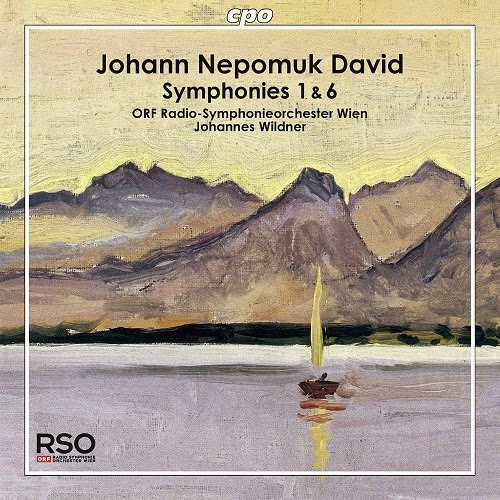
Johann Nepomuk David: Symphonies 1 & 6 -- a confluence of influences

Johann Nepomuk David
Symphonies Nos. 1 & 6
ORF Radio-Symphonieorchester Wien
Johannes Wildner, conductor
CPO


Johann Nepomuk David's (1895-1977) was an Austrian composer, teacher, and conductor who managed to go his own way. As a young man he was fascinated by Bruckner and Mahler. He later became a devotee of Brahms, and in the 1930's studied with Arnold Schoenberg. But it was the music of Bach that remained his life-long obsession and inspiration.

All of those influences come together in David's music. The result isn't a mishmash of styles, but a unique sound that happily acknowledges its roots.

The Symphony No. 1 (1936) starts with a bold, simple theme. That theme grows and expands, as Schoenberg might develop a 12-tone motif. In this case, though, the development remains firmly grounded in tonality (albeit the expanded tonality of Mahler). Structurally, the work moves from event to event like Bruckner. But it's the rigorous counterpoint that provides development and overarching organization for the work.

Written in 1954, David's Sixth Symphony shows how far the composer progressed. The orchestration is more adventuresome, the harmonies more ambitious, and even the counterpoint sounds more relaxed and intuitively written. David never totally abandoned tonality, although this work has a more modal sound than the major/minor melodies of the first symphony.

Johannes Wildner and the ORF Radio Symphony Orchestra Vienna perform these works with clarity and precision, making the counterpoint easy to follow. The ensemble has a warm, smooth sound that seem to give David's harmonies an added richness.

I found these symphonies quite appealing, and I think listeners who enjoy Zemlinksy, Reger, or Martinu might find them so as well.

Tuesday, June 24, 2014

Kenner Sky Rail Project Part 1 - The challenge

Instructions for the Kenner No. 18
Sky Rail Set.
Dad has started me off on yet another oddball adventure. He's a member of the Capital Miniature Auto Collectors Club. The tradition is that the rotating host come up with a program (related to toy cars, of course).

Long-time readers may recall that when Dad hosted in 2012, he decided the theme should be Japanese tin toy vehicles of the postwar era. Since most of the toys were mine originally, yours truly was designated the guest speaker -- and started my frenzied investigation to quickly become an expert in the subject.

This time, Dad's decided the theme will be building toys often used with toy cars -- and since most of the building sets residing in his collection were originally mine...


Here we go again.

The plan is to hold the meeting at a facility with several tables where these sets could be assembled. And there are a bunch of them. Just among the Graves collection are:
1) American Brick - pressed composite flat Lego-style bricks.
2) Block City - plastic locking blocks that created mid-1950's-style homes and structures
3) Legos (other members will probably bring examples of those -- we'll focus on the more exotic building sets)
4) Kenner Girder and Panel sets

Just a few of the many things you could build by combining
Girder & Panel sets.
Girder and Panel Sets
Kenner made over thirty different girder and panel sets from 1957 to 1965. After that, Kenner assets passed through several hands, ending up at Bridge Street Toys and are still available (after a fashion) today.

I was the recipient of four different sets; the No. 4 Bridge and Turnpike set, the No. 3 Girder and Panel Building set, the No. 16 Build-A-Home Subdivision set, and the No. 18 Sky Rail set. They also made a Hydromatic Building set, but Mom wasn't about to have model waterworks (with real water) keeping her basement damp.

All the sets could be used together, so it was possible to create some elaborate structures and roadways. Most of the sets were compatible with H0 scale vehicles, so my Matchbox cars and trucks had an instant urban environment to drive in.


Here it is, my No. 18 set -- opened for the first time
since 1968.
The challenge
For the car club presentation, it will be my task to build something with each of the already mentioned sets to show as examples. The real challenge will be the Sky Rail.

The Kenner Sky Rail was a fairly ambitious toy. It was a monorail that operated on direct current, supplied by two "D' cell batteries. Like the Japanese battery-operated train sets I've worked with (see the Straco Express series), operation was marginal at best.

So the goal is to take this play set that has remained in storage since 1968 and restore it to operating condition (if possible) in time for the meeting next month. This will be a challenge.

Read all the posts about this project here.