Showing posts with label Baroque music. Show all posts

Thursday, August 01, 2024

Colin de Blamont Occasional Works Consistently Entertain

These days we commemorate life events with photos and videos shot on smartphones. In the 1700s, there were other options -- if you were wealthy enough. And Louis XV, King of France certainly was. 

His father, Louis XIV, habitually commissioned large-scale musical works for important events. Weddings, birthdays, dignitary visits, etc. were all worthy of a large-scale production.  This release features two such works from the reign of his son. 

"Le Retour de Dieux sur la Terre" celebrated the wedding of Louis XV and Marie Leszczynska in 1725. The second divertissement is "Le Caprice d'Erato." It premiered in 1729 to mark the birth of the couple's first son.

Both were intended as light entertainment -- light lavish entertainment, that is. Both feature large casts, mostly portraying allegorical figures.

The singers deliver their melodies with delicacy and simplicity. The choruses are sufficiently robust. This is music meant to entertain, and so it does!

De Blamont is an effective orchestrator. Recorders signal a pastoral setting. Hunting horns accompany Diana, the goddess of the hunt. Percussion sounds during the ballets, and low double reeds provide effective tonal color.

The Helsinki Baroque Orchestra has a bright, crisp sound. Their energetic readings of the dance numbers help keep things moving along.

This release doesn't include the librettos, but they're not necessary. There's no drama here. These are set pieces with various gods and goddesses praising the king and queen (or king, queen, and heir). 

Although these were occasional works, they did have staying power. "Le Retour de Dieux sur la Terre" premiered in 1725. It was performed either in its entirety or in excerpts for the Queen through 1748.

And they still entertain today. Especially with these performances.

Colin de Blamont: Le Retour de Dieux sur la Terre
Le Caprice d'Erato
Les Chantres du Centre de musique baroque de Versailles
Helsinki Baroque Orchestra; Alexis Kossenko, conductor
Chateau de Versailles CV139 CD
2 CD set

Tuesday, May 14, 2024

Welcome Purcell Reissues from William Christie


Well this is a nice present. In honor of William Christie's 90th birthday, Harmonia Mundi is reissuing some of his landmark recordings. This particular present is a two-disc set of Purcell. It's really a present for us all. 

Christie and Les Arts Florissants recorded Purcell's "Dido and Aeneas" in 1989. "The Fairy Queen" recording followed three years later. Both the recorded sound and performances have aged well. 

Early music, like other aspects of classical music, is an evolving art form. Over time ideas about interpretations evolve. New recordings of this material can sound very different than Christie's. 

But William Christie's genius was in finding the balance between scholarship and musicality. These are well-researched, historically-informed performances. Les Arts Florissants effectively recreated the sound heard in Purcell's time. 

But they're also musical performances. Purcell's 1689 "Dido and Aeneas" is considered the first English opera. His work "The Fairy Queen" from 1692 is based on Shakespeare's "A Midsummer Night's Dream." These are both dramatic works for the theater.

Christie knew he was telling stories with these works. Both performances effectively convey the dramas. If you know nothing about 17th-century music, you can still enjoy these stories. 

Everything is sung with such clean, clear articulation. You might not even need the libretto. These recordings are as rewarding to listen to today as they were when first released.

As I say, this set is a present to us all.  

Henry Purcell: Dido and Aeneas; The Fairy Queen
Les Arts Florissants; William Christie, conductor
Harmonia Mundi HAX 8904106.08
2 CD Set


Thursday, April 11, 2024

New Bach Series from Les Arts Florissants

This is the first release in a new series. According to director Paul Agnew, he wants to "understand the life and the personality of Johann Sebastian Bach through his music." Each volume presents music composed during a particular phase of Bach's life. 

The goal isn't to do a complete survey of Bach's music. Rather, it's to present representative compositions that illustrate Bach's personality.

Volume one starts with Bach's first post as an organist and composer. In 1706, at age 22 he became the organist at the Blasius Church in Mühlhausen. Selections include "Christ lag in Todes Banden" BWV 4, which he submitted with his application.

Agnew and Les Arts Florissants perform this work with modest forces. The musicians available to Bach in Mühlhausen were limited. It was a factor in the music he wrote. These performances provide context by matching the forces Bach had available. 

Benjamin Alard provides some interludes. He plays Bach's organ settings of the hums used in the cantatas. These also inform. At this time, Bach was better known for his performing abilities than his compositions. These give us an idea of just how advanced his playing technique was at the time. 

Also included is a setting of "Christ lag in Todesbanden" by Johann Kuhnau. Agnew does a little foreshadowing here. Kuhnau was kapellmeister at Thomaskirche, Leipzig. Bach would succeed him in 1723. Kuhnau held his position for over 20 years, and was considered almost irreplaceable. 

Hearing this work, written around 1720 is enlightening. Kuhnau's textures are more transparent. His counterpoint is a little simpler than Bach's. But it's not an inferior work. Kuhnau was one of the most respected composers of his generation and with good reason. Kuhnau's work gives us the state of music at the time. Bach's music hints at what was to come.

I'm very much looking forward to Volume 2. 

Johann Sebastian Bach: Early Cantatas, Anrstadt & Muhlhausen (1703-1708)
A Life in Music, vol. 1
Les Arts Florissants; Paul Agnew, conductor
Benjamin Alard, organ
Harmonia Mundi HAAF 8905364

Tuesday, August 15, 2023

Handel Coronation Anthems Get the Royal Treatment

Harmonia Mundi's timing is much better than mine. They released this recording to coincide with the coronation of King Charles III. This review appears way after that event. (Sorry, just working my way through the pile.)

Fortunately, this release isn't dependent on that event. The centerpiece of the album is music from George II's coronation. But it features other royal music as well. 

Included is William Croft's "The Lord is a sun and a shield" written for George I's coronation in 1714. A 1674 chaconne from John Blow provides a welcome break from the grandeur. 

Handel's "An Occasional Oratorio" opens the album. This was a patriotic work commissioned in 1745. George II's goal was to renew the nation's resolve against the threat of the Jacobeans. Critics at the time didn't think much of the work, but it's classic Handel (or should I say royal Handel). 

From George II's coronation, maestro Justin Doyle selected four works by Handel. "Zadok the Priest," sung after the anointing, is one of his biggest hits. It's been a staple of British coronations since, and a popular choral work besides. 

"Let thy hand be strengthened" was heard during the enthronement. "The King shall rejoice" marked the recognition of the new sovereign by his subjects. And "My heart is inditing" celebrates the coronation of the queen. 

The RIAS Kammerchor Berlin performs with a clean, clear sound. The ensemble sound is full, yet it's easy to hear inividual lines. The Akademie für Alte Musik Berlin is ably directed by Justin Doyle. These pieces need a certain gravitas. But at the same time they should sound joyous and even excited. 

Doyle delivers on those emotions. The music sounds expansive without being ponderous. The actual number of musicians is modest (26). But they put out a strong, robust sound that belies their number. This is Handel at his most regal. And these performances underline that. 

George Frideric Handel: Coronation Anthems
Additional music by John Blow and William Croft
RIAS Kammerchor Berlin
Akademie für Alte Musik Berlin; Justin Doyle, conductor
Harmonia Mundi HMM902708

Wednesday, May 24, 2023

Album for Lute a Rare Find

Dr. Werner  Wolffheim was one of the pre-eminent collectors of music manuscripts. He gathered over 15,000 original works and publications dating back centuries.  

In 1929 Wolffheim liquidated his music collection. And in the process, a hidden treasure emerged.  

One of the volumes that came up for auction was the "Album for the Lute." It contained works for the Baroque lute, the majority written in the mid-1600s. And many of these pieces are only found in this collection.

This recording delivers twenty world premiere recordings from that collection. Most are anonymous. A few are credited. Some such as Ennemond Gaultier and Easias Reusner were lutenists. But there's also a work by Johann Heinrich Schmelzer. 

By the early 1700s, the lute had greatly expanded in scope. It grew from a 7-course instrument (14 strings) to 11 (22 strings).  Bernhard Hofstotter plays on the instrument the music was written for: an 11-course Baroque lute.  

Hofstotter navigates around this complex instrument with ease. I appreciated how clean the performances were. In other genres, fingers sliding across strings are part of the musical expression. In classical music, it's a distraction, but something that can still happen on occasion. 

Hofstotter never falters. Every note sounds clean and clear. No slides, no extraneous sound. That purity of tone added to my enjoyment of these works. Some of them have very thick textures. Being able to hear every note made a huge difference. 

A fascinating collection, and one I'm glad I heard. Recommended. 

Album for the Lute
Bernhard Hofstotter, baroque lute
TYXart TXA22172

Wednesday, May 17, 2023

Xenia Löffler Unearths Forgotten Oboe Concertos (again)

Xenia Löffler is a renowned oboist, specializing in the Baroque repertoire. She's released several albums of oboe concertos concentrating on a particular geographic area. 

Löfflers recorded concertos by Frantisek Jiranek, Johann Gottlieb, Carl Heinrich Graun, and Carl Philipp Emmanuel Bach.

This album continues her survey of oboe music at the various courts in Germany. Previous installments include "Oboe Concerto at the Dresden Court," "The Oboe in Dresden," and "The Oboe in Berlin." This release focuses on the court at Thurn und Taxis.

The House of Thurn und Taxis was an important noble family in central Germany. They developed Europe's postal services in the 1600s. And they controlled it through the 1800s. The family also owned several breweries. $$$  

Thurn und Taxis kept an extravagant court, as befitted their status (and bankroll).  It included an orchestra stocked with first-rate musicians. Oboe virtuoso Giovanni Palestrini was one of them. Over 100 concertos were written for him by various court composers.

This release presents four of them. Two are by Franz Xaver Kerzelli. These are well-crafted works, written in the breezy Style Galante. 

Joan Baptista Pla was from Spain but spent most of his career in Germany and France. Pla was an oboist as well. His concerto leans towards the late Baroque and has a more formal sound. But the oboe part is killer.

The real showpiece, though, is by Theodor von Schacht. His 1786 Concerto for Three Oboes in B-flat major is in the Classical Era style. Schacht uses the three oboes effectively. They toss motives back and forth as often as they harmonize together.

Löffler plays in an easy, natural manner. The music seems to pour out of her. None of these composers are household names, but that doesn't matter. There was some serious music-making going on in Regensburg. I'm glad Löffler brought some of it to light.

Oboe Concertos at the Court of Thurn and Taxis
Xenia Löffler, oboe
Alfredo Bernardini, Micahel Bosch, oboes
Batzdorfer Hofkapelle
Accent ACC 24388

Wednesday, May 03, 2023

Fresh Sound for Vivaldi Bassoon Concertos

Antonio Vivaldi wrote 39 basson concertos. So undertaking a complete traversal of them is no mean feat. Mauro Monguzzi is off to a good start with this volume. He plays with a rich, full sound. And his bassoon can nimbly dance up and down the instrument's range when needed. 

His ensemble features members of the Teatro all Scala supplemented by harpsichord. The ensemble blend is (to my ears) a little unusual. Basso continuo usually consists of two instruments -- the cello and the harpsichord. 

Here it's three: cello, harpsichord, and double bass. That last instrument gives the ensemble sound a robust bass line. And it's a fuller sound than I expect from a Baroque ensemble.

The harpsichord is somewhat buried in the mix. The result makes these pieces sound like works for bassoon and string sextet. It's not a bad sound at all. And one that can make for a refreshing alternative to most early music ensemble readings.

Monguzzi is a first-rate musician. I quickly got past the unusual sound of the ensemble and focused on his playing. And that made this release an enjoyable listen. I'm up for volume two now! 

 Antonio Vivaldi: Complete Basson Concertos, Vol. 1
Mauro Monguzzi, basson
Members of the Teatro alla Scala; Giovanni Brollo, harpsichord
Bongiovanni GB 5639-2

Wednesday, April 26, 2023

Leipzig 1723 - Audition Cantatas Impress


Many music lovers know that in 1723 Johann Sebastian Bach became Tomaskantor in Leipzig. He would remain there the rest of his life, composing some of his greatest works for the church. 

Not as many know that Bach wasn't the town council's first choice. Or even their second choice.  And most -- including myself -- were unaware of the application requirements. 

Johann Kuhnau, Tomaskantor from 1701 to 1722, was a polymath. He composed weekly church services and played the organ. Kuhnau also taught at the Thomasschule. And he practiced law,  published novels, and translated classical literature. 

The council quickly realized they weren't going to find another Kuhnau. But they tried.

The applicants had to compose two cantatas based on texts supplied by the council (one of whom was a poet). The council would then hear the application pieces. They were performed in Thomaskirche with the applicant conducting. The council's first choice was Germany's greatest composer -- George Philipp Telemann. 

He passed the musical test easily and was promptly hired. Within a week Telemann resigned -- his former employer had come through with a better offer. 

Next on the list was Christoph Graupner. After hearing his cantatas, the council was ready to sign. But not Graupner. He, too, was using the gig to negotiate a better deal with his current employer. But he did recommend a friend of his -- Johann Sebastian Bach.

The council, twice burned, waited until Graupner confirmed he was unavailable. Only then, after two months, did Bach get the nod. 

This release presents the audition cantatas of the three composers. And they're quite different stylistically. Aelbut and the Capalla Jenensis give these works spirited readings. In a way, these are showpieces. Each composer stresses his strengths to impress the council. 

Telemann presents ingenious word painting coupled with imaginative orchestration. Graupner delivers lush, almost operatic works. And Bach gave the council introspective spiritual works. As one council member remarked, Bach's music "was highly praised by all those who appreciate such things!"

Here's my recommendation. Get this release, and without looking at the liner notes, do some blind listening tests. Based on the music alone, who would you hire? 

Leipzig 1723: Telemann, Graupner, Bach
AElbtu; Capella Jenensis
Accentus

Wednesday, February 22, 2023

Johann Kuhnau Cycle Now Complete

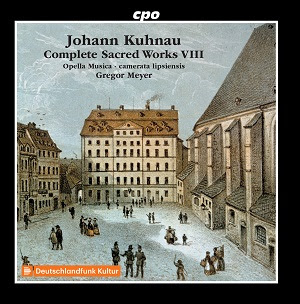
This release completes a 10-year project by Gregor Meyre, Opella Musica, and the camera lipsiensis. Over the course of a decade, these musicians recorded the complete sacred works of Johann Kuhnau. 

Johann Sebastian Bach succeeded Kuhnau as Kantor at St. Thoamskirche, Leipzig. Like Bach, Kuhnau enjoyed a long tenure -- from 1701 until his death in 1722. 

Kuhnau, like Bach, wrote not for the ages, but for next Sunday. He composed cantatas and oratorios for all major feast days in the church year. And he also produced occasional music as needed by the Leipzig town council. 

Over the course of 21 years, Kuhnau produced a large amount of music. Unfortunately, most of his sacred music was lost. What survives is now available in these eight volumes on CPO. 

They reveal that Kuhnau was as much an innovator as his successor. Kuhnau's cantatas have a supple flow, unlike the staid four-square cantatas of his contemporaries. 

Volume 8 focuses on the non-church works Kuhnau wrote over the course of his career. They include music written for school plays. (The church ran a boarding school for their boy's choir.) Also featured are three stand-alone arias and a couple of chamber cantatas.

The assembled musicians perform to their usual high standards. The Opella Musica has a translucent ensemble sound. It's easy to follow individual voices through the counterpoint. And when all sing together, the voices blend to create a pleasing unity. 

Gregor Meyer's direction serves the music well. Slow passages are slow, not ponderous. Big gestures are grand, not bombastic. 

The entire collection is worth acquiring -- especially if you're interested in the high Baroque. At the very least, this volume is worthwhile because of the variety of materials. I'd also recommend volume 3,  with Kuhnau's surviving Christmas cantatas. They are spectacular.   

Johann Kuhnau: Complete Sacred Works, Vol. 8
Opella Musica; camerata lipsiensis; Gregor Meyer, conductor
CPO

Tuesday, January 24, 2023

Johann Joachim Quantz Trio Sonatas Show Versatility

Johann Joachim Quantz is best remembered for his flute concertos. After all, he wrote over 300 of them for his employer, Frederick the Great. Quantz's job was keeping Frederick, an enthusiastic amateur flutist, supplied with music. But he wrote in other forms, too 

This release presents six of his trio sonatas. What exactly a trio sonata was depended on the players. Composers wrote these works for two treble clef instruments plus basso continuo. 

The lead instruments could be violins, transverse flutes, oboes, or recorders. Or any pairing of them. The basso continuo could be as simple as a cello outlining the bass. Or it could have a keyboard or fretted stringed instrument to fill out the harmony. 

The Ensemble Labrinto Armonico has chosen an appealing blend of instruments. The melodic lines are played with a recorder and baroque violin. The recorder takes the first part. 

The basso continuo features a baroque cello. Both harpsichord and archlute provide the underlying harmonies. Good choices.

The sound is richly layered. Nicely filled-out harmonies support the melodies. And the difference in timbre between the recorder and violin enhances the contrast. It's easy to hear the clever interplay Quantz writes for the two solo instruments. 

Well-recorded and well-performed.

Johann Joachim Quantz: Trio Sonatas
Ensemble Labirinto Armonico
Dynamic CDS7957

Thursday, December 22, 2022

Galant Cathedral Music from New Spain

Style Galante was fashionable in the mid-1700s. It formed a bridge between the Baroque and Classical Eras. And in New Spain, music was being written and performed in that oh-so-current style. 

New Spain was the collective name for Spain's possessions in the New World. It included modern-day Mexico, Cuba, the American Southwest, and Central America. Mexico City and Veracruz were thriving cities, with sophisticated cultural life. 

Italian composers Santiago Billoni and Ignacio de Jerusalem emigrated to New Spain. David Pérez (Lisbon) and Luis Misón (Madrid) remained in Europe.  But their music was well-known and often performed in New Spain. 

I think location makes a difference. There's something that the Billoni and Jerusalem compositions have that the others don't. Indigenous music and culture weren't far below the surface. The Italian composers didn't adopt folk tunes into their music. But there's a rhythm pulse in their works that seems distinctively LatinX. 

The quality of the compositions is on par with that of the Mannheim School. The melodies are all well-formed and easy to follow (a hallmark of the style). And they're all quite tuneful. 

The performances by the Camerata Antonio Soler are generally good. And the vocal soloists also do a credible job. All in all, this release succeeds in its intent. And that is to demonstrate just how rich and vibrant the music scene was in New Spain. 

Galant Cathedral Music from New Spain
Camerata Antonio Soler; Javier José Mendoza, conductor
Orchid Classics ORC100208

Wednesday, November 30, 2022

Ambitious Oratorios from Georg Philipp Telemann

This release presents two of Georg Philipp Telemann's "Johannis" oratorios. For the church year 1730-31, Telemann set himself an ambitious task. For every church service, he would compose a full oratorio (rather than a short cantata). 

Few composers other than Telemann could have pulled it off. And an even smaller group could have done so at the quality Telemann maintained. 

The first oratorio recorded here is Gelobet sei der Herr. It relates the birth of John the Baptist, and of the role he would play in preparing the way for Christ.

The second was sung during the Third Sunday of Easter. Bequemliches Leben, gemächlicher Stand is a contemplation of Jesus as the Good Shepherd, and what that role means. 

These are indeed, big works. Soloists include not only the principal characters of the stories. Old Testament prophets comment on the action and provide historical background. Allegorical figures personify concepts such as love and faith.  

The 20 musicians Telemann had at his disposal are given plenty to do, as is the chorus. And yet these oratorios have a lighter feel to them than J.S. Bach's. The choral and instrumental textures have greater transparency. And the relatively straightforward solo lines have a natural clarity to them. 

Michael Alexander Willens and the Kölner Akademie are among the premier practitioners of high German Baroque choral music. Their performances here are fluid and supple. Willens guides the singers (and our ears) through the subtleties of the text. His direction makes a strong connection between the emotional content of Albrecht Jacob Zell's words and the music. 

Will they do all 50+ oratorios? That's a tall order. But I'm glad these two were recorded. Both are works that are worth revisiting time and again.

Georg Philipp Telemann: Johannis Oratorium
Rahel Maas, Harsányi, soprano; Elvira Bill, alto; Mirko Ludwig, tenor; Klaus Mertens, bass baritone; Mauro Borgioni, bass; André Morsch, baritone
Kölner Akademie; Michael Alexander Willens, director
CPO

Wednesday, November 23, 2022

Matthias Weckmann Sonatas given good account by Musica Fiata

Collegium Musicum societies sprang up across Germany during the Reformation. Originally, they were amateur musical groups created to perform instrumental works. 

In time, many incorporated professional musicians. These expanded groups provided instrumental ensembles for large civic and church functions. 

And in many cities, it wasn't long before the leading local composers joined. They often wrote music for their collegiums and conducted performances.  

The Hamburg Collegium Musicum of the 1650s was one of the most prestigious. Composers from other cities would send scores for the collegium to perform. This was the organization Matthias Weckmann founded.

Weckmann was a student of Heinrich Schutz and organist at JakobKirche in Hamburg. He was very much interested in the music of Italy, especially contrapuntal music. The works he composed for the Collegium Musicum reflect that interest.

The eleven sonatas recorded here use a variety of instrumental combinations. These were the musicians Weckmann worked with professionally, and he knew their capabilities. Every one of these sonatas pushes the limits of the instruments involved.

The Musica Fiata directed by Roland Wilson is up to the challenge. Wilson also plays cornetto with the ensemble. Wilson's direction brings out the contrasting sections in Weckmann's music. To my ears, there were hints of Gabrielli and his use of contrasting choirs. 

The ensemble is well-recorded. There's a little ambiance, but not a lot. And that's appropriate. These would have been performed in a coffee house or other secular gathering place. So the sound would have been closed in. 

There's no harpsichord used here, only a chamber organ. That gives these works a very different sound quality than many Baroque chamber recordings. And, I think, one truer to the vision of organist Mathias Weckmann.

Matthias Weckmann: Eleven Sonatas for the Hamburg Collegium Musicum
Musica Fiata; Roland Wilson, director
CPO


Tuesday, November 01, 2022

Vincenzo and Michelangelo Galilei -- Musiche per liuto

These days, Galileo is the most famous member of the Galilei family. But at the turn of the 17th Century, that wasn't the case. Galileo's father, Vincenzo Galilei was a renowned lutenist and an influential music theorist. 

In the 1590s, a group of musicians and scholars -- the Florentine Camerata -- sought to revive ancient Greek music and drama. Vincenzo Galilei had done extensive acoustical experiments. His work became a key component of what the Camerata developed. 

The Camerata didn't succeed in reviving ancient Greek music. But they did develop a new style of music -- the Baroque -- and a new musical form, the opera.

Vincenzo Galilei published several collections of lute music based on his new theories. Christian Zimmermann presents a selection of this music. 

Galilei wrote these pieces in only major and minor keys. This was part of the new Baroque aesthetic. And it represented a clean break from the church modes of the Renaissance. 

This recording also includes music by Michelangelo Galilei. He was Vincenzo's son and Galileo's brother. And he was also a virtuoso lutenist. 

Michelangelo's music is more concerned with technique than theory. So hearing music by father and son together is enlightening. 

Zimmermann uses both a six-course lute and a ten-course lute for this recording. The two instruments provide a welcome variety of timber. And, I suspect, some of these pieces are better suited to a particular instrument. 

The recital is well-recorded. The sound is clean and close-up. But the balance is good, and the instruments have a natural resonance. 

Highly recommended to anyone curious about the origins of the Baroque.

Vincenzo and Michelangelo Galilei
Musiche per liuto
Christian Zimmermann, lute
Tactus

Tuesday, September 20, 2022

Adrian Butterfield consistently delivers with Leclair sonatas

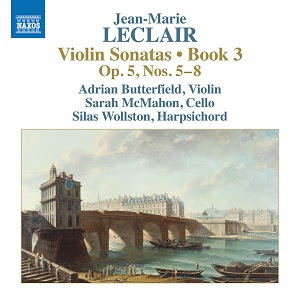
Jean-Marie Leclair published twelve sonatas in his Opus 5 collection. This release presents sonatas 5 through 8 of the set. I reviewed the previous installment in this series, which included sonatas 1-3. 

In many ways, this release follows through with the standards set by that release.

Violin Adrian Butterfield shows remarkable musicality and technique with his performances. Leclair was a violin virtuoso. He wrote these works for professional musicians, not amateurs. 

Butterfield nicely handles Leclair's technical challenges. At the same time, he plays with expressive sensitivity, each phrase thoughtful shaped. 

All that was true of the previous volume. What makes this one stand out is the music itself. I can't quite explain why, but I think this set of sonatas is better written. They sound a little less fussy than Nos. 1-4. And they seem to have more cleanly-defined melodies. 

Both volumes are worth a listen. but if you only have the budget to buy one, I'd recommend this release. 

Jean-Marie Leclair: Violin Sonatas, Book 3, Op. 5, Nos. 5-8
Adrian Butterfield, violin
Sarah McMahon, cello; Silas Wollston, harpsichord
Naxos 8.574351

Tuesday, August 23, 2022

Clemencic Consort excite with Fux and Biber

René Clemencic died in March of this year. He was a major figure -- and influence -- in the world of early music. His first ensemble, the Musica Antiqua performed with period instruments in 1958. In 1968 he founded the Clemencic Consort. 

René Clemencic and his ensemble released over 100 recordings over the span of 54 years. And they've won several awards in the process. This release reissues two of the four Clemencic Consort recordings produced in 2005.

Biber's Balletti & Sonatas for Trumpets and Strings explore a small part of his output. Clemencic pulls music from a variety of sources. The resulting program has a nice flow to it. Trumpet works are leavened with pieces for string ensembles. 

The second disc presents music by Johann Fux. It includes two ouvertures from his Concentus musico-instrumentalis, Op. 1. This 1701 collection shows Fux's mastery of both French and Italian styles. Clemencic also includes four partitas, showing Fux's contrapuntal skills.

Clemencic and his consort were first and foremost about the performances. Their scholarly research was solid, but they aimed to make the music come alive. This release is but a sampling of their success. 

Heinrich Biber: Balletti & Sonatas for Trumpets and Strings
Johann Fux: Concentus musico-instrumentalis
Clemencic Consort; René Clemencic, director
OEHMS Classics OC1904
2 CD Set

Tuesday, July 19, 2022

Adrian Butterfield excels with Leclair Violin Sonatas

Jean-Marie Leclair was one of the most pre-eminent violinists of his day. Each collection of sonatas he published advanced the art of violin playing. The third book from 1734 challenges the player's dexterity.

The fast movements are sometimes just a blur of notes. Leclair frequently uses double stops, and not always with the most convenient fingering. 

This volume also shows a transition in style. This release features the first four sonatas from Book 3. They all have a four-movement structure that looks ahead to the Classical Era.

Adrian Butterfield plays with a clear, singing tone. It's especially effective for the lyrical slow movements. He delivers Leclair's most difficult passages with precision and musicality. 

These may have been works written to develop the art of violin playing. Butterfield understands that they are also pieces to be listened to and enjoyed. And in that, he and his fellow musicians succeed.

Jean-Marie Leclair
Violin Sonatas Book 3 Op. 5, Nos. 1–4
Adrian Butterfield, violin; Sarah McMahon, cello; Silas Wollston, harpsichord
Naxos


Tuesday, May 31, 2022

Johann Heinichen Dresden Vespers hit a sweet spot

In 1720, Johann David Heinichen was rehearsing his latest opera in Dresden. The lead castrato pitched a fit. He tore up the music and hurled the pieces at Heinichen's feet. 

That incident was all the excuse King Augustus the Strong needed. He dismissed his temperamental -- and very expensive -- singers. It effectively ended Italian opera in Saxony. 

Heinichen was kind of out of a job. But then realpolitik kicked in. Augustus was Protestant, which meant minimal liturgical music. But Augustus wanted to be elected King of Poland. To do so, he had to convert to Catholicism. He did. 

He won the throne and returned to Dresden with a Catholic wife. Augustus demonstrated his support for Catholicism through the arts. And so Heinichen was in demand once again, composing music for the Roman Catholic liturgy.

This album shows the results of those efforts. The music is big, complex, and almost operatic in vocal lines. Augustus' Protestant services used a small ensemble singing simple melodies. For the Catholic Augustus, Heinichen was free to expand his forces. These works use large ensembles with interweaving lines of complex counterpoint.

To me, Heinichen's Vespers walks a stylistic middle path. The music isn't overly florid. While it is substantial, the music doesn't detract from the spiritual nature of the text. At the same time, the complexity of the choruses requires a high degree of skill.

The Ensemble Polyharmonique has a wonderful vocal blend. The Wrocław Baroque Orchestra proved suitable support for the singers. 

Jarosław Thiel injects a lot of energy into this music through his conducting. I suspect the tempi were a little on the fast side. And that was fine with me.

This recording has a somewhat dry sound. It does make the counterpoint clearer. But I kept wanting a little more ambiance, as one would hear even in a small chapel. 

Not completely operatic, not completely pared-down Protestant, nor completely overblown Catholic. Heinichen's music sits at the intersection of all three, in an undeniably sweet spot.

Johann David Heinichen: Dresden Vespers
Ensemble Polyharmonique
Wrocław Baroque Orchestra, Jarosław Thiel, director
Accent ACC 24381

Thursday, April 14, 2022

Kölner Akademie's Telemann Easter Cantatas Highly Recommended

Let's be clear. This is a mere sampling of Georg Philipp Telemann's output for Easter. After all, he composed Easter cantatas and oratorios for about sixty years.  And often more than one for a specific date. 

This release focuses on works composed during the 1720s. Telemann was in his 30s, working in Frankfurt. He was the city's music director. And Kapellmeister for Frankfurt's five largest churches.

He had a lot of musical forces at his disposal and a lot of new ideas. For example, Telemann borrowed the concept of da capo arias from Italian operas. During this period, Telemann composed cycles of sacred works. These cycles covered the entire liturgical year. 

That meant 72 works -- plus cantatas for Easter, Pentecost, and Christmas (each of which had three feast days). The five cantatas collected here represent a minute fraction of Telemann's output!

Two of the cantatas come from the "Jahrgang ohne Recitativ" (Annual Cycle without Recitative).  "Ich war tot, und siehe, ich bin lebendig" TVWV 1:872 is for the first day of Easter. "Brannte nicht unser Herz in uns" TVWV 1:131, is for the second. 

The two works share musical themes. They're not in sequence on the album. But when I listened to them one after the other, the connections became clear.

For the Easter Sunday morning service, Teleman composed "Triumph! Ihr Frommen, freuet euch" TVWV 1:1424. The trumpets sound and all is right with the world. This is the most joyous and joyous-sounding of the five cantatas on this release.

This is the fifth Telemann release by the Kölner Akademie and Michael Alexander Willens. And it's their 42nd release of music from the Baroque and Classical Eras. 

The musicianship is superb. Willens' direction brings out the individual characters of each cantata. Telemann was prolific, but he was also profound. This collection shows how he could approach the same theme from different angles. And each approach results in a work of substance and beauty. 

Recommended.

Georg Philipp Telemann: Easter Cantatas
Johanna Winkel, soprano; Margot Oitzinger, alto; Georg Poplutz, tenor; Peter Kooij, bass
Kölner Akademie; Michael Alexander Willens, conductor
CPO

Tuesday, March 15, 2022

Symphonies of the Bach Family span generations

This release presents symphonies by a veritable alphabet of Bachs: WF, CPE, JE, JCF, JL, and (of course) JS. It's an excellent program, comprised of many seldom-heard works. 

The release opens with a symphony by Wilhelm Friedemann (WF) Bach. And it concludes with a sinfonia by his father, Johann Sebastian (JS) Bach. The two works make effective bookends. WF was Johann's eldest son, and his style most closely resembles his father. 

Carl Philipp Emanuel (CPE) Bach was the second-eldest son. A good part of his career was spent at the court of Frederick the Great. CPE's symphonies are closer to the galant style -- clear melodies supported with clean, simple harmonies.

Johann Ernst (JE) Bach was the son of Johann Bernhard Bach, JS Bach's second cousin. His symphony is a jovial bustling work that leans towards the Baroque.

Johann Christoph Friedrich (JCF) Bach was the fifth son of JS Bach. His employer, the Count Wilhelm of Bückeburg, had a taste for Italian music. JCF obliged. His works, like this symphony, bear a passing resemblance to Vivaldi's.

Johann Ludwig (JL) Bach was JS Bach's third cousin. His "Cantata Symphony" is actually a concerto for two violins. JL was a product of his time. The concerto is solidly Baroque in style. Soloists alternate with the ritornello of the ensemble. JL may not have been THE Bach, but he was a Bach. The work is finely crafted, and quite exciting as performed here. 

The Berliner Barock Solisten has a clean sound. Bach's sons composed during a time of transition. And although the harpsichord is present, it's far back in the mix. 

That's a good choice, I think. For the Baroque composers, JL and JS, the instrument is more prominent. Having that contrast makes it easier to hear the differences between the generations. 

Symphonies of the Bach Family
Berliner Barock Solisten; Reinhard Goebel, conductor
Hanssler Classic HC21029