This release launches a new series from Naxos -- the Music of Brazil. Working with three Brazilian orchestras, Naxos will record about 100 works by native composers. It should be a phenomenal and revelatory cycle. That's my impression after hearing this first release of music by Alberto Nepomuceno (1864-1920).
It's a logical place to start. Nepomuceno was one of the first composers to blend Brazilian traditional music with classical forms. He was a friend and colleague of Edvard Grieg, and his music shares some similarities.
Nepomuceno writes in a very clear, economic style. His use of Brazilian musical elements is organic, which makes the works recorded here so successful. Another plus is the Minas Gerais Philharmonic Orchestra, led by Brazilian conductor Fabio Mechetti. Like a Czech orchestra performing Dvorak, they understand the subtext of music in a way a non-native orchestra couldn't. The orchestra's performances give these works an extra spark that's hard to define, but easy to hear.
Nepomuceno's 1893 Symphony in G minor follows a Brahmsian model. The four-movement work lays out its themes and develops them in a logical fashion. But this isn't Brahms. Nepomuceno's strong rhythms and distinctive melodies give it a distinctly Brazilian character.
The 1891 Série Brasileira brings Nepomuceno's heritage to the fore. Each movement uses folk elements from different parts of Brazil. The first movement is based on an Amazonian theme and the second based on the Brazilian tango (maxixe). the third movement references Northeastern Brazilian music and the finale the batuque dance of southern Brazil.
It's Nepomuceno's most popular work. While the folk elements make it naturally appealing, Fabio Mechetti goes beneath the surface. Under his direction, the Minas Gerais Philharmonic brings out the full richness of Neopmuceno's orchestrations. It turns the work from a set of orchestrated folk songs to an orchestral work incorporating folk elements.
In Brazil, Alberto Nepomuceno is a national treasure. This release helps listeners outside the country understand why.
Alberto Nepomuceno: Symphony in G minor; O Garatuja; Prelude; Série Brasileira
Minas Gerais Philharmonic Orchestra; Fabio Mechetti, conductor
Naxos 8.574067
Views and reviews of over-looked and under-appreciated culture and creativity
Wednesday, January 08, 2020
Tuesday, January 07, 2020
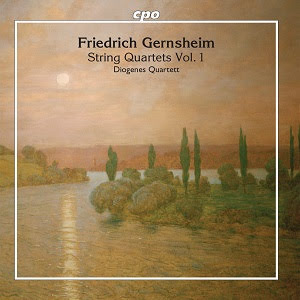
Friedrich Gernsheim string quartet cycle off to a solid start
The musical influences of Friedrich Gernshiem are easy to hear; Robert Schumann, Camille Saint-Saëns, and Johannes Brahms. The latter is perhaps the strongest. Gernsheim was a friend and colleague of the famous composer.
Like Brahms, Gernsheim only wrote a handful of string quartets. The Diogenes Quartett launches a traversal of those five works with this release. Featured in this recording are Gernsheim's first and third quartets.
The first quartet was written when Gernsheim was 33. While it's not exactly a youthful work it does have a certain energy about it. Gernsheim's melodies have a Schubertian grace about them. And they're supported with lush Romantic harmonies that almost seem self-indulgent.
I especially enjoyed the final movement with its rapid accelerando. It was a frantic race to the finish that ended the work with a flourish.
Gernsheim's third quartet was composed over a decade later. It's the work of a more mature composer. Here the melodies are more fully formed, and sweetly romantic. The harmonies give the work a somewhat sentimental character (at least to these 21st Century ears).
The Diogenes Quartett plays with commitment and authority. Gerhsheim was a skilled composer, and the quartet makes the most of the material. Their ensemble blend is quite smooth -- an asset with Gernsheim's thick harmonies.
This is a solid start to what promises to be an interesting series. I look forward to volume two.
Friedrich Gernsheim: String Quartets, Vol. 1
String Quartet No. 1 in C minor, Op. 25
String Quartet No. 3 in F major, Op. 51
Diogenese Quartett
CPO 777 3872
Like Brahms, Gernsheim only wrote a handful of string quartets. The Diogenes Quartett launches a traversal of those five works with this release. Featured in this recording are Gernsheim's first and third quartets.
The first quartet was written when Gernsheim was 33. While it's not exactly a youthful work it does have a certain energy about it. Gernsheim's melodies have a Schubertian grace about them. And they're supported with lush Romantic harmonies that almost seem self-indulgent.
I especially enjoyed the final movement with its rapid accelerando. It was a frantic race to the finish that ended the work with a flourish.
Gernsheim's third quartet was composed over a decade later. It's the work of a more mature composer. Here the melodies are more fully formed, and sweetly romantic. The harmonies give the work a somewhat sentimental character (at least to these 21st Century ears).
The Diogenes Quartett plays with commitment and authority. Gerhsheim was a skilled composer, and the quartet makes the most of the material. Their ensemble blend is quite smooth -- an asset with Gernsheim's thick harmonies.
This is a solid start to what promises to be an interesting series. I look forward to volume two.
Friedrich Gernsheim: String Quartets, Vol. 1
String Quartet No. 1 in C minor, Op. 25
String Quartet No. 3 in F major, Op. 51
Diogenese Quartett
CPO 777 3872
Monday, January 06, 2020
Katarzyna Drogosz bring Franz Xaver Mozart out of father's shadow
In his lifetime Franz Xaver Wolfgang Mozart was better known as a virtuoso pianist than a composer. And for good reason. As a performer, he was judged on the merits of his own talent. As a composer, he was always compared to his father, Wolfgang Amadeus.
As a result, F.X. Mozart virtually ceased composing in his thirties. Only now is his music being evaluated on its own merits. This release presents Mozart's piano sonata and an assortment of shorter piano works.
The Piano Sonata in G major, Op. 10 is a major work with a playing time of about 25 minutes. To my ears, this four-movement sonata strongly resembles those of Clementi. The texture is light, with scales and arpeggiated chords being the primary building blocks.
And yet there's a difference. Some of the phrasings are deliberately irregular, playing on the listener's expectations. Mozart was only 16 when he wrote the sonata, and there's a youthful lighthearted feel to it.
Mozart spent time in Poland and published four collections of polonaises. The Polonaises mélancoliques Op. 22 were composed when Mozart was in his thirties. The writing is much more sophisticated and, I think, more interesting. Each of the polonaises adheres to the traditional 3/4 pattern of the dance. And yet each is very different in character.
Mozart uses thick harmonies to color his melodies, effectively shifting their emotional content. Are they as good as Chopin's? Not quite -- but they do point the way.
Katarzyna Drogosz performs admirably, subtly phrasing and shaping the music in interesting ways. I'm especially impressed as she's playing on an 1800 fortepiano, an instrument with markedly less responsiveness than a modern piano. Nevertheless, Drogosz plays with elegance and executing runs and trills with a delicate touch.
A well-executed program of music by a composer overshadowed by his heritage.
Franz Xaver Wolfgang Mozart: Rondos, Sonata, Polonaises, Variations
Katarzyna Drogosz; fortepiano
Accord ACD260
As a result, F.X. Mozart virtually ceased composing in his thirties. Only now is his music being evaluated on its own merits. This release presents Mozart's piano sonata and an assortment of shorter piano works.
The Piano Sonata in G major, Op. 10 is a major work with a playing time of about 25 minutes. To my ears, this four-movement sonata strongly resembles those of Clementi. The texture is light, with scales and arpeggiated chords being the primary building blocks.
And yet there's a difference. Some of the phrasings are deliberately irregular, playing on the listener's expectations. Mozart was only 16 when he wrote the sonata, and there's a youthful lighthearted feel to it.
Mozart spent time in Poland and published four collections of polonaises. The Polonaises mélancoliques Op. 22 were composed when Mozart was in his thirties. The writing is much more sophisticated and, I think, more interesting. Each of the polonaises adheres to the traditional 3/4 pattern of the dance. And yet each is very different in character.
Mozart uses thick harmonies to color his melodies, effectively shifting their emotional content. Are they as good as Chopin's? Not quite -- but they do point the way.
Katarzyna Drogosz performs admirably, subtly phrasing and shaping the music in interesting ways. I'm especially impressed as she's playing on an 1800 fortepiano, an instrument with markedly less responsiveness than a modern piano. Nevertheless, Drogosz plays with elegance and executing runs and trills with a delicate touch.
A well-executed program of music by a composer overshadowed by his heritage.
Franz Xaver Wolfgang Mozart: Rondos, Sonata, Polonaises, Variations
Katarzyna Drogosz; fortepiano
Accord ACD260
Friday, January 03, 2020
#ClassicsaDay #ClassicalDoubleDigits Week 1
The Classics a Day team noted that the new year is comprised of two twenties -- double digits. So the theme for January 2020 is to post other examples of double digits found in classical music. Prolific composers are a good place to start. But I found a few surprises among composers with very small catalogs.
Here are my posts for the first week of #ClassicalDoubleDigits.
1/1/20 Ludwig van Beethoven (1770-1827): Piano Sonata No. 11 in B-flat major, Op. 22
We open #ClassicalDoubleDigits with two sets. Sonata No. 11 was completed in 1800. Beethoven considered the work (published as Op. 22) one of his best early period sonatas.1/2/20 Alexander Tcherepnin (1899-1977): Eight pieces for piano Op. 88
According to the publisher, "tonality and dissonance bolster each other to create a dynamic and dramatic whole" in these 1957 preludes.1/3/20 Johann Sebastian Bach (1685-1750): Cello Suite No. 4 in E-flat major, BWV 1010
The Bach-Werke-Verzeichnis (Bach Works Catalog) was first published in 1950. The numbering isn't strictly chronological. Nos. 1001-1040 are chamber works.Thursday, January 02, 2020
Raphael Wallfisch continues cello concerto cycle with Ben-Haim, Korngold, and Bloch
This installment of Raphael Wallfisch's innovative series features three very different composers. "Cello Concertos by Jewish Composers in Exile" is in its fourth volume. All three composers were Jewish, and all were forced from their homes. But not every work on this album is a concerto (sort of).
The outlier is Ernest Bloch, represented by some transformed works. Included are two movements the Baal Shem Suite. Originally written for violin and piano, It's heard here in orchestration for cello and orchestra, and work quite well in this version.
His major work is the Symphony for Violoncello and Orchestra. This 1954 work (symphony, not concerto) was composed for solo trombone and orchestra. The piano reduction noted the solo part could be played by either trombone or cello. And so we have the version on this release.
The Symphony (not concerto) is a wonderful work. Although he didn't count it as one of his Jewish works (such as Schlomo), there's no escaping one's roots. The melodies, particularly as played by Wallfisch have echoes from Jewish musical culture.
Paul Ben-Haim was one of the early immigrants to Britsh Mandate Palestine (later Israel). His work is strongly influenced by Eastern Mediterranian music. Those influences are easy to hear in his 1972 Cello Concerto.
Erich Wolfgang Korngold fled Austria ahead of the Nazis. He found a new life (and career) in America, transitioning from composing concert music to film scores. But he never completely left classical music, nor his Viennese roots behind.
His Cello Concerto in C major recycles themes from his score for "Deception." A cellist and a composer are opposite points of a love triangle (with a pianist!). Part of the drama involves a concerto the composer has written for the cellist, snippets of which are heard in the movie.
Korngold takes his movie cues and develops them into an organic if compact, whole. The thirteen-minute concerto never completely shakes its Hollywood origins. Because Wallfisch takes the music seriously, though, those traces recede in the background.
Overall, Raphael Wallfisch delivers some beautiful performances. He adapts his playing to the character of the music. For Bloch's music, he plays with a rich, rounded tone, while in the Korngold his cello seems to have a steely edge to it.
This release is a diverse collection of composers and styles. But it's unified in the quality of the playing, both by Wallfisch and the BBC National Orchestra of Wales.
Paul Ben-Haim; Ernest Bloch; Erich Wolfgang Korngold: Cello Concertos
Cello Concertos from Exile, Vol. 4
Raphael Wallfisch, cello
BBC National Orchestra of Wales; Lukasz Borowicz, conductor
CPO 555 273–2
The outlier is Ernest Bloch, represented by some transformed works. Included are two movements the Baal Shem Suite. Originally written for violin and piano, It's heard here in orchestration for cello and orchestra, and work quite well in this version.
His major work is the Symphony for Violoncello and Orchestra. This 1954 work (symphony, not concerto) was composed for solo trombone and orchestra. The piano reduction noted the solo part could be played by either trombone or cello. And so we have the version on this release.
The Symphony (not concerto) is a wonderful work. Although he didn't count it as one of his Jewish works (such as Schlomo), there's no escaping one's roots. The melodies, particularly as played by Wallfisch have echoes from Jewish musical culture.
Paul Ben-Haim was one of the early immigrants to Britsh Mandate Palestine (later Israel). His work is strongly influenced by Eastern Mediterranian music. Those influences are easy to hear in his 1972 Cello Concerto.
Erich Wolfgang Korngold fled Austria ahead of the Nazis. He found a new life (and career) in America, transitioning from composing concert music to film scores. But he never completely left classical music, nor his Viennese roots behind.
His Cello Concerto in C major recycles themes from his score for "Deception." A cellist and a composer are opposite points of a love triangle (with a pianist!). Part of the drama involves a concerto the composer has written for the cellist, snippets of which are heard in the movie.
Korngold takes his movie cues and develops them into an organic if compact, whole. The thirteen-minute concerto never completely shakes its Hollywood origins. Because Wallfisch takes the music seriously, though, those traces recede in the background.
Overall, Raphael Wallfisch delivers some beautiful performances. He adapts his playing to the character of the music. For Bloch's music, he plays with a rich, rounded tone, while in the Korngold his cello seems to have a steely edge to it.
This release is a diverse collection of composers and styles. But it's unified in the quality of the playing, both by Wallfisch and the BBC National Orchestra of Wales.
Paul Ben-Haim; Ernest Bloch; Erich Wolfgang Korngold: Cello Concertos
Cello Concertos from Exile, Vol. 4
Raphael Wallfisch, cello
BBC National Orchestra of Wales; Lukasz Borowicz, conductor
CPO 555 273–2
Subscribe to:
Posts (Atom)