Showing posts with label Lionel. Show all posts

Tuesday, April 24, 2018

Lessons from York - We See Change

Dad and I recently returned from our semi-annual trip to the Train Collectors Association (TCA) Eastern Division toy train meet in York, PA. This is the largest such show in the United States and provides an interesting snapshot of the state of the hobby.

It can also hint at the current state of collecting in general. As is our tradition, we spent a lot of time discussing what we saw a lot of (and what we didn't) -- and more importantly, the reasons behind them


From collector to operator


In Part 1 I shared some examples of a hobby in flux. The first three generations of toy train collectors are selling more than their buying. There is a fourth generation, though. But this middle-aged group is made up of operators rather than collectors.

Yes, they're interested in the larger gauge trains that were the mainstay of Lionel and American Flyer.  But they prefer to run trains on a layout rather than display them on shelves.

Trains made by Lionel, MTH, Atlas, Bachmann, and others for today's market are much more reliable that fragile and finicky vintage equipment that's a half-century old.

And that change was readily apparent at the meet.

Code Orange

The York meet had six dealer halls, designated by color. Four were for members who sell vintage toys (that being a loose definition). Two -- the Orange and Purple Halls -- were reserved for manufacturers of new products.

In these two halls were the latest offerings from Lionel, MTH, et al. There were also plenty of offerings from smaller companies that specialize in operating layout accessories; scenery, benchwork, electronics; structures, etc.

 The Lionel booth in the Orange Hall. It didn't look like this in
the members-only halls.


The Orange and Purple Halls were packed (at least while we were there). TCA allowed the general public into these two halls during the weekend. They did so at the last meet, and it was successful enough to continue this time as well.

Let's make a deal!

By contrast, the members-only halls weren't nearly as busy. These halls had the train items of interest primarily to the first three generations of collectors. There were many empty tables in these halls.

In the past, I had run across vendors who were anxious to close the deal. If I stopped to look at something, the table holder would appear at my side. He'd extoll the virtues of the object, and give me every reason why I should buy it right that minute!

And if I still resisted, he'd sometimes hint that the price was negotiable.

This time, it seemed that more of the vendors were like That Guy. Plus, I saw several signs at tables: "Prices negotiable" "Make me an offer" and so on.

I ran across a table with a pile of MPC Lionel boxes -- $10 each. Normally these would be in the $20-30 range, but not that day. The other half of the table was marked 50% off.

My two York purchases. I was really only interested in the red
Southern box car from Lionel MPC. But for $10 each, I couldn't resist.

To me, this suggests that the vendors also know the market is changing. And they want to get rid of their stock while there's still a window of opportunity to sell it. Because once the third generation stops buying, demand will plummet.

The October, 2018 meet should show if my impressions were correct.

One more thing


For the first time ever, I didn't see a Lionel Lifesavers Tank Car. Not one. It's been one of the few items I could count on spotting every meet. Have they all finally found homes?


Monday, April 23, 2018

Lessons from York - A Sea Change?

At one time, this volume was worth
over $100 - if you could find it. Now
it's readily available for $10.
Dad and I recently returned from our semi-annual trip to the Train Collectors Association (TCA) Eastern Division toy train meet in York, PA. This is the largest such show in the United States and provides an interesting snapshot of the state of the hobby.

It can also hint at the current state of collecting in general. As is our tradition, we spent a lot of time discussing what we saw a lot of (and what we didn't) -- and more importantly, the reasons behind them.

What we saw

Most of what we saw at the April 2018 meet seemed to suggest that the market for vintage toy trains was still shrinking. If anything, the decline of the hobby (at least in its current form) seems to have accelerated.

One big library sale

Throughout the years a number of hobby-related reference books have been published. Because of their highly specialized subject matter, these books tended to have very short print runs. The better ones seldom came on the market. These were books collectors would use -- and use often.

Out of print for years, and now back on the market.
This meet we saw several tables with piles of reference books. These weren't factory remainders. Each table usually had just one copy of a particular title. They just had a lot of titles.

Why? Reference works are one of the last things to leave a collection. Even after the objects have been sold, you can still enjoy looking at their color photos in books.

I think these books are the final liquidation of collections. The subjects of most of these books were for trains made between 1900 and the Second World War. This was the focus of the first and second generation of collectors, those who grew up in the 1920s and 1930s.


The past few years I've seen evidence of these collectors downsizing. I believe this flood of books represents estate sales.

Lionel and American Flyer HO

In the 1950s, HO scale was hot. And both Lionel (O-gauge) and American Flyer (S-gauge) started to lose market share. Both companies tried to enter the HO market, and both were unsuccessful.

This did not end well. 
This did not end well, either.
Which made their HO trains somewhat rare, but not especially desirable. Except for a certain type of collector.

Most collectors have very specific interests, but there are some who want it all. For a hard-core Lionel post-war collector, that means not just having every O-gauge train set the company produced from 1948-1970.

It means owning every rail car, every accessory, and every esoteric item Lionel produced, like their chemistry sets, science kits -- and HO scale trains.

The current active generation of collectors grew up in the 1950s. These are the people who would acquire Lionel and American Flyer HO trains to fill out their collections.

But this is also the generation that's just entering retirement. And that means downsizing. The easiest way to begin downsizing a collection is to get rid of the outliers. And if you're a Lionel O-gauge or American Flyer S-gauge postwar collector, these companies' HO trains are just that.

A changing hobby

So if the last remnants of the old collectors is now hitting the market, and the current generation is starting to downsize, is this the end? I don't think so. I think, rather, these are signs of change -- as I'll explain in Part 2.

Tuesday, October 24, 2017

Lessons from York: What We Saw - Clearing out the clutter

Dad and I recently returned from our semi-annual trip to the Train Collectors Association (TCA) Eastern Division toy train meet in York, PA. This is the largest such show in the United States and provides an interesting snapshot of the state of the hobby.

It can also hint at the current state of collecting in general. As is our tradition, we spent a lot of time discussing what we saw a lot of (and what we didn't) -- and more importantly, the reasons behind them.

There were three things that we saw in abundance this time, and I think they were there due to an aging market and shifting tastes.

Victims of the Aging Market

Toy collecting is a nostalgic endeavor, and most collectors focus on the objects of their youth. For the founding members of the TCA, that golden age would be the early 1920s. For the second generation to join, it was the late 1930s-early 1940s. For the third generation (of which I'm a part), it's postwar. 

And then there's a break. Because the third generation -- late Baby Boomers -- are really the last to grow up with toy trains. When the organization was founded, early trains commanded top dollar. That remained so during the second generation but started to decline by the third. And the slide continues.


1. Blue Comet and State Sets

Right before the Great Depression Lionel's top of the line train sets were indeed non plus ultra. The State set (each passenger car bore the name of a state) was a massive standard gauge (bigger than 0-gauge) train. Next in desirability was the Blue Comet.

These sets were made of high-quality metal, with detailed interiors, hinged doors and illumination. But in the early 1930s few families could afford such luxuries, and not many were sold.

An original 1930s Lionel standard gauge Blue Comet. Looks nice on a shelf.
For many, these sets remain the pinnacle of collecting. Even those who weren't especially interested in prewar trains would have a Blue Comet or a State Set if their pockets were deep enough.

At this show we saw an unusually high number of these vintage sets for sale. And while there weren't any real bargains, prices were $500-$1000 below average.

Why? The hobby is shifting from collectors who put trains on shelves to collectors who run trains on layouts. Reproduction Blue Comets and State Sets have hit the market. They cost a little less than the originals, run more reliably, and have modern operating features (like remote control).

The MTH 2014 reproduction. More features (like smoke and sound), and even more cars!

I think the vintage set we saw were the result of down-sizing and estate liquidations.

2. Postwar American Flyer

We noticed the abundance of American Flyer trains at the last show. This time there were even more tables offering postwar American Flyer trains. This Lionel competitor went out of business in 1967.

Original locomotives and rolling stock were scarce. But then in the early 1990s both Lionel and a new company S-Helper began offering new equipment. For the collector/operator, there was no longer a need for the vintage 1950s stuff.

This show I think we saw an acceleration of the change from collector to operator. There's less of a market for vintage Flyer, and plenty of demand for the new.

Transformers!

Last show we saw a lot of vintage ZW transformers. This time, we saw even more for sale.
For layout operators, the Lionel ZW transformer was the Holy Grail. It was the most powerful of Lionel's transformers, rated at 275 watts. It had independent controls for two trains, plus terminals to power accessories and lights.

That ZW (right) may have been powerful, but if you're one from the
late 1940s-early 1950s, it can get real hot real fast.

Lionel offered the ZW from 1948 to 1966. The first generation of collector/operators created a huge demand for refurbished ZWs. But as locomotives acquired on-board electronics, these became less satisfactory.

The Z4000 has more features, plus it's UL-rated.
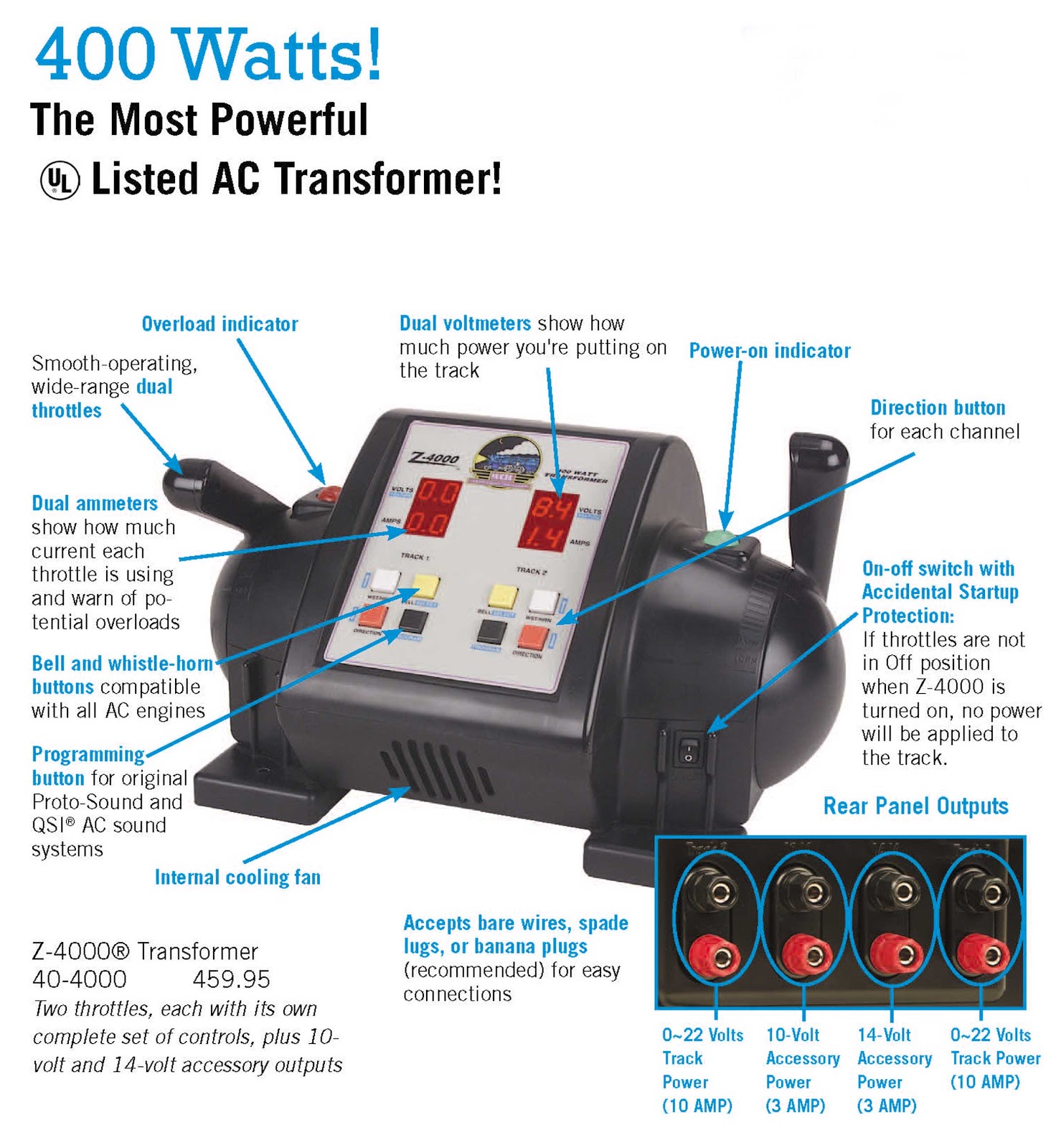
In the late 1990s MTH offered their own line of transformers for modern 0-gauge locomotives. Their top-of-the-line Z-4000 transformer delivers 400 watts of power, has an internal cooling fan and is UL-rated. If your an operator, it just makes sense to replace that vintage ZW with something that's not only more powerful, but less likely to burn your house down.

What we didn't see

What we didn't see at York supports the theory that toy train operators are now driving the marketplace. What we didn't see are the very things most operators would want on their layouts:

1) Operating accessories, both pre- and postwar (such as coal loaders, beacon lights, etc.). They're right at home on the modern collector/operators' layouts.

2) Post 1990 locomotives and rolling stock from Lionel, Atlas, MTH, and Bachman. If you're running it, you're not going to sell it.

3) Modern reproductions from Weaver, Williams, MTH, and others. Those are the products that are pushing the vintage originals off the shelves and into the market place.

Thursday, May 18, 2017

Lessons from York: What We Saw (Part 3) - 6464 No More?

It appears such displays are moving from the
collector's home to the open market.
Dad and I recently returned from our semi-annual trip to the Train Collectors Association (TCA) Eastern Division toy train meet in York, PA. This is the largest such show in the United States and provides an interesting snapshot of the state of the hobby.

It can also hint at the current state of collecting in general. As is our tradition, we spent a lot of time discussing what we saw a lot of (and what we didn't) -- and more importantly, the reasons behind them.


In Part 1 I outlined the reasons for what I see as a major shift in the hobby. Basically, younger collectors seem more interested in operating their trains rather than simply displaying them. And that, I think, explains what we say this time at York -- the results of upgrading.

And that upgrading, I think, has affected one of the mainstays of toy train collecting -- the Lionel 6464 series box car.

A little background

 From 1953 to 1969 Lionel Trains made a semi-scale box car that would become the standard for O-gauge railroading. It's known as the 6464 series, from the catalog number prefix all these box cars share. 29 different models were made. They were found in both high-end and entry-level sets. Some were available separately.

The Lionel 6464-300 from 1955-56. All the box cars in this series start with
6464. 

Stamp collecting for trains 

The 6464 box cars look good on layouts, but the primary reason these boxcars have retained their value over the years is their desirability as collectables. There are two different door types, four different body types, one of which has two different roof types. There are variations in the colors and applications of the graphics. There are factory samples, production prototypes, and factory errors.

Some of the box cars are readily available. Some, like the pastel-colored box car for the ill-fated Girl's Train are extremely rare. Just like stamp collectors seeking all the denominations of a single stamp design, train collectors have been filling their shelves with row after row of just 6464 box cars.

Taking it off the shelf

Vintage 6464 box cars have appealing graphics, and they look great in a train rolling along the track. But there are some disadvantages for the collector/operator.


  1. The cars (especially the ones from the 1950s) are somewhat heavy, which limits the length 
  2. The wheels don't turn that easily, increasing the strain on the locomotive. 
  3. Only about 17 road names are represented. If you like the Norfolk & Western, for example, you're out of luck

But the 6464 box car remained an influence in the hobby long after they were discontinued. When MPC took over Lionel in the 1970s, they reused the molds to issue their own "collectible" line of 9700 box cars. While some of the graphics were interesting, the cheapening of the plastic and trucks made these less desirable.

An MPC/Lionel 9700 box car from the 1970. Compare it to the original 1950s
version above. It's easy to see that the plastic is cheaper, and the
graphics not quite as crisp.


As time went on, others (including the new Lionel) offered better quality box cars designed for the operator. The advantages over the classic 6464 cars are:


  1. Modern 6464-like box cars are much lighter than the vintage cars 
  2. Needle nose axles produce minimal friction, allowing the wheels to spin freely, reducing strain on the locomotive. 
  3. Between all the manufacturers, hundreds of road names (both of current and defunct railroads) are available. If you like the Norfolk & Western, you can find examples of their box car liveries from the 1940s through the modern era.

6464 galore

So what did we see at York?

Tons of vintage 6464 box cars, including several examples of the Girl's Train model. If, as I believe, the trend is towards operation, then a wall of box cars has perhaps lost its appeal. Virtually all of the graphics of the original 6464 box cars are now available at much lower prices.

If you want a green NYC box car on your layout, why not use the Mikes' Train House version instead of the vintage Lionel one? It's less expensive, it runs better, and it looks just as good.

A 6464-900 Lionel NYC box car from the 1960s. 

The MTH version. 


We've always seen 6464 box cars at York, but never like this. There were tables with nothing but boxes stacked in four or five layers. And they were all there -- all 29 models.

Prices seemed a little soft, too -- about $40 to $120. Is this just the beginning?

Next: American Flyer's flown

Thursday, May 11, 2017

Lessons from York: What We Saw (Part 2) - Powering Up

Dad and I recently returned from our semi-annual trip to the Train Collectors Association (TCA) Eastern Division toy train meet in York, PA. This is the largest such show in the United States and provides an interesting snapshot of the state of the hobby.

It can also hint at the current state of collecting in general. As is our tradition, we spent a lot of time discussing what we saw a lot of (and what we didn't) -- and more importantly, the reasons behind them.


In Part 1 I outlined the reasons for what I see as a major shift in the hobby. Basically, younger collectors seem more interested in operating their trains rather than simply displaying them. And that, I think, explains what we say this time at York -- the results of upgrading.

If you have more than a 4' x 8' train layout
in the 1950s, you needed a Z transformer.

Power base

Most Lionel train sets of the 1950s and 60s came with small 35-watt transformer power packs. For the small oval or figure eight, the supplied track could make, that was enough power to keep the train moving.

When the owner of one of those sets built something bigger and more elaborate on a tabletop, though, 35 watts didn't cut it.

Bigger layout, bigger power demands

In order to overcome power drops in longer loops,  a 75-watt or higher-powered transformer was required. If one had two trains running, then a transformer with dual controls was a must. So the Z transformers (250 watts) and ZW transformers (275) became increasingly desirable. Lionel stopped making these powerhouses in 1969.

As more collectors turned to operating layouts, the demand for these transformers increased, as did their price. And they became scarce. Because once they were installed on a layout, they were out of circulation.

 The Lionel ZW transformer. At one time, this was the
ultimate power source for a large 0-gauge layout.

Power shift

This show we saw vintage Z and ZW transformers at virtually every table. Why?

I think the older transformers no longer cut it. Beginning in the late 90s, manufacturers installed printed circuits in their locomotives.

Some were for sound effects, which became increasingly realistic as digital sound technology advanced. Other circuits allowed for sophisticated remote control. The older transformers limited some of those functions.

So Lionel, MTH and other current manufacturers built new transformers for the new generation of trains. The MTH Z-4000, for example, provides 400 watts of power, and connectivity for newer remote control functions that didn't exist in the 1960s.

I think operators are trading up, and when they replace their Z or ZW with a Z-4000, the vintage transformer goes up for sale. There were many at this show, and prices were lower than I've ever seen them.

If you wanted to create a strictly vintage  layout, you were in luck. But most just passed them by without a glance.

The MTH Z-4000 transformer. While its form gives a nod to the vintage ZW, its electronics and functionality
is strictly 21st Century. 


Next: 6464 no more?


Thursday, May 04, 2017

Lessons from York: What We Saw (Part 1) - Operators Welcome

Sure, it's great as a display piece -- but this 1925
American Flyer set probably doesn't have that many
spins around the layout left in it.
Dad and I recently returned from our semi-annual trip to the Train Collectors Association (TCA) Eastern Division toy train meet in York, PA. This is the largest such show in the United States and provides an interesting snapshot of the state of the hobby.

It can also hint at the current state of collecting in general. As is our tradition, we spent a lot of time discussing what we saw a lot of (and what we didn't) -- and more importantly, the reasons behind them.

Changes in the wind


There's a major change happening in the toy train world, spurred in part by the changing age demographic. The older collector who accumulated vintage trains to proudly display on shelves is being replaced by a younger collector who prefers to run their trains.

Both are reconnecting with the toys of their youth (the essence of any type of toy collecting, I think). But there's a big difference. The toys of the first and second generation TCA member's youth date from the 1920s and 1930s -- and are too fragile to be run regularly without restoration work. But for the early collectors, that was fine. The toy was a trophy, not a, well, toy to be played with.

For current enthusiasts, the goal is not necessarily to get that toy train Santa never brought but to build that dream layout they never got around to. There are several professional layout building companies ready to serve this market. Classic Toy Trains, one of the premier magazines of the hobbies, features two or three operating layouts every issue and offers tips for DIY modelers.


The toy trains of these collectors date from the 1950s and 1960s and still run fairly well. But not as well as the current crop of locomotives. Digital electronic sounds and wireless commands are now standard equipment on Lionel trains. For the modern operator/collector, the reliability of the new products has resulted (I believe) in a declining interest in older trains.

Out with the Old?


For the first time, the York train meet was open to the public. It was only open for a limited time, and only for the halls that dealers and manufacturers of new products were. The goal was to reverse the slow decline in membership by showing potential members first-hand what TCA was all about.


As you can see from the above video, the public areas of the show were all about operating trains. In addition to layouts operated by Lionel, Mike's Train House, and Atlas displaying their latest offerings, there were smaller demo layouts for various accessories and products. There were also three large modular layouts for visitors to enjoy.
Unlike the example at the beginning of the post,  this reproduction of a classic Lionel 1930s train set runs just fine.
And MTH has built-in the modern electronic sound and control features that operators are looking for.
So what happens when people move from static to active displays of their collections? I think the answer can be found in what we saw (which I'll explain in Part 2) -- what we didn't see.

Thursday, October 27, 2016

Lessons from York: What We Didn't See: Variety

Dream on, kid. There was no Dorfan
to be found at this show.
Dad and I recently returned from our semi-annual trip to the Train Collectors Association (TCA) Eastern Division toy train meet in York, PA. This is the largest such show in the United States and provides an interesting snapshot of the state of the hobby. 

It can also hint at the current state of collecting in general. As is our tradition, we spent a lot of time discussing what we saw a lot of (and what we didn't) -- and more importantly, the reasons behind them.

An amazing compendium

This particular event has a decades-long history, enjoying continual growth (some years dramatically) up through the early 2000s. When I first started attending, it was a veritable bazaar of all things toy trains. All the major manufacturers have represented -- Lionel, American Flyer, and Marx -- as well as the second tier toy companies that had fallen by the wayside, such as Ives, Dorfan, and Kusan. You could also find toy trains from all eras, from the 1910s up through the present.

Naturally, the very rare and/or very expensive items were not on as many tables as the more commonplace toy trains. But if you went through the entire show, you could pretty much see first-hand an example of pretty much every line offered by every company.

Lionel's top-of-the-line trains and accessories from 1928. Most were
MIA for this show.

A substantial imbalance

The mix was always slightly different, which is what this series has been about -- trying to determine the reasons behind the ebb and flow of an item's availability. This show had its standout items, but as I explained in yesterday's post (What We Saw) there was a serious imbalance. Rather than there being a wide variety of eras and brands with a few things seemingly more plentiful, this time there were eras and brands that were ubiquitous, and some that weren't there at all.

Big, beautiful Lionel postwar 0-gauge sets. Those F3s were
everywhere a few years ago --almost non-existent at this show. 

Where's the good stuff?

I think the same theory explains what we saw and what we didn't. The graying of the toy train collector population means more estate liquidations and more downsizing. Most collections that are part of estates are handled by auction houses. And that makes sense. Heirs with no knowledge or interest in toy trains can simply let the auction house collect it all and liquidate it. If the heirs do their homework, they'll place the items with a house specializing in vintage toys. And notices from those houses I see with increasing frequency, announcing the sale of another "legendary" collection.

Those super-collections don't show up at the dealer tables at York. But what does show up are the results of gradual downsizing -- particularly for said dealers. When anyone downsizes, they discard the least valuable and desirable, and just keep a few valuable items.

At York, we didn't see many valuable items. No top-of-the-line standard gauge sets, desirable both for the quality of their craftsmanship and their rarity; no "girl's train," Lionel's Edsel; very few postwar Lionel GG1s, Santa Fe streamliners, Trainmasters, and other extremely popular trains and accessories; nothing above mid-level products. And usually, the more desirable a piece was in the overall hierarchy, the worse it's condition.

Lionel's Girl's Train (top) was a really bad idea that didn't sell well.
Its rarity and kitsch appeal makes it valuable today -- but a no-show at this show.

Conclusion

Most of what we saw were trains in the low to mid-range of collectability -- the very part of a collection that's easiest to let go. And the more collectible pieces we saw were in average or below average condition. If you've upgraded, then you'd want to get rid of those pieces. My personal theory is that if you have extremely limited display room, you're not going to waste it on scratched or rusty toys. So even if they're of higher collectability, if you don't have the shelf space, they've got to go.

Wednesday, October 26, 2016

Lessons from York: What We Saw: Low-end unloading

Dad and I recently returned from our semi-annual trip to the Train Collectors Association (TCA) Eastern Division toy train meet in York, PA. This is the largest such show in the United States and provides an interesting snapshot of the state of the hobby. 

It can also hint at the current state of collecting in general. As is our tradition, we spent a lot of time discussing what we saw a lot of (and what we didn't) -- and more importantly, the reasons behind them.

A question of imbalance

In the past, this series has talked about what we saw a lot of and what we saw almost none of -- but it was set against the context that of a wide variety of choices. So even if everyone had Madison cars (as they did in 2011), or Lionel diesels from the 1950s (2015), if you looked long enough, you could find an early 1900s Ives piece or a 1950s Kusan train. Big-ticket items such as a 1929 Lionel State Set wouldn't be on every table, but there would two or three (or a few more) scattered throughout the halls.

This time, though, the variety was missing. We saw a lot of two things, and only a smattering of anything else.

Price matters

With rare exceptions, for toy trains desirability pretty much follows original pricing. Top of the line train sets tends to remain the most desirable and command the highest prices. Mid-priced trains tend to be common in collections -- they were made in greater quantities than the high-end trains, and remain more affordable and therefore easy to acquire.

Low-end trains usually sold the best, and so were made in the largest quantities. Their lower quality, though, meant that they don't hold up as well as mid-level trains. Top tier sets, because of their expense, were usually handled very carefully (many only run under the Christmas tree once yearly). If you wanted to play train wreck, it was the low-price trains you did it with.

We saw a lot of these Lionel ten series standard gauge freight cars.
None were in as good a condition as these -- and priced accordingly.

So many low-end trains didn't survive. Those that did usually have condition issues. That makes mint examples of these entry-level trains somewhat desirable. But they're still low-end trains with a limited appeal so that extra value isn't very high.

Low-end Prewar

There were a lot of prewar (before WWII) trains available. We saw O-gauge trains and the larger-scale standard gauge trains from the major toy companies. And they all had one thing in common -- they were all from the lower end of the collecting scale. We saw the bottom-of-the-line sets from Lionel and American Flyer, as well as some others. There were lots of locomotives and rolling stock, but not a lot of accessories (such as stations, signal posts, and lights).

Lionel Junior was created to compete with Marx (see below) at the same
price point. We saw a lot of this at the show.


It was the type of items I'd choose to get rid of if I was downsizing a prewar toy train collection. Remember, most toy collecting is nostalgic -- we want the toys of our youth. Collectors who were youths in the 1930s are in their 80s. If you can only keep some of your collection, you'll want to hold on the best of the best. And what we saw at York was the rest.

All very reasonably priced, and most of it in fair to good condition. Even low-end trains have their fans -- but they're probably holding on the near-mint examples. If you wanted to start a prewar collection, this would have been the show for you -- most every table had some entry-level items.

When Santa couldn't afford Lionel, he went with Marx.
Postwar Marx

Louis Marx and Co. were always the low-price alternatives in the toy train field. They mimicked the offerings of Lionel and American Flyer with the product sold at a fraction of the price. Marx trains have a certain appeal -- they're elaborately lithographed with bright, bold colors and plenty of detail. They're fun toy trains, but they're still cheaply made, and still run third in popularity behind Lionel and American Flyer. You dreamed of Lionel -- but often Marx was what you got instead.

This show we saw a lot of Marx postwar trains. And I think it was also a symptom of downsizing and liquidation. None of it is very valuable, and all of it takes up space. Even if you were a dedicated Marx collector, these were the items you could live without. We saw table after table of the most commonplace engines and freight cars.

Again, if you were just starting out collecting Marx, this would have been a great show. But I wonder. It seems to me that prewar toy trains and postwar Marx are areas of the hobby more people are transitioning out of rather than into. And that makes me wonder how many of the things we saw this year were packed up and taken back home unsold.

Tomorrow: What we didn't see

Wednesday, August 19, 2015

Signaling a Change in the O-Gauge Zen Garden 2

Last post I outlined the project; install a Lionel 450 signal bridge and make it operational. It was a little bit of a challenge, because the pressure plate switch that operated the signals wasn't compatible with the brand of track I had on the layout. So instead, I used three-position toggle switches for manual control.

I don't have a separate control panel for the layout. The transformers and switch controls just kind of huddle in a corner of the layout (at least for now). I couldn't mount the toggle switched directly to the table. I would then have to reach over the switch controls to activate them, which would have been awkward.

So I built a switch box that would hold the toggle switches at the same level as the other controls. And I did it with a ruler. Hardware store yardsticks are actually pretty sturdy, and their width was about the height I wanted. I simply built a box with pieces cut from a single yardstick (with plenty left over).

After cutting the pieces, I drilled holes in what would be the top of the box
for the switches. I had a jury-rigged switch for the floodlight on the layout,
so I replaced it with a two-position toggle switch and added it to the box, too.

Ready for final assembly.

And here it is. I removed the switches, then primed and painted the box.

Yep, it all looks a little rough, but with the box in place,
everything will look much better.

And the box is installed. Sure, it looks homemade, but not totally
out of character with the other controls.


Now the installation's complete. The signal bridge adds to the clutter of an urban industrial area that I'm after. And more lights (and colored ones at that) are always a good thing on my O-Gauge Zen Garden -- as you can see below..


Tuesday, August 18, 2015

Signaling a Change in the O-Gauge Zen Garden 1

The Lionel 450 Signal Bridge installed. Now everyone can travel safely,.
As I mentioned in the last post in this series, real estate is at a premium on my little 3" x 5' tabletop. And so the only way to keep adding things is by building up, not out. One of the ways to go up is to put something over the tracks.

I opted for a double signal bridge. This was a fairly common sight on most railroad mainlines. It's basically a frame with a set of lights for each track. Green means the track ahead is clear. Red means its not. A number of companies made such signal bridges over the years, some more toylike in appearance than others.

I chose an early Lionel 450 double signal bridge. It was inexpensive (always a plus), and unlike the later versions -- including the one offered today from Lionel -- it was made mostly of metal with very little plastic. So it looks pretty realistic. And it's sturdy, which is good. Because I know from experience that anything sticking up on the layout (like telephone poles) are going to get dinged from time to time by a hand reaching for something in the middle of the layout.

I couldn't use the 153C pressure plate connector
with the MTH track I had. So it was time for
another solution.
There was a problem with the signal bridge, though. I didn't have the right type of track to connect it properly. As you can see from the wiring diagrams, the signal lights were activated by a pressure plate that attached to the tubular track. I was using a different type of track, and the pressure plate wouldn't fit.

Plus, on my little layout, it takes about 5-7 seconds for a train to complete the loop. So those bulbs would be blinking like a strobe light. So I decided instead to wire the lights to a pair of toggle switches so I could set them manually -- and have them stay in that position.

Working out the wiring for the bridge wasn't difficult. One lead ran to each light, and the other to power. In the original configuration, the pressure switch would change orientation each time a train passed over completing the circuit between one of those lights and the power. The next go around the switch to connect the other light instead.

I opted for a three-position toggle switch, which allowed me to turn the lights off. Just one problem, though. How to install toggle switches on the layout where -- as mentioned before -- space was at a premium? As you'll see in part 2, I uses some materials already at hand.

Wednesday, April 29, 2015

Lessons from York - What we didn't see: standard collectables

Dad and I recently returned from our semi-annual trip to the Train Collectors Association (TCA) Eastern Division toy train meet in York, PA. This is the largest such show in the United States and provides an interesting snapshot of the state of the hobby.

It can also hint at the current state of collecting in general. As is our tradition, we spent a lot of time discussing what we saw a lot of (and what we didn't) -- and more importantly, the reasons behind them. 

Last post I discussed what we saw an unusually large number of. And most of it had to do with that sweet spot of toy collection -- items that were made during the pre-teen years of the collector. And with the majority of said collectors in their late fifties-early sixties, trains from the mid-1960's have become very desirable.


While quite common in their day, these Lionel standard gauge locos
were hard to find this time around.

Standard gauge is no longer the standard


When the TCA was founded, the members were mostly interested in toy trains from 1900-1920. At that time, a "standard gauge" was developed. The trains were big -- standard gauge track is about 2-1/8" wide from outside rail to outside rail. By contrast, in HO gauge the rails are about 0.64 of an inch apart. Standard gauge lasted through 1929, and for a long time standard gauge trains were highly desirable.

Over time, the demand has remained high for the few top of the line examples (mostly from 1928-1929), while slowly declining for the rest. This time around we saw only two examples of those highly desirable pieces, and a dearth of other standard gauge. But then, the demographic that most wanted those pieces has passed on.

Hopefully the days of seeing
Lionel MPC boxes stacked
like cord wood is over.

MPC MIA

Lionel was bought by General Mills in 1969 and reintroduced under the MPC brand in 1970. Through 1985 the company seemed to endlessly recycle old Lionel products with new graphics. While the original Lionel Corp. made products for boys to play with, MPC focused on those grown-up boys who wanted to collect. They turned out all kinds of "collect them all" sets that were eagerly snapped up by collectors knowing their retirements were now secure.

Not so. MPC Lionel kept margins high by skimping on quality. Diecast metal was replaced with plastic, plastic replaced with cheaper, thinner plastic, and so on. For a long time, the prices on most MPC products remained flat.

And for years we would see tables with MPC mint-in-the-box products stacked high.

A Lionel MPC state box car. The idea was to collect
all 13 (one for each of the original 13 colonies)
plus the loco plus the caboose to make a special
train that looked ridiculous.
But not this time. There were a few items (I did see two Coke sets -- priced at $150-$165), but not many. Where did all the MPC Lionel items go? I'm not sure. Maybe the vendors finally got tired of lugging them to and from the shows.

Tuesday, April 28, 2015

Lessons from York -- What we saw: echoes of youth

Dad and I recently returned from our semi-annual trip to the Train Collectors Association (TCA) Eastern Division toy train meet in York, PA. This is the largest such show in the United States and provides an interesting snapshot of the state of the hobby.

It can also hint at the current state of collecting in general. As is our tradition, we spent a lot of time discussing what we saw a lot of (and what we didn't) -- and more importantly, the reasons behind them.

There's been a definite demographic shift in the hobby,  and I suspect it parallels those of similar hobbies. For toys especially, nostalgia plays a major role. For the most part, collectors are looking to either replace what they had in their youth (usually pre-teen) or finally acquire those items they wanted but never got during that time.

As the population ages, the window of peak desirability moves with it. When the Train Collectors Association first formed in 1954, the founding members were most interested in the toys of their youth -- about 1900 to 1920. That corresponded nicely to the beginnings of electric toy trains (Lionel was founded around 1900), and so for a while toy trains of that era were the most desirable. By 1964, the focus had started to shift into the between-war years. When my Dad joined in the early 1970's he was most interested in the trains of the early 1930's.

What we saw the most of tended to follow that pattern.

It was always easy to find parts of this set on a vendor table.
But the whole thing intact and with the original box? That
was something that only happened at this show.
Marx marks the spot

This time around we saw plenty of Marx toy train sets in the box. Now that's actually quite remarkable. Lionel and American Flyer electric trains were often used as Christmas decorations. Set them up under the tree, pack them away with the rest of the ornaments. Many were packed back in their set boxes. They were handled carefully, so it's relatively easy to find Lionel and American Flyer sets in good condition.

Marx lithographed tin trains were a different story. They were always meant to the be a low-cost alternative, and as such were usually treated as everyday toys. If you were going to build a permanent train layout, you went with Lionel or American Flyer equipment -- the trains were very realistic and ran reliably. Marx trains with their bright colors and (mostly) unrealistic designs were seldom anyone's choice.

Marx trains were rarely anyone's Christmas train, and so rather than being brought out for the holidays, they were played with year round. There wasn't any need to keep the set box -- many Marx trains ended up in the toy box with the rest of the child's playthings.

Finding vintage Marx is good condition can be something of a challenge, but not impossible. And because Marx trains weren't sought after by many collectors, the prices remained low -- until now.

My theory is that the plethora of Marx train sets in their original boxes is due to two things. The first is the recent emergence of new old stock from dime stores, department stores, and drug stores. I'm not sure if this is inventory discovered when a building is renovated, or what -- but it's increasingly easy to find new old stock toys from the late 1950's through the mid-1960s.

The second is that the population has aged. The majority of collectors now have found memories of those Marx trains that were probably thrown out years ago with the other broken toys. Prices weren't astronomical (around the $100-$200), but they did show an increased interest in what were formerly considered disposable toys.

There were many different configurations of this set made
between 1959-1962. I think I saw at least one example
of each at this show.

Lionel General Sets


We also saw a lot of General box sets. In 1959 Lionel brought out "The General," an 1860's-style locomotive. The locomotive was offered in a variety of sets, including an inexpensive set with a passenger car and a mail car (I actually received one from Santa), a larger set with a horse car, and some other variations as well. The sets were offered through 1962.

Many vendors had General sets on their tables, most in very good condition. I'm not sure where they all came from, but I know why they were there. The pre-teen boys who looking longingly at them in the Lionel catalogs of that era were now roaming the halls of the York Fairgrounds with plenty of disposable cash.

Monday, February 20, 2012

A Night in the O-Gauge Zen Garden

Things have been pretty rough this past week. A family member's in the hospital (recovering at this point), there's a storm brewing at church (see yesterday's entry), crushing deadlines at work, a disagreement with our neighbor (not uncommon, he can be pretty disagreeable), all coming together to make a perfect storm of emotional turmoil.

Fortunately, I have a solution that works for me. The other night I spent about twenty minutes operating my O-gauge Zen garden (or layout, if you will). It had absolutely nothing to do with anything else that was going on in my life. For a little while, I was content just to let my imagination run free as these sturdy trains went grinding around the track.

And, for fun, I also shot some video. This week's started out a little less stressful, thanks in part to my ability to take some mental time out. Hope you enjoy the video as much as I enjoyed making it! (And I'm not kidding about "grinding." Just listen to the racket these things raise!)

Wednesday, May 20, 2009

Market Reality Followup

Yesterday I talked about how changing markets impact collectibles and showed how a fragmenting customer base can erode value (because at the end of the day, a collectible item, like a stock certificate, is only worth what people agree it's worth).

Waiting for in the mail this afternoon was a littler from AmbroseBauer Trains, "the nation's foremost marketplace of toy trains and toy train auctions." In this rather lengthy solicitation letter* Drew Bauer presented another take on what affects market value. He writes:

...Toy Trains do share with Financial Instruments [read: stocks] the fact that values of different Toy Trains do rise and fall depending on current market and demand conditions.

Because of changing demographics, an incredible amount of Toy Trains will come to market over the next several years. This large supply will have a negative effect on prices... since demand will not rise as quickly as supply.
Which makes sense. Even with the same field, the highly desirable items of one generation may not be the top collecting priority of the next. Going back to my post yesterday about Ken's Lionel 752E, the demand (and value) has dropped with the arrival of a quality reproduction that satisfies a certain market segment. As older collectors retire (or pass on), more 752Es are likely to resurface, driving down the price even more.

The lesson's still the same. Invest in a collection for enjoyment. Invest in stocks for profit.

- Ralph

*Note to Mr. Bauer: four-page single-spaced letters need bullet points. Really.


Day 45 of the WJMA Podwatch.

Tuesday, May 19, 2009

Lionel 752E and the Market Reality

Doesn't matter what you collect -- you should do it because you're interested in the subject, not because it's a good investment. Even in the current market, you're better off buying stocks.

Case in point: Ken's Lionel 752E streamliner set. As you may recall, his wife inherited this 1934 Lionel set in its original boxes. When we looked at the train a couple of months ago, the value was appraised at $2,500.

As with any collectible object, that value is a function of condition, availability, and desirability. Last month I attended the semiannual York Meet, one of the largest toy train show and marketplace in the world.

I saw a fair number of Lionel 752E's on the dealer tables in comparable condition to Ken's train -- at an average price of $1,500 (and that was negotiable). What happened?

Lionel and Mike's Train House are working together to reproduce some of Lionel's classical trains with the same quality and materials as the original. One of the first offerings is the M100000, otherwise known as the 752E (and its later incarnations).


(click on image to enlarge)

Now the toy train market consists of two basic and sometimes overlapping groups; operators and collectors. The latter want to display their acquisitions, the former want to run them. The rerelease of the 752E set (with some nice upgrades) basically split the market for the original 1934 train. The reproduction, though, only costs $800. That's about a third the original's market value -- which makes it a better choice for operators.

So let's say I had offered Ken $2,000 for his train when he showed it to me, and he accepted. If I had purchased the 752E because I really wanted it, I'd still be happy.

If I had hoped to score a $500 profit by reselling it at York, I would have been sorely disappointed and probably have taken a $300-$500 loss. And chances are that the value won't significantly increase over time, but the reproduction might go up in value once it's no longer available on the market -- depends on demand.

In our hypothetical case, if I make the purchase because I want the train, then I'm still happy after it loses value. If I'm in it for the money, then I'm not. But either way, Ken's happy with his (hypothetical) two grand.

- Ralph


Day 44 of the WJMA Podwatch.

Tuesday, April 28, 2009

Object Lesson #4 - Lionel's 752E and Its Owner

In previous posts we looked at a 1934 toy train and what it says about the technology of the day, the values of the culture, and how it functions in said culture. But there's one more thing this object can tell us -- the character of its owner.

Although I never met Ken's father-in-law, we can deduce a few things about him through this Lionel 752E streamliner. The train's set box has the name of the West Virginia department store it was shipped to (via Railway Express), so we know where he lived (Ken’s confirmed this). While we don’t know how much money he made, we do have some clues that he made some, but was careful with it.


As outlined previously, this train was a big purchase, and consequently its led a gentle life. The minor nicks and scratches on the body are simply evidence of a half-century of seasonal use.

Ken's father-in-law also purchased some accessories along the way. These aren’t top-of-the line, but they're the kind of inexpensive accessories that most any department or dime store. Mostly likely they were bought within a year or so of the train set. The lights currently with these accessories aren’t original – as they burnt out, the owner replaced them with Christmas lights.


It may have been possible to special order the correct lights, but using readily available holiday lights would have been a much more economical way to keep these accessories operational. And interestingly enough, not a lot else has been added to this set. The train came complete in 1934, and there are no additional cars or locomotives.


The scale of this set is pretty big. Lionel was transitioning to O-gauge (about 1:43 scale) from Standard Gauge (about 1:24 scale) moving from the 1920’s to the 1930’s. The trains were smaller, and for the most part more affordable. Most O-gauge trains could navigate a 34” diameter circle of track.

The articulated 752E couldn’t, though. It required a 72” diameter curve – a considerable space investment. We know the owner lived in a house with at least one room big enough to accommodate something this size (Ken says it was traditionally set up in the sun room). So the price tag and the space requirements suggest someone living in a fairly nice house or apartment.

I could go on with more details about the model itself, but that’s not the point here. This train set has a story to tell – just like many of the objects that surround us in our own homes. I wonder what stories they could tell?

- Ralph

Part 1: Lionel's 752E and Technology
Part 2: Lionel's 752E and Cultural Values
Part 3: Lionel's 752E and Its Function

Monday, April 27, 2009

Object Lesson #3 - Lionel's 752E and Its Function

Historical objects can tell us many things. We've seen how the Lionel train that belonged to Ken's father-in-law can tell us about the technological level of the times, as well as its cultural values. This time, we look at how its function also says much about traditions and daily life.


How it was used

So who did Lionel make this 752E Union Pacific streamliner for, anyway? In 1934 there was no law requiring that toys be labeled for age-appropriateness (another cultural difference). And perhaps it's just as well. Lionel offered many toy trains of varying sophistication and prices for different age groups. Many had toy-like proportions instead of the scale-model look of the 752E. Clearly, this was not a toy for everyone.

The original price tag was in 1934 for this train set was $34. Not a lot? The equivalent price today would be about $500. This was not something to purchase on a whim and hand over to a child to leave out in the rain. In the heart of the Depression, such a purchase was an investment – and Lionel meant for their Union Pacific streamliner to be a worthy one.

The 752E (like other Lionel high-end products of the day) was solidly constructed and built to last. At the time many of these trains were purchased for family Christmas displays (sometimes called putzes). This practice had its origins in the late 1800’s, and adding a circle of track and an electric train to an elaborate winter scene around the Christmas tree was a natural progression. (The concept of the putz lives on, witness the continued growth of Department 56 figures and buildings).

As with many holiday decorations, these trains were generally carefully unpacked and set up just for the season. Afterward, they were just as carefully repacked and stored away for the rest of the year.

Ken’s family train is no exception. This 734E is still stored in the original boxes it arrived in back in 1934. The train's clearly been run, and you can see some wear in the lettering where it was repeatedly handled throughout the years. But this was decidedly not an everyday toy (and perhaps not even considered a toy at all), but a valued object.

Many toy trains from before World War II tend to have similar stories. The more expensive ones are more likely to be found in their original boxes, and have evidence of wear and some scratches, but not hard use. Most damage comes from being stored in attics, where extreme temperature fluctuations fatigue the metals, or in basements, where moisture causes rusting over time.

Tomorrow: what an object tells us about its owner.

- Ralph

Part 1: Lionel's 752E and Technology
Part 2: Lionel's 752E and Cultural Values
Part 4: Lionel's 752E and Its Owner

Friday, April 24, 2009

Object Lesson #2 - Lionel's 752E and Cultural Values

This post we continue our look at Ken's father-in-law's train set. What can such an object tell us about the world it was made for?

Cultural Values

The reason Lionel chose to make this particular model was because of the immense popularity of the prototype. In the early 1930’s aircraft design had led the way with the concept of streamlining.

Soon all forms of transportation were adopting the concepts (and the look) of modern aircraft. Car fenders became smoother with fluted edges, while car bodies sported rounded corners and flowing lines.

Railroads looked into streamlining for two reasons: fuel efficiency (and therefore lower costs), and to counter the competition from airlines for the passenger business.

Lionel's version is very close proportionally to the prototype.
In 1934 the Union Pacific unveiled the “City of Salinas” M10000, a train billed as the future of railroading. Instead of a series of separate passenger cars linked together by couplers, the train was one long, integrated (and articulated) unit. Some called it an airplane fuselage on wheels, and the UP was glad for the association.

The M10000 was sent on an extensive goodwill tour across the country, and became the last word in modern rail travel for a while.

If you look carefully at commercial art of the day that celebrates progress, you’ll often see some version of the M10000 pictured alongside a fast-moving airplane, zeppelin, and steamship.

The body made of light-weight airplane-grade extruded aluminum, and coupled with its streamlined contour, made the M10000 one of the fastest trains in service.

By modeling the M10000, Lionel offered a product would have had a great deal of positive association to the general public.

Part 1: Lionel's 752E and Technology
Part 3: Lionel's 752E and Its Function
Part 4: Lionel's 752E and Its Owner