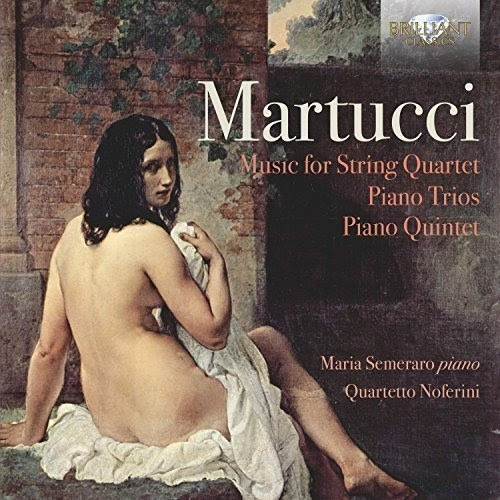
Giuseppe Marticcui is credited with being the first Italian composer of the late 19th century to eschew opera for instrumental music, paving the way for Busoni, and Respighi.
This collection of chamber music gathers together prime examples of Martucci's craft and makes for an engaging listening experience.
While Martucci didn't write opera, he had an Italianate gift for lyrical melody. The themes for these works are beautifully turned, letting the instruments sing.
He was also a child prodigy at the piano -- the piano parts for these works aren't showy, but they're quite substantial. Pianist Maria Semeraro rises to the occasion. Her expressive playing revels in the sound of her instrument while keeping it part of the conversation with her fellow performers.
Included in this collection are Martucci's two piano trios and his piano quintet. They reminded me a little of Schubert's music in the way that they just seem to flow from idea to idea. Martucci's music is more formally structured, though, making it easier to follow the development of his material.
The performers are closely mic'ed, with only a hint of room ambiance. That actually serves the music well, making it easier to hear the subtle interplay between the instruments. If you enjoy late-romantic chamber music, you should appreciate Martucci's efforts. After listening to this recording, I certainly do.
Giuseppe Martucci: Piano Trios, Piano Quintet
Maria Semeraro, piano; Quartetto Noferini
Brilliant Classics 94968
Views and reviews of over-looked and under-appreciated culture and creativity
Wednesday, May 10, 2017
Tuesday, May 09, 2017
Dick Tracy's Spirit - Part 1
Dick Tracy recently concluded a storyline involving the Spirit (Dec. 2016 through Mar. 2017). It's significant for a number of reasons. First, the creative team of Mike Curtis and Joe Staton bring the Spirit's world into the ever-expanding Tracyverse.
Second, it was well-done from start to finish, remaining true to Will Eisner's iconic character. And third, it was the type of story that would have worked for either detective individually.
In addition to a 7-8 page Spirit story, the insert included 4-page stories from supporting characters from the Eisner shop, such as Mr. Mystic and Lady Luck.
The stories could be anything from a simple crime adventure to a love story, to social satire.
After the Spirit was discontinued in 1952, the comic lived on. The original comic inserts were collected and studied. Several series of reprints were also collected and studied.
As a result, Eisner's work influenced several generations of comic strip and comic book artists. He so defined the field that in 1988 the Will Eisner Comic Industry Award was created.
For the industry, the Eisner is equivalent to the Oscar. Awards are given each year for categories such as Best Writer, Best Artist/Penciller/Inker, Best New Series, Best Continuing Series, Best Letterer/Lettering, Best Limited Series or Story Arc, and more.
That's how much Eisner's artistry (and his creation) are regarded.
So how do you incorporate a character with so much history into a current comic strip? We'll look at what Curtis and Staton brought from the canon into Dick Tracy next week.
Second, it was well-done from start to finish, remaining true to Will Eisner's iconic character. And third, it was the type of story that would have worked for either detective individually.
So who was the Spirit?
For those who came in late, the Spirit was a masked detective created in 1940 by Will Eisner. The character was part of a 16-page newsprint insert distributed to the Register and Tribune Syndicate newspapers for their Sunday comics.In addition to a 7-8 page Spirit story, the insert included 4-page stories from supporting characters from the Eisner shop, such as Mr. Mystic and Lady Luck.
| And so it begins. |
So who cares?
Quite a lot of people. Eisner used the Spirit to stretch the boundaries of sequential art. The splash page featured the title treated differently each week.![]() |
| The first page of three different Spirit stories. Each week the title was treated differently. |
The stories could be anything from a simple crime adventure to a love story, to social satire.
After the Spirit was discontinued in 1952, the comic lived on. The original comic inserts were collected and studied. Several series of reprints were also collected and studied.
As a result, Eisner's work influenced several generations of comic strip and comic book artists. He so defined the field that in 1988 the Will Eisner Comic Industry Award was created.
For the industry, the Eisner is equivalent to the Oscar. Awards are given each year for categories such as Best Writer, Best Artist/Penciller/Inker, Best New Series, Best Continuing Series, Best Letterer/Lettering, Best Limited Series or Story Arc, and more.
That's how much Eisner's artistry (and his creation) are regarded.
So how do you incorporate a character with so much history into a current comic strip? We'll look at what Curtis and Staton brought from the canon into Dick Tracy next week.
Monday, May 08, 2017
Diabelli Project 151 - Piano Piece
The Diabelli Project is about offering my weekly flash-composition sketches freely to all. Like Antonio Diabelli's theme, these sketches aren't great music. But perhaps (as in Diabelli's case) there's a Beethoven out there who can do great things with them.
This week's sketch is something fairly simple. I started with a descending figure in the right hand and an ascending one in the left. It didn't take long for things to go off track. I seemed to have kept the notion of contrary motion going throughout the sketch, though.
As always, you can use any or all of the posted Diabelli Project sketches as you wish for free. Just be sure to share the results. I'm always curious to see what direction someone else can take this material.
This week's sketch is something fairly simple. I started with a descending figure in the right hand and an ascending one in the left. It didn't take long for things to go off track. I seemed to have kept the notion of contrary motion going throughout the sketch, though.
As always, you can use any or all of the posted Diabelli Project sketches as you wish for free. Just be sure to share the results. I'm always curious to see what direction someone else can take this material.
Friday, May 05, 2017
Line Mar Match Box Construction 049
Line Mar Match Box Construction 002
I found a Line Mar Match Box Construction Set from the 1930s, complete and with instructions. The box claimed the set made 100 different toys. I decided to test that claim -- one toy at a time. You can read all the posts for the Line Mar construction project at 100 Toys.
049. Sink
The sink was a pretty simple build. The most difficult part was making sure the legs were as straight as they could be. Fiberboard collars pressed together from both sides of the metal basin helped secure them (at least long enough for me to take the photo).
There was one compromise I had to make. The illustration shows the side pieces for the faucets having five holes each. Those, plus the horizontal five-hole strip makes three needed for this toy equals one more strip than came with the set. I needed the length in the horizontal strip, so the side pieces are three-hole braces, rather than five.
If you look very carefully at the drawing, it appears as though there are supposed to be some braces under the sink. But that would have required two additional strips that I didn't have. And of course, the dowels representing the faucets are drawn at about half their actual length.
This is one of those times when the artistic vision differed greatly from the reality of the build.
Thursday, May 04, 2017
Lessons from York: What We Saw (Part 1) - Operators Welcome
![]() |
| Sure, it's great as a display piece -- but this 1925 American Flyer set probably doesn't have that many spins around the layout left in it. |
It can also hint at the current state of collecting in general. As is our tradition, we spent a lot of time discussing what we saw a lot of (and what we didn't) -- and more importantly, the reasons behind them.
Changes in the wind
Both are reconnecting with the toys of their youth (the essence of any type of toy collecting, I think). But there's a big difference. The toys of the first and second generation TCA member's youth date from the 1920s and 1930s -- and are too fragile to be run regularly without restoration work. But for the early collectors, that was fine. The toy was a trophy, not a, well, toy to be played with.
For current enthusiasts, the goal is not necessarily to get that toy train Santa never brought but to build that dream layout they never got around to. There are several professional layout building companies ready to serve this market. Classic Toy Trains, one of the premier magazines of the hobbies, features two or three operating layouts every issue and offers tips for DIY modelers.
The toy trains of these collectors date from the 1950s and 1960s and still run fairly well. But not as well as the current crop of locomotives. Digital electronic sounds and wireless commands are now standard equipment on Lionel trains. For the modern operator/collector, the reliability of the new products has resulted (I believe) in a declining interest in older trains.
Out with the Old?
As you can see from the above video, the public areas of the show were all about operating trains. In addition to layouts operated by Lionel, Mike's Train House, and Atlas displaying their latest offerings, there were smaller demo layouts for various accessories and products. There were also three large modular layouts for visitors to enjoy.
Subscribe to:
Posts (Atom)


