Showing posts with label American Flyer. Show all posts

Tuesday, April 24, 2018

Lessons from York - We See Change

Dad and I recently returned from our semi-annual trip to the Train Collectors Association (TCA) Eastern Division toy train meet in York, PA. This is the largest such show in the United States and provides an interesting snapshot of the state of the hobby.

It can also hint at the current state of collecting in general. As is our tradition, we spent a lot of time discussing what we saw a lot of (and what we didn't) -- and more importantly, the reasons behind them


From collector to operator


In Part 1 I shared some examples of a hobby in flux. The first three generations of toy train collectors are selling more than their buying. There is a fourth generation, though. But this middle-aged group is made up of operators rather than collectors.

Yes, they're interested in the larger gauge trains that were the mainstay of Lionel and American Flyer.  But they prefer to run trains on a layout rather than display them on shelves.

Trains made by Lionel, MTH, Atlas, Bachmann, and others for today's market are much more reliable that fragile and finicky vintage equipment that's a half-century old.

And that change was readily apparent at the meet.

Code Orange

The York meet had six dealer halls, designated by color. Four were for members who sell vintage toys (that being a loose definition). Two -- the Orange and Purple Halls -- were reserved for manufacturers of new products.

In these two halls were the latest offerings from Lionel, MTH, et al. There were also plenty of offerings from smaller companies that specialize in operating layout accessories; scenery, benchwork, electronics; structures, etc.

 The Lionel booth in the Orange Hall. It didn't look like this in
the members-only halls.


The Orange and Purple Halls were packed (at least while we were there). TCA allowed the general public into these two halls during the weekend. They did so at the last meet, and it was successful enough to continue this time as well.

Let's make a deal!

By contrast, the members-only halls weren't nearly as busy. These halls had the train items of interest primarily to the first three generations of collectors. There were many empty tables in these halls.

In the past, I had run across vendors who were anxious to close the deal. If I stopped to look at something, the table holder would appear at my side. He'd extoll the virtues of the object, and give me every reason why I should buy it right that minute!

And if I still resisted, he'd sometimes hint that the price was negotiable.

This time, it seemed that more of the vendors were like That Guy. Plus, I saw several signs at tables: "Prices negotiable" "Make me an offer" and so on.

I ran across a table with a pile of MPC Lionel boxes -- $10 each. Normally these would be in the $20-30 range, but not that day. The other half of the table was marked 50% off.

My two York purchases. I was really only interested in the red
Southern box car from Lionel MPC. But for $10 each, I couldn't resist.

To me, this suggests that the vendors also know the market is changing. And they want to get rid of their stock while there's still a window of opportunity to sell it. Because once the third generation stops buying, demand will plummet.

The October, 2018 meet should show if my impressions were correct.

One more thing


For the first time ever, I didn't see a Lionel Lifesavers Tank Car. Not one. It's been one of the few items I could count on spotting every meet. Have they all finally found homes?


Monday, April 23, 2018

Lessons from York - A Sea Change?

At one time, this volume was worth
over $100 - if you could find it. Now
it's readily available for $10.
Dad and I recently returned from our semi-annual trip to the Train Collectors Association (TCA) Eastern Division toy train meet in York, PA. This is the largest such show in the United States and provides an interesting snapshot of the state of the hobby.

It can also hint at the current state of collecting in general. As is our tradition, we spent a lot of time discussing what we saw a lot of (and what we didn't) -- and more importantly, the reasons behind them.

What we saw

Most of what we saw at the April 2018 meet seemed to suggest that the market for vintage toy trains was still shrinking. If anything, the decline of the hobby (at least in its current form) seems to have accelerated.

One big library sale

Throughout the years a number of hobby-related reference books have been published. Because of their highly specialized subject matter, these books tended to have very short print runs. The better ones seldom came on the market. These were books collectors would use -- and use often.

Out of print for years, and now back on the market.
This meet we saw several tables with piles of reference books. These weren't factory remainders. Each table usually had just one copy of a particular title. They just had a lot of titles.

Why? Reference works are one of the last things to leave a collection. Even after the objects have been sold, you can still enjoy looking at their color photos in books.

I think these books are the final liquidation of collections. The subjects of most of these books were for trains made between 1900 and the Second World War. This was the focus of the first and second generation of collectors, those who grew up in the 1920s and 1930s.


The past few years I've seen evidence of these collectors downsizing. I believe this flood of books represents estate sales.

Lionel and American Flyer HO

In the 1950s, HO scale was hot. And both Lionel (O-gauge) and American Flyer (S-gauge) started to lose market share. Both companies tried to enter the HO market, and both were unsuccessful.

This did not end well. 
This did not end well, either.
Which made their HO trains somewhat rare, but not especially desirable. Except for a certain type of collector.

Most collectors have very specific interests, but there are some who want it all. For a hard-core Lionel post-war collector, that means not just having every O-gauge train set the company produced from 1948-1970.

It means owning every rail car, every accessory, and every esoteric item Lionel produced, like their chemistry sets, science kits -- and HO scale trains.

The current active generation of collectors grew up in the 1950s. These are the people who would acquire Lionel and American Flyer HO trains to fill out their collections.

But this is also the generation that's just entering retirement. And that means downsizing. The easiest way to begin downsizing a collection is to get rid of the outliers. And if you're a Lionel O-gauge or American Flyer S-gauge postwar collector, these companies' HO trains are just that.

A changing hobby

So if the last remnants of the old collectors is now hitting the market, and the current generation is starting to downsize, is this the end? I don't think so. I think, rather, these are signs of change -- as I'll explain in Part 2.

Tuesday, October 24, 2017

Lessons from York: What We Saw - Clearing out the clutter

Dad and I recently returned from our semi-annual trip to the Train Collectors Association (TCA) Eastern Division toy train meet in York, PA. This is the largest such show in the United States and provides an interesting snapshot of the state of the hobby.

It can also hint at the current state of collecting in general. As is our tradition, we spent a lot of time discussing what we saw a lot of (and what we didn't) -- and more importantly, the reasons behind them.

There were three things that we saw in abundance this time, and I think they were there due to an aging market and shifting tastes.

Victims of the Aging Market

Toy collecting is a nostalgic endeavor, and most collectors focus on the objects of their youth. For the founding members of the TCA, that golden age would be the early 1920s. For the second generation to join, it was the late 1930s-early 1940s. For the third generation (of which I'm a part), it's postwar. 

And then there's a break. Because the third generation -- late Baby Boomers -- are really the last to grow up with toy trains. When the organization was founded, early trains commanded top dollar. That remained so during the second generation but started to decline by the third. And the slide continues.


1. Blue Comet and State Sets

Right before the Great Depression Lionel's top of the line train sets were indeed non plus ultra. The State set (each passenger car bore the name of a state) was a massive standard gauge (bigger than 0-gauge) train. Next in desirability was the Blue Comet.

These sets were made of high-quality metal, with detailed interiors, hinged doors and illumination. But in the early 1930s few families could afford such luxuries, and not many were sold.

An original 1930s Lionel standard gauge Blue Comet. Looks nice on a shelf.
For many, these sets remain the pinnacle of collecting. Even those who weren't especially interested in prewar trains would have a Blue Comet or a State Set if their pockets were deep enough.

At this show we saw an unusually high number of these vintage sets for sale. And while there weren't any real bargains, prices were $500-$1000 below average.

Why? The hobby is shifting from collectors who put trains on shelves to collectors who run trains on layouts. Reproduction Blue Comets and State Sets have hit the market. They cost a little less than the originals, run more reliably, and have modern operating features (like remote control).

The MTH 2014 reproduction. More features (like smoke and sound), and even more cars!

I think the vintage set we saw were the result of down-sizing and estate liquidations.

2. Postwar American Flyer

We noticed the abundance of American Flyer trains at the last show. This time there were even more tables offering postwar American Flyer trains. This Lionel competitor went out of business in 1967.

Original locomotives and rolling stock were scarce. But then in the early 1990s both Lionel and a new company S-Helper began offering new equipment. For the collector/operator, there was no longer a need for the vintage 1950s stuff.

This show I think we saw an acceleration of the change from collector to operator. There's less of a market for vintage Flyer, and plenty of demand for the new.

Transformers!

Last show we saw a lot of vintage ZW transformers. This time, we saw even more for sale.
For layout operators, the Lionel ZW transformer was the Holy Grail. It was the most powerful of Lionel's transformers, rated at 275 watts. It had independent controls for two trains, plus terminals to power accessories and lights.

That ZW (right) may have been powerful, but if you're one from the
late 1940s-early 1950s, it can get real hot real fast.

Lionel offered the ZW from 1948 to 1966. The first generation of collector/operators created a huge demand for refurbished ZWs. But as locomotives acquired on-board electronics, these became less satisfactory.

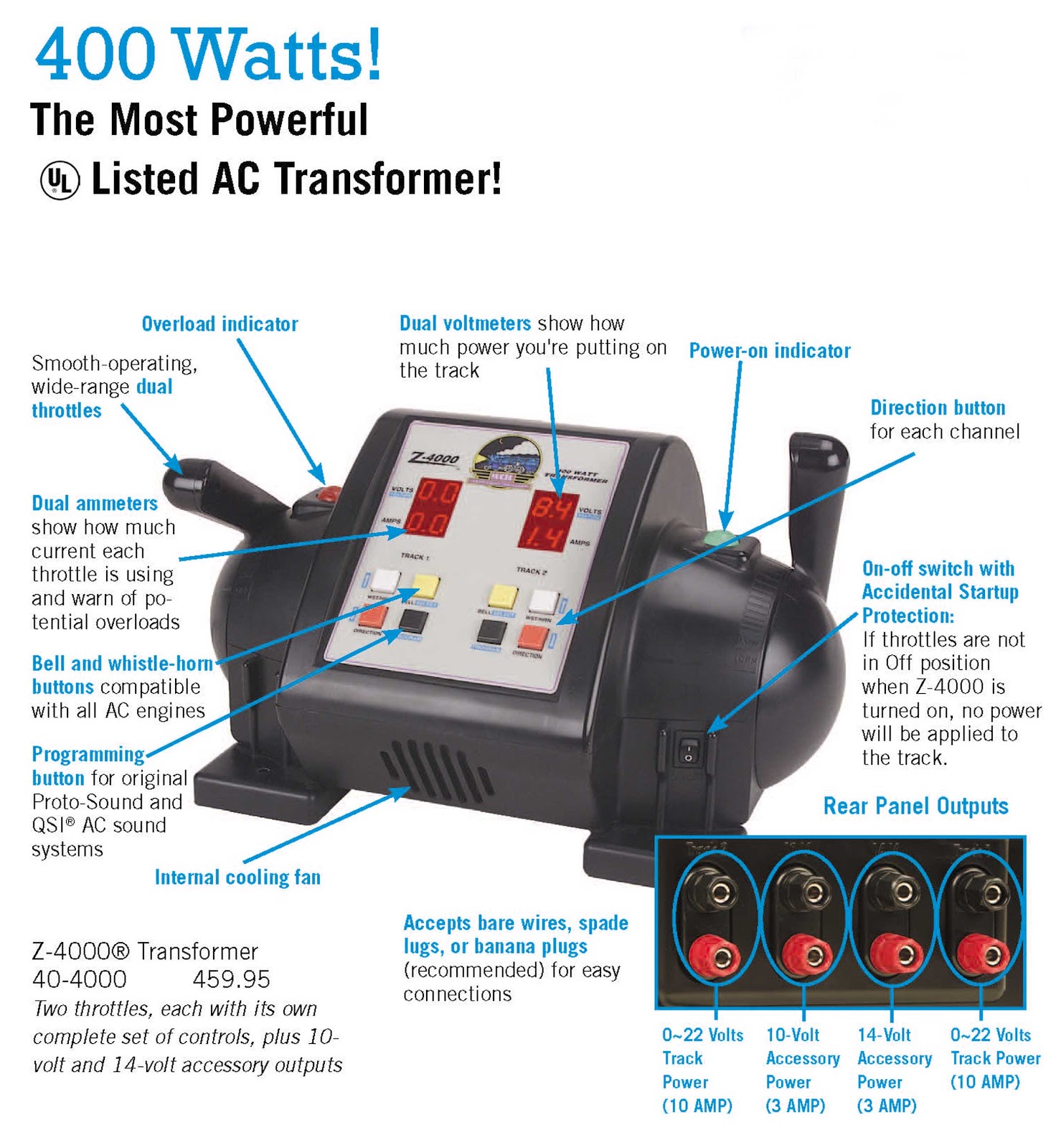
The Z4000 has more features, plus it's UL-rated.
In the late 1990s MTH offered their own line of transformers for modern 0-gauge locomotives. Their top-of-the-line Z-4000 transformer delivers 400 watts of power, has an internal cooling fan and is UL-rated. If your an operator, it just makes sense to replace that vintage ZW with something that's not only more powerful, but less likely to burn your house down.

What we didn't see

What we didn't see at York supports the theory that toy train operators are now driving the marketplace. What we didn't see are the very things most operators would want on their layouts:

1) Operating accessories, both pre- and postwar (such as coal loaders, beacon lights, etc.). They're right at home on the modern collector/operators' layouts.

2) Post 1990 locomotives and rolling stock from Lionel, Atlas, MTH, and Bachman. If you're running it, you're not going to sell it.

3) Modern reproductions from Weaver, Williams, MTH, and others. Those are the products that are pushing the vintage originals off the shelves and into the market place.

Thursday, May 25, 2017

Lessons from York: What We Saw (Part 4) - American Flyer flown

Pre-war standard gauge AF trains.
We saw about the same amount we
normally do at this show.
Dad and I recently returned from our semi-annual trip to the Train Collectors Association (TCA) Eastern Division toy train meet in York, PA. This is the largest such show in the United States and provides an interesting snapshot of the state of the hobby.

It can also hint at the current state of collecting in general. As is our tradition, we spent a lot of time discussing what we saw a lot of (and what we didn't) -- and more importantly, the reasons behind them.

In Part 1 I outlined the reasons for what I see as a major shift in the hobby. Basically, younger collectors seem more interested in operating their trains rather than simply displaying them. And that, I think, explains what we say this time at York -- the results of upgrading.

And it wasn't just limited to Lionel. We saw a lot of postwar American Flyer sets, locomotives, and rolling stock.


A little background

American Flyer trains, like those of Lionel, have a long history. The company started out in 1907 as a low-cost alternative to the higher-priced (and higher-quality) German imported toy trains. In the 1920s and 1930s, it competed directly with Lionel, offering trains in the same track gauge. A.C. Gilbert (or Erector Set fame) bought the company in 1937.

In 1937 A.C. Gilbert bought American Flyer. It seemed
to be a good match.
Toy train production ceased during World War II, and when it resumed, American Flyer had changed. Lionel continued to use O-gauge track, with a middle rail for the motor's electric pickup. American Flyer went with S-gauge track and used the same two-rail electrical system as the new H0 trains.

Flyer was never as successful as Lionel and went out of business in 1967. Children who received American Flyer trains in the 1950s grew up to be American Flyer collectors in the 1970s. It was a smaller group than Lionel collectors, but no less enthusiastic.


Limited resources

Unlike Lionel trains, which were in continual production even after the original company was bought out, American Flyer trains were not reintroduced into the market until the 1990s.

American Flyer, 1955. We saw plenty of these pieces, both in sets and for
individual sale.
So if you wanted to have an operating S-gauge layout, you were pretty much confined to vintage Flyer equipment


S-Helper Service helps

S-Helper Service and American Models jump-started the S-gauge operator's market in the early 1990s. These independent companies produced their own lines of rolling stock -- and eventually locomotives -- for S-gauge operators. S-Helper Service was purchased in 2013 by MTH, one of the largest toy train manufacturers in the US. American Models is still in business.

An example of MTH's S-gauge offerings. There's a greater variety
of road names and more realistic detail in these cars, compared
to vintage American Flyer rolling stock.
In the meantime, Lionel had purchased the assets to the old American Flyer line of products and started reissuing old trains. And they also began offering new products.

A sampling of Lionel's American Flyer-branded S-gauge trains. Like MTH,
Lionel offers models and road names never made by Gilbert

So what does that mean?

New products mean modern materials. New S-gauge cars roll more easily than older AF. The electronics in the locomotives offer remote control and more reliable operation. And there's a greater variety of road names and locomotive types, which lets the operator model the rail lines he wants, not just the few Flyer offered.


What did we see?

A LOT of American Flyer trains. But not from the prewar era. No, most of the American Flyer we saw was post-war. Train sets from the 1950s and 1960s, as well as individual locomotives, freight cars, and passenger cars. We didn't see a lot of postwar accessories, though.

Conclusion? As with their O-gauge brethren, S-gauge operators are trading in their aging Flyer pieces for newer, better-running equipment.

So what didn't we see? 

Across the board, anything that would be useful for modern toy train operators was in short supply. We didn't see operating accessories, buildings, crossing gates, billboard signs, etc.

The hobby has indeed changed.


Thursday, October 27, 2016

Lessons from York: What We Didn't See: Variety

Dream on, kid. There was no Dorfan
to be found at this show.
Dad and I recently returned from our semi-annual trip to the Train Collectors Association (TCA) Eastern Division toy train meet in York, PA. This is the largest such show in the United States and provides an interesting snapshot of the state of the hobby. 

It can also hint at the current state of collecting in general. As is our tradition, we spent a lot of time discussing what we saw a lot of (and what we didn't) -- and more importantly, the reasons behind them.

An amazing compendium

This particular event has a decades-long history, enjoying continual growth (some years dramatically) up through the early 2000s. When I first started attending, it was a veritable bazaar of all things toy trains. All the major manufacturers have represented -- Lionel, American Flyer, and Marx -- as well as the second tier toy companies that had fallen by the wayside, such as Ives, Dorfan, and Kusan. You could also find toy trains from all eras, from the 1910s up through the present.

Naturally, the very rare and/or very expensive items were not on as many tables as the more commonplace toy trains. But if you went through the entire show, you could pretty much see first-hand an example of pretty much every line offered by every company.

Lionel's top-of-the-line trains and accessories from 1928. Most were
MIA for this show.

A substantial imbalance

The mix was always slightly different, which is what this series has been about -- trying to determine the reasons behind the ebb and flow of an item's availability. This show had its standout items, but as I explained in yesterday's post (What We Saw) there was a serious imbalance. Rather than there being a wide variety of eras and brands with a few things seemingly more plentiful, this time there were eras and brands that were ubiquitous, and some that weren't there at all.

Big, beautiful Lionel postwar 0-gauge sets. Those F3s were
everywhere a few years ago --almost non-existent at this show. 

Where's the good stuff?

I think the same theory explains what we saw and what we didn't. The graying of the toy train collector population means more estate liquidations and more downsizing. Most collections that are part of estates are handled by auction houses. And that makes sense. Heirs with no knowledge or interest in toy trains can simply let the auction house collect it all and liquidate it. If the heirs do their homework, they'll place the items with a house specializing in vintage toys. And notices from those houses I see with increasing frequency, announcing the sale of another "legendary" collection.

Those super-collections don't show up at the dealer tables at York. But what does show up are the results of gradual downsizing -- particularly for said dealers. When anyone downsizes, they discard the least valuable and desirable, and just keep a few valuable items.

At York, we didn't see many valuable items. No top-of-the-line standard gauge sets, desirable both for the quality of their craftsmanship and their rarity; no "girl's train," Lionel's Edsel; very few postwar Lionel GG1s, Santa Fe streamliners, Trainmasters, and other extremely popular trains and accessories; nothing above mid-level products. And usually, the more desirable a piece was in the overall hierarchy, the worse it's condition.

Lionel's Girl's Train (top) was a really bad idea that didn't sell well.
Its rarity and kitsch appeal makes it valuable today -- but a no-show at this show.

Conclusion

Most of what we saw were trains in the low to mid-range of collectability -- the very part of a collection that's easiest to let go. And the more collectible pieces we saw were in average or below average condition. If you've upgraded, then you'd want to get rid of those pieces. My personal theory is that if you have extremely limited display room, you're not going to waste it on scratched or rusty toys. So even if they're of higher collectability, if you don't have the shelf space, they've got to go.

Wednesday, October 26, 2016

Lessons from York: What We Saw: Low-end unloading

Dad and I recently returned from our semi-annual trip to the Train Collectors Association (TCA) Eastern Division toy train meet in York, PA. This is the largest such show in the United States and provides an interesting snapshot of the state of the hobby. 

It can also hint at the current state of collecting in general. As is our tradition, we spent a lot of time discussing what we saw a lot of (and what we didn't) -- and more importantly, the reasons behind them.

A question of imbalance

In the past, this series has talked about what we saw a lot of and what we saw almost none of -- but it was set against the context that of a wide variety of choices. So even if everyone had Madison cars (as they did in 2011), or Lionel diesels from the 1950s (2015), if you looked long enough, you could find an early 1900s Ives piece or a 1950s Kusan train. Big-ticket items such as a 1929 Lionel State Set wouldn't be on every table, but there would two or three (or a few more) scattered throughout the halls.

This time, though, the variety was missing. We saw a lot of two things, and only a smattering of anything else.

Price matters

With rare exceptions, for toy trains desirability pretty much follows original pricing. Top of the line train sets tends to remain the most desirable and command the highest prices. Mid-priced trains tend to be common in collections -- they were made in greater quantities than the high-end trains, and remain more affordable and therefore easy to acquire.

Low-end trains usually sold the best, and so were made in the largest quantities. Their lower quality, though, meant that they don't hold up as well as mid-level trains. Top tier sets, because of their expense, were usually handled very carefully (many only run under the Christmas tree once yearly). If you wanted to play train wreck, it was the low-price trains you did it with.

We saw a lot of these Lionel ten series standard gauge freight cars.
None were in as good a condition as these -- and priced accordingly.

So many low-end trains didn't survive. Those that did usually have condition issues. That makes mint examples of these entry-level trains somewhat desirable. But they're still low-end trains with a limited appeal so that extra value isn't very high.

Low-end Prewar

There were a lot of prewar (before WWII) trains available. We saw O-gauge trains and the larger-scale standard gauge trains from the major toy companies. And they all had one thing in common -- they were all from the lower end of the collecting scale. We saw the bottom-of-the-line sets from Lionel and American Flyer, as well as some others. There were lots of locomotives and rolling stock, but not a lot of accessories (such as stations, signal posts, and lights).

Lionel Junior was created to compete with Marx (see below) at the same
price point. We saw a lot of this at the show.


It was the type of items I'd choose to get rid of if I was downsizing a prewar toy train collection. Remember, most toy collecting is nostalgic -- we want the toys of our youth. Collectors who were youths in the 1930s are in their 80s. If you can only keep some of your collection, you'll want to hold on the best of the best. And what we saw at York was the rest.

All very reasonably priced, and most of it in fair to good condition. Even low-end trains have their fans -- but they're probably holding on the near-mint examples. If you wanted to start a prewar collection, this would have been the show for you -- most every table had some entry-level items.

When Santa couldn't afford Lionel, he went with Marx.
Postwar Marx

Louis Marx and Co. were always the low-price alternatives in the toy train field. They mimicked the offerings of Lionel and American Flyer with the product sold at a fraction of the price. Marx trains have a certain appeal -- they're elaborately lithographed with bright, bold colors and plenty of detail. They're fun toy trains, but they're still cheaply made, and still run third in popularity behind Lionel and American Flyer. You dreamed of Lionel -- but often Marx was what you got instead.

This show we saw a lot of Marx postwar trains. And I think it was also a symptom of downsizing and liquidation. None of it is very valuable, and all of it takes up space. Even if you were a dedicated Marx collector, these were the items you could live without. We saw table after table of the most commonplace engines and freight cars.

Again, if you were just starting out collecting Marx, this would have been a great show. But I wonder. It seems to me that prewar toy trains and postwar Marx are areas of the hobby more people are transitioning out of rather than into. And that makes me wonder how many of the things we saw this year were packed up and taken back home unsold.

Tomorrow: What we didn't see