Showing posts with label Sakai. Show all posts

Wednesday, May 25, 2016

Seeking Sakai, Part 2

In part 1 I shared the details about an early H0-scale tinplate set I found. It was manufactured by Sakai, a company that was founded in Japan around 1947.

Recently I found out quite a lot about this set from a variety of sources.

Turns out this is Sakai also.
There was a Japanese company called Seki that operated before the war. They competed primarily with Marx in the US, offering some interesting variants on Marx and low-end Lionel and American Flyer 0-gauge sets.

Seki and Sakai are sometimes confused, but they were different companies. Seki ceased operation during the Second World War. Sakai Seisakusho Ltd. began operation after the war, offering different products.

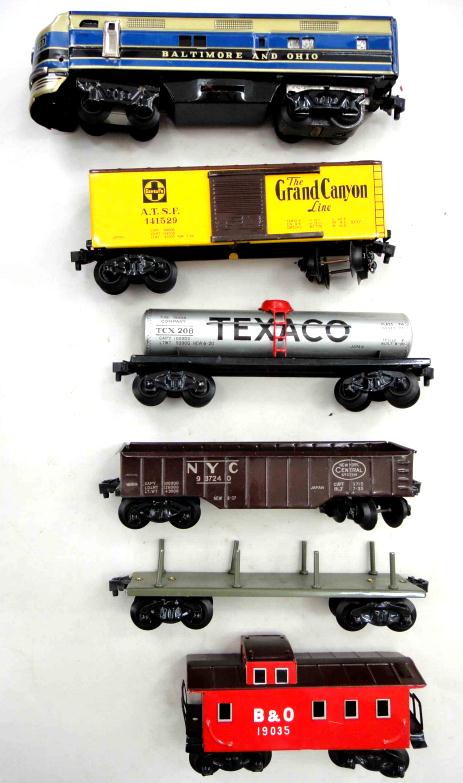
From a Seki/Sakai online group, I learned that Sakai manufactured the mystery train set (at right) I've talked about before on this blog. They also made an 0-gauge tinplate train set sporting "Hudson & Pacific" livery that's quite desirable.

I've seen boxed examples on eBay of their H0-gauge switches and tracks. They survived into the 1960s, offering plastic H0 rolling stock and at least one locomotive.

And eventually, I found what I was looking for -- an example of my set in its original box. The set was made by Sakai for Macys Department stores and offered under their Stalwart house brand. Although the example I found only had the train, I'm sure it came originally came complete with track and transformer.


No question. It's a match. Too bad this example's missing the track and transformer.


The headline reads "Macys Own Stalwart H0 Electric Train Set"
But when was this set offered? There's no copyright notice on the box to indicate the year, and I don't have access to an archive of Macys catalogs. But I did find a newspaper ad from 1953, featuring the set. So there it is. This set was made by Sakai for Macys, imported and sold in 1953 for $9.98.

Don't be fooled by the price. In today's dollars, that set would sell for $89.61. This was a premium set offered for a premium price. And well worth it, I think. The quality of the materials and details of construction are in keeping with what one would expect from Macys. Nomura, Straco, and Bandai battery-operated toy train sets may have been good enough for Woolworth's and Western Auto, but not for Macys.

Tuesday, May 24, 2016

Seeking Sakai - Part 1

I'm always on the lookout for vintage Japanese tin H0-gauge trains for my Straco display layout. There's not a lot of collected information about any of the manufacturers involved in early postwar production, so I've been slowly discovering what was available and from whom one piece at a time.

They looked like a good fit for the Straco display layout. However...

A set of rolling stock came up for auction on eBay. Having only the photos to go by, I determined they would be a good fit. I won the auction for a price I was comfortable with, and everything was fine -- until the pieces arrived.

It was then I discovered that these cars were of a much higher quality than the ones I had been collecting. Not only was the quality higher, but they weighed far more than the Nomura, Bandai, or Straco pieces I had.

Below are side-by-side comparisons:

Top to bottom: Straco, Nomura, Haji (Nomura), Sakai

Top to bottom: Straco, Nomura, Bandai, Sakai

Top to bottom: Straco, Bandai, Sakai

Top to bottom: Bandai, Sakai

Top to bottom: Straco, Bandai, Nomura, Sakai

In time, I discovered that the pieces were made by Sakai, a post-war Japanese company that specialized in H0-gauge track and accessories (such as switches). They also manufactured O-gauge trains that competed with high-end Marx and low-end Lionel in the American market..

And eventually, I found a locomotive for my set. And it's a monster, as it needs to be to haul those cars. On average, the rolling stock for all the examples I owned -- Nomura, Bandai, Straco, and Haji -- weighed about 2.5 oz. The Sakai rolling stock was closer to 5 oz. per car. The Nomura and Bandai diesels each weighed 7 oz.; the Straco diesel weighed 5 oz. By contrast, the Sakai locomotive weight 20 oz. -- 1.4 lbs.

The Sakai locomotive shell is diecast metal. And it's heavy.
The shell of the Sakai diesel is diecast metal, which accounts for most of the weight. But that weight was necessary. As you can see from the chart below, it had more weight to pull. The Nomura diesel can only pull its two cars weighing a total of 6 oz. I've tried adding a third 3 oz. boxcar -- the engine's wheels just spin. By contrast, the Sakai diesel is designed to pull 4 cars weighing a total of 17 oz..

The Sakai chassis. Those wheel frames are diecast metal, and the
motor is also pretty substantial. Both give the locomotive a lot of traction.
The lithographed metal construction makes the set seem more toy-like. But this train was designed for true H0-scale track, rather than the taller tinplate track of the toy train sets. Note the scale-proportioned flanges of the wheels of the Sakai rolling stock as compared to those of the Nomura set.

Note the difference between the wheels of the Sakai boxcar (l) and the
Nomura car (r). The Sakai train was designed for standard
H0-gauge track, as opposed to the bigger tinplate track of the
Nomura/Bandai sets.
The diesel I found was in rough shape, but the price was right. And it works as a display piece placeholder until I can upgrade.

The train is complete, for now.

My next project is to see if I can get the engine to work again.

And this past week I discovered a bit more about this unique set which I'll share in Part 2.

Tuesday, May 28, 2013

Collecting -- and collecting information 10

The Mystery Train (complete)
 When collecting information, whether on- or off-line, it's important to know the source.

I've been trying to compile information about Japanese tin toy trains of the 1950's and 1960's through some online detective work. There are no published reference books about this subject, and very few online sources, either. And since accumulating the actual toys to examine is cost-prohibitive, I'm using online photos (mostly from ebay) to determine the origins and makeup of these sets.

In Collecting -- and collecting information 9 I wrote about my attempt to identify a mystery train that had no markings whatsoever. And it was one of the few times I have been able to do so with the actual item in front of me. I had carefully looked at every photo of the train components and the set box from various online sources, and I couldn't find a brand. Handling the items allowed me to look at the set from every angle -- and I found no markings. The origin of the set remains a mystery.

So I was very interested to see the ebay listing below. (click on image to enlarge)
Nomura certainly made these types of trains, although of substantially different design. So how did the seller know this was Nomura set? Had I not examined the set myself, I might have accepted the Nomura attribution, perhaps with a question mark.

 The instruction sheet has no information about
who made this or when.
But I know better. Without any marks on the set, and no supporting documentation, I'm thinking this is just a mislabeled item.  It happens with some frequency on ebay. That's why the only information I'm interested in is the printing on the box.

It's important to know the source -- and which parts of the source are reliable.

Tuesday, May 07, 2013

Collecting -- and collecting information 9

A beautiful box. But how can you be sure it contains
everything its supposed to?

There are two curious -- and archaic -- rules for the Train Collectors Association Eastern Division toy train meet in York, PA: no photography in the buildings, and no cell phone use in the buildings. So as you wander through the eight buildings of vendors and products, you have to rely on your memory of what you've seen, and whatever knowledge you've already learned to make your buying decision.

On one of the tables I saw a beautiful Japanese tin toy train set. It was made in the 1950's and the box was almost completely intact. The contents contained a full oval of tinplate track, and a brightly lithographed tinplate train. The engine, which took a "D" cell battery, worked, and had a light that also worked. There was a Santa Fe box car, and a caboose. And it was only $75.

Was it a bargain? I couldn't go online and look it up -- even if the rule hadn't been in effect, I had tried to research this particular type of train before. It had taken several carefully constructed searches to find out what little I did know. It would not have been possible to do the research necessary in the limited amount of time I had.

The set was a curious one. There was no indication as to manufacturer. I had run across similar sets online -- and no two alike. So far, I had found the following configurations of this toy train.

Here's a set with the full
complement of rolling stock.
1) A B&O diesel with two B&O passenger cars
2) A B&O diesel with a Santa Fe box car, NYC gondola car, and B&O caboose
3) A B&O diesel with a Santa Fe box car, a Texaco tank car, and a B&O caboose (and an up-and-over figure 8 track)
4) A B&O diesel with a Santa Fe box car, a Texaco tank car, a NYC gondola car, a flat car, and a B&O caboose
5) Two B&O diesels with a Santa Fe box car, a Texaco tank car, a  flat car, and a B&O caboose

This set fit between Nos. 1 and 2 in terms of content: B&O diesel with a Santa Fe box car and a B&O caboose. Did it come that way, or was it a No. 2 with a missing car?

I wasn't sure. And since the box was missing its dividers, I couldn't tell if everything was there or not. But I did know this: Set No. 3 is currently on ebay with a starting price of $20. Set No. 5 sold for $134. So one way to look at it was that $75 was in the ballpark.

What I like: a box with its dividers.
Easy to tell if something's missing.
If I knew nothing about this line of mystery trains, I might have purchased it. That nagging thought that perhaps it wasn't complete bothered me, though. Enough to make me decide to pass on the set.

What I don't like: a box without dividers. Hard
to tell if everything's there.
Having knowledge at your fingertips is convenient, but internalizing it is even better. Especially when there's no time to go online.