Showing posts with label Tracyverse. Show all posts

Tuesday, April 17, 2018

Dick Tracy, the Green Hornet, and a Masked Hero

Dick Tracy's creative team, Joe Staton and Mike Curtis, continue to add characters to the what I call the ever-expanding Tracyverse. In a storyline started in April 2018, they not only added a current hero, but also a famous one from the past.

In the sequence below, publisher of the Daily Sentinal, Britt Reid, comes to Tracy's city in pursuit of two criminals -- the Topper, and the Green Hornet.


In reality, Britt Reid is the Green Hornet. The Hornet fights criminals while posing as an outlaw. Reid is assisted by his Asian manservant, Kato. The Green Hornet uses a gas gun to disable, rather than kill his foes.

Reid's secretary Lenore (Casey) Case shares the secret of the Hornet's identity. In the Dick Tracy sequence, Case is filling in for Kato, who's working undercover for Topper.

The character debuted on radio in 1936 and ran through 1952. The Green Hornet spawned a comic book series and four movie serials in the 1940s. In 1966 "The Green Hornet" TV show appeared as a spin-off of "Batman." It lasted one season.

If you're only familiar with the Green Hornet because Bruce Lee played Kato on TV, read on.

George W. Trendle helped create the Green Hornet for his radio station WXYZ. It was his second successful character. The first was the Lone Ranger -- whose older brother was Dan Reid.

Over the course of the Lone Ranger radio show, the Lone Ranger adopted his nephew Dan Reid, Jr. And eventually the Green Hornet radio show revealed that Dan Reid, Jr. was Britt's father.

Britt Reid is the grandnephew of the Lone Ranger. Which means a famous part of the fictional Wild West is now part of the Tracyverse.

Eventually, the Lone Ranger and Green Hornet properties were sold to different companies. Because of copyright issues, the familial connection between the two heroes was never explored further.

But true fans know.

And in the world of Dick Tracy, back in the 1880s, the Lone Ranger and Tonto rode the trails of the Old West.

Tuesday, June 06, 2017

Dick Tracy Meets Harold Teen (sort of)

Coming off their successful crossover story with the Spirit (see: Dick Tray's Spirit), Mike Curtis and Joe Staton shift gears with something quite different. And as always, the fun is in the small details.

This sequence ran April 7-9, 2017. Note the change in credits. Shelley Pleger stepped in for Joe Staton, who needed time for some other projects. Pleger's a part of the Dick Tracy creative team, inking Staton's penciled art and doing the lettering.

She's also a talented artist in her own right and provided the art for Mike Curtis "Shanda the Panda."


As with most of the references written into Dick Tracy, these sequences further the story without getting in the way. If you don't recognize any of these characters, no worries. This three-day sequence simply establishes the upcoming cosplay convention (where a crime will happen) as a major event everyone will be attending.

But for some comics readers, it's the reappearance of some very old friends. "The Love Life of Harold Teen" was a comic strip written and drawn by Carl Ed. It ran from 1919 to 1959, and featured the exploits of a typical teenager -- Harold Teen.

There was a regular cast of supporting characters, of course. The action usually centered around the Sugar Bowl, a soda shop run by Pop Jenks. Gedunk sundaes were often advertised in depictions of the shop.

Harold's sidekick was Shadow Smart. He was often shown wearing earmuffs. Note how Pleger updated the character by changing them to earbud headphones.

Harold Teen and Shadow were jazz-crazy in the 1920s, and were just as wild about swing in the 1940s, at the height of the strip's popularity. So  Pleger's change is in keeping with the character.

Harold references his long-time girlfriend, Lillums Lovewell, though she's not shown in this sequence.

It's a great homage to a once-popular comic strip that's all but forgotten. And now Harold Teen's world joins the Tracyverse.


Tuesday, May 16, 2017

Dick Tracy's Spirit - Part 2

Dick Tracy recently concluded a storyline involving the Spirit (Dec. 2016 through Mar. 2017). Last week, I shared some of the basic backgrounds for Will Eisner's creation (see: Part 1). But importing a comic book character from the 1940s isn't just as simple as drawing it accurately.  Mike Curtis and Joe Staton had to strike a delicate balance between the accepted canon and modern sensibilities.
Ebony White was always a valuable aide for the Spirit.
But sensibilities for acceptable cartoon
exaggeration have changed greatly
since the 1940s.
A Changing Cast of Characters

The Spirit had a fairly stable cast of supporting characters. There was Police Commissioner Dulan, who was one of the few people who knew the Spirit was resurrected policeman Denny Colt. Dulan was the reason the Spirit was able to work with -- and under the sanction -- of the police department.

Ellen Dolan, the commissioner's daughter, was the love interest of Denny Colt/the Spirit. She was more than just a convenient damsel in distress. Ellen Dolan was competent, capable, and often more than a match for the men in her life.

Like many masked crime fighters of the 1940s, the Spirit had a youthful sidekick. Ebony White was drawn as an African American stereotype, but his character was anything but.

Most comic scholars agree that Will Eisner wasn't inherently racist, just a product of his time. But times change. By 1949 it was clear that Ebony had to go.

And so he was replaced by Sammy Strunk, who would fill out remaining three years of the Spirit's run as his sidekick. For true Spirit fans, Ebony White remains the Spirit's true sidekick. But for new readers in 2017? No way.

(L-R) Sammy Strunk, Commissioner Dulan, the Spirit. I do wonder how
he managed to board a commercial flight with a mask and traveling
under an alias...

Singing a song


Although Ebony White was gone, he certainly wasn't forgotten. Staton and Curtis had the Spirit singing the song "Every Little Bug" in several sequences. The tune first appeared in a Spirit comic in 1946, and was a running gag through 1950.


The tune was written by Ebony White, and was on the Hit Parade (at least in the Spirit's world). Sheet music for the tune was also published in the real world (Will Eisner, lyrics; Bill Harr, music), although it was less successful outside of the comic strip.


The Lunar Connection

In the course of Staton and Curtis' story, it's mentioned that the Spirit has been to the moon.

By 1951 appeal for the masked hero had pretty much run its course. After World War II superhero comics were on the decline, and popular tastes were changing. Will Eisner employed Wally Wood, one of the premier science fiction comic artists, to help steer the Spirit into a new direction.

In 1952, the comic was rebranded "Outer Space" with the Spirit parenthetically mentioned. The six-part story involved the first moon expedition. The crew was a mix of scientists and criminals, earning their pardon by participating in was could well be a fatal mission. The Spirit came to keep the cons in line.

It was a gritty, mostly somber tale with stunning artwork. And it pretty much marked the end of the series. After the Spirit returned to Earth, there was one further adventure (with the Spirit as a UFO hunter), and the comic was canceled.


 Since the Moon also played an important part of Chester Gould's Dick Tracy strip, it seemed only natural that the subject arises in conversation.


Next week: the ever-expanding Tracyverse

Tuesday, May 09, 2017

Dick Tracy's Spirit - Part 1

Dick Tracy recently concluded a storyline involving the Spirit (Dec. 2016 through Mar. 2017). It's significant for a number of reasons. First, the creative team of Mike Curtis and Joe Staton bring the Spirit's world into the ever-expanding Tracyverse.

Second, it was well-done from start to finish, remaining true to Will Eisner's iconic character. And third, it was the type of story that would have worked for either detective individually.

So who was the Spirit?

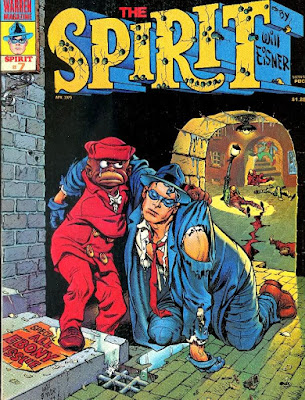
For those who came in late, the Spirit was a masked detective created in 1940 by Will Eisner. The character was part of a 16-page newsprint insert distributed to the Register and Tribune Syndicate newspapers for their Sunday comics.

In addition to a 7-8 page Spirit story, the insert included 4-page stories from supporting characters from the Eisner shop, such as Mr. Mystic and Lady Luck.

And so it begins.

So who cares?

Quite a lot of people. Eisner used the Spirit to stretch the boundaries of sequential art. The splash page featured the title treated differently each week.

The first page of three different Spirit stories. Each week the title was
treated differently.
An example of Eisner's virtuosity. The comic
strip panels are incorporated into the house.
As the eye moves from left to right, the story
unfolds, with the dramatic point being hit
in the last panel (room) in the lower right.

The stories could be anything from a simple crime adventure to a love story, to social satire.

After the Spirit was discontinued in 1952, the comic lived on. The original comic inserts were collected and studied. Several series of reprints were also collected and studied.

As a result, Eisner's work influenced several generations of comic strip and comic book artists. He so defined the field that in 1988 the Will Eisner Comic Industry Award was created.

For the industry, the Eisner is equivalent to the Oscar. Awards are given each year for categories such as Best Writer, Best Artist/Penciller/Inker, Best New Series, Best Continuing Series, Best Letterer/Lettering, Best Limited Series or Story Arc, and more.

That's how much Eisner's artistry (and his creation) are regarded.

So how do you incorporate a character with so much history into a current comic strip? We'll look at what Curtis and Staton brought from the canon into Dick Tracy next week.