Showing posts with label contemporary music. Show all posts

Wednesday, May 01, 2024

George Crumb: Final Volume

It is truly the end of an era. Forty-two years ago Bridge Records began a collaboration with George Crumb. The goal was to present his music to the world through a series of recordings. When Crumb died in 2022, the label had released twenty volumes in the series. 

All were done in consultation with the composer. Based on the recording dates, most of these works were recorded before Crumb's death. 

This volume presents works from the early, middle, and late stages of Crumb's career. It also includes both versions of Processional. Crumb wrote the work in 1983 for Gilbert Kalish. Kalish's performance opens the program. 

Crumb created two versions of Processional. Kalish performs the version for regular piano. Marcantonio Barone concludes the album with the second version. This one is for prepared piano, with different objects sitting on the strings. Hearing the two versions back-to-back is enlightening. Both have their merits, and I honestly can't say which I prefer. 

Kronos-Kryptos began as a percussion septet in 2005. A quintet version was premiered in 2018, but Crumb wasn't satisfied. In 2020 he revised the work yet again. The Curtis Institute of Music, Ensemble 20/21 delivers a stellar performance. This is the distilled essence of Crumb's style. Both notes and silence are equally important.

One of Crumb's earliest works is the Sonata for Solo Violoncello. Written in 1955, it is the most traditional-sounding work on the album. Crumb was ambivalent about the work, but let it remain in his catalog. There are clearly defined melodies, weaving through a highly-chromatic maze of accidentals. 

I'm not sure one could predict that this composer would later produce Black Angels and Macrocosmos. But it is a piece that deserves to be heard. 

Bridge Records has created something truly phenomenal with this series. We have a recorded document of one of the 20th Century's most unique composers. This is an invaluable reference for anyone seeking to understand Crumb's music. 

And that includes future performers looking for a starting point for their interpretations.

And here's something else to consider. This isn't the only such collaboration Bridge Records has undertaken. Other contemporary composers are being similarly well-served by this extraordinary label. 

George Crumb: Processional
Kronos-Kruyptos; Sonata for Solo Violoncello
Curtis Institue of Music, Ensemble 20/21
Gilbert Kalish; Timothy Eddy; Marcantony Barone
Complete Crumb Edition Vol. 21
Bridge Records

Thursday, February 22, 2024

Chromosphere Explores Woodwind Orchestra's Potential

Let's be clear. A woodwind orchestra isn't a regular orchestra with the strings and brass removed. The Czech Philharmonic Wind Ensemble has 18 players. This lineup includes four sax players -- a rarity in a standard orchestra.

It's definitely a contemporary grouping of instruments. And this release presents grouping of contemporary British composers.

Judith Bingham is the most prominent of this group. Her work "Mozart's Pets" premiered in 2021. It's a lighthearted blend of instruments depicting animals with Mozart's music.

"Domes" by Kamran Ince is an entirely different kind of music. The work was originally written for orchestra in 1993. Ince reworked it for woodwind orchestra in 2022. He creates long, flowing lines with wavering dissonances. It's somber, ethereal, and thought-provoking.

The works by Keiron Anderson, Charlotte Harding, and Christopher Hussey are of similar quality. This isn't high school band music. These compositions use instrumental combinations in effective and imaginative ways.

These works are written at a level of complexity that engages the listener. And rewards multiple listening.  

Chromosphere: Symphonic Colors of the Woodwind Orchestra
Czech Philharmonic Wind Ensemble
Divine Art DDX 21117

Tuesday, January 23, 2024

Irina Muresanu/Violeta Dinescu Amazing Collaboration

This is the kind of release that excites me. Violinist Irina Muresanu collaborated with composer Violeta Dinescu to create this recording. Why exciting? Because it's a document we're privileged to have. 

Joseph Joachim collaborated with Johannes Brahms in the creation of his violin concerto. But we don't know how he performed it. There are no recordings to give us insights. But these are modern times. It's possible to record those types of collaborations.

And in this case, that collaboration is especially fruitful. And with this recording, listeners can enjoy the music. And other artists can learn from Muresanu's informed performances. 

Romanian composer Violeta Dinescu has an impressive catalog covering all the major genres. In Romanian violinist Irina Muresanu, she's found a kindred spirit. As Dinescu says in the liner notes, Maresanu has found the "space between the notes," the essence of her work. 

And that's what makes these compositions live. There's an underlying Romanian character to these pieces that Muresanu brings out. It's often a subtle character -- just the way a note bends, or a double stop is articulated.

These works push the limits of the instrument, and a little beyond. And yet they have a lyrical quality to them. 

Muresanu won the Montreal International Violin Competition. One of her showpieces was Dinescu's "Aretusa" (included in this release). So make no mistake. These are indeed definitive performances. And ones not to be missed.   

Irina Muresanu Plays Violeta Dinescu
Solo Violin Works
Metier MEX 77106

Thursday, May 11, 2023

Kevin Puts - Dynamic City and Concerto

Kevin Puts is a composer who seems to go from strength to strength. His opera "Silent Night" won a Pulitzer Prize in 2012. His composition "Contact" won a Grammy this year. This release features three fairly recent works, all receiving their world recording premiers. 

Puts revised his Marimba Concerto in 2021, which is the version recorded here. The revision was at the behest of Ji Su Jung, who performs it here. 

The concerto has an elegiac quality to it. Puts' harmonic language resembles the wide-open "Western" sound of Aaron Copland. Jung's taken ownership of this concerto. The music seems to just flow from her. 

Most percussion concertos focus on rhythm. This one is more about poignant simplicity. It's my favorite work on the album (but then, I'm a percussionist).  

If you're looking for a work with rhythm, "The City" delivers. Marin Alsop and the Baltimore Symphony co-commissioned this piece. So of course their performance is assured and insightful. Puts' sound kaleidoscope represents the various ethnic groups that make up any city. A driving pulse holds it all together, much like the inherent energy of a city. 

Classical music, whether directly or indirectly, embodies the zeitgeist of its time. Puts writes that he created this work shortly after the 2016 presidential election. The polarization and fears it raised found expression in "Moonlight, Oboe Concerto No. 2."

The first movement is unsettled and anxious. The second movement ratchets up the tension. Think Bernard Hermann's "Psycho." The final movement resolves that tension. Its lush harmonies suggest a peace that has yet to come. 

Puts consulted Katherine Needleman as he crafted the oboe part. She's playing music that was created for her, and it shows. A beautiful and impressive performance.  

Kevin Puts: The City
Marimba Concerto; Moonlight
Katherine Needleman, oboe; Ji Su Jung, marimba
Baltimore Symphony Orchestra; Marin Alsop, conductor
Naxos 8.55926

Thursday, April 06, 2023

Andrea Tarrodi: Four Elements

If you're not familiar with the name Andrea Tarrodi, then you probably don't follow the classical music press. In addition to winning multiple prestigious awards in her native Sweden, 

Tarrodi's music has captured a world audience in a very short time. And no wonder. Her style is both accessible and challenging. 

This release features some of her more recent works. It includes Choryn - Harp Concerto (2020), and the Symphony in Fire, Water, Earth, and Air (2021). It also features two shorter works from 2020, Fanfare, and Tarot Garden.

The Nordic Chamber Orchestra commissioned or co-commission all four of these compositions. So be assured these are authoritative performances. Choryn, with harpist Delphine Constantin-Reznik, is an effective evocation of synaesthesia, or experiencing one sense through another. It's an exotic soundscape where everything seems strangely distorted and yet makes perfect sense. 

Equally ambitious is the Symphony in Fire, Water, Earth, and Air. Tarrodi composed it while isolated during the pandemic. The opening music captures the unsettled emotions of that time: urgency vs. status, panic vs. discipline, and isolation vs. companionship. As the symphony moves through the elements, these emotions are gradually transformed. And then, in the final movement -- Air -- they dissipate like clouds in the sky. 

I can't really describe Tarrodi's music, because it's so unlike anything else. And yet it all works. Every single note. The only way to understand her work is to experience it. And this release is an excellent place to start. 

Andrea Tarrodi: Four Elements
Nordic Chamber Orchestra; JoAnn Falletta & Patrik Ringborg, conductors
Delphine Constantin-Reznik, harp
dB Productions dBCD 204


Thursday, September 15, 2022

Simone Lamsma recovers Rautavaara's Lost Landscapes

This release features works written in the final years of Rautavaara's life. In 2004 a ruptured blood vessel brought him near to death -- and six months in the ICU. That experience changed the composer's creative output. It affected the types of music he wrote and their emotional centers. 

Violinist Simone Lamsma plays a selection of these late works for violin and orchestra. Her playing has an exceptionally fluid and luminous tone. Rautavaar's music always has an ethereal quality to it. Lamsna embodies it in her performances. 

This is especially true in the Two Serenades. Rautavaara left these pieces unfinshed at the time of his death. In this composition, he revisits music from early in his career. 

The music's reinterpreted and given added emotional depth. And it's colored with a hint of sadness. Rautavaar's student Kavali Aho completed and orchestrated these serenades. 

And they are ravishing. Lamsma's playing is heartbreaking at times. Robert Trevino leads the Malmö Symphony Orchestra in some truly fine performances.    

The title track, "Lost Landscapes" is an elegiac piece. Rautavaara recalls in music significant places that shaped him as a composer. Movements include musical portraits of Tanglewood; Ascona, where he studied 12-tone technique, his apartment in Vienna, and his home at West 23rd St in New York. And while the movements have a trace of nostalgia, there's also a sense of saying goodbye.

I'm a fan of Rautavaara's music, so of course, I loved this release. But if you have yet to experience his music, I recommend "Lost Landscapes." It's just gorgeous music full of honest emotion. 

Einojuhani Rautavaara: Lost Landscapes
Works for Violin and Orchestra
Simone Lamsma, violin
Malmö Symphony Orchestra; Robert Trevino, conductor
Ondine

Wednesday, December 15, 2021

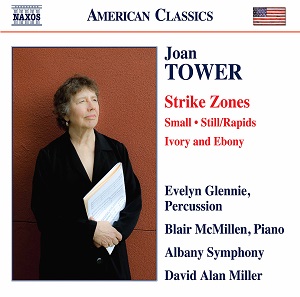
Joan Tower scores a hit with Strike Zones

I'm a percussionist by training. And I'm an admirer of Joan Tower's music. So a disc featuring Tower's compositions for Evelyn Glennie was a must-review for me. 

Glennie is one of the foremost percussionists in the world. Her innovative technique is only matched, by her drive to enrich the repertoire. To that end, she has commissioned works from major composers -- like Joan Tower.

Strike Zones is a concerto composed for Glennie. Most concertos feature a single solo instrument. It features a battery of both tuned and indefinite pitch percussion instruments. 

Tower exploits the characteristics of these instruments. In doing so, she weaves them into a dialogue with the orchestra. It's a high-energy thrill-ride, and one I'd love to see live in performance.

Small, also composed for Glennie, is Strike Zones polar opposite. Here Tower confines herself to a small grouping of instruments laid out on a table. Though the music is more intimate, it's no less exciting. Glennie elicits complex, expressive sounds from simple instruments like tambourines and metal bars.

The album is nicely balanced. After the percussion concerto and solo percussion work, there's a piano concerto (Still/Rapids) and a solo piano work (Ivory and Ebony). These, too, bristle with energy and excitement. 

Pianist Blair McMillen is a tireless performer. His high-octane playing never falters. He carries the listener along on a dizzying sonic journey. 

These works were more than just an exhibition of beats. Tower uses her solo instruments percussively. But she also uses them expressively. She makes us aware that one object striking another can create beautiful sounds. 

I loved it. 

Joan Tower: Strike Zones
Small; Still/Rapids; Ivory and Ebony
Evelyn Glennie, percussion
Blair McMillen, piano
Albany Symphony; David Alan Miller, conductor
Naxos 8.55902


Monday, August 09, 2021

Geraldine Mucha - Chamber Works Merit Discovery

Geraldine Mucha is a fascinating figure. This Scottish composer was born in 1917, and as a teenager studied with Arnold Bax. Her works were published while she was still attending the Royal Academy of Music.

In 1941 she met widowed Czech writer Jiří Mucha. The couple married, and after the war moved to Czechoslovakia. 

Jiří Mucha was the son of Art Nouveau artist Alfonse Mucha. The couple's efforts to preserve the artist's heritage ran afoul of the Communist authorities. This political displeasure severely curtailed Geraldine Mucha's musical career. 

After the Velvet Revolution, her music returned to Czech concert halls and broadcast programs. She's now considered one of the country's most important composers of the 20th Century.

This recording brings Mucha's chamber music to the rest of the world. She draws on both her Scottish heritage and her adopted Czech heritage. The blend is quite appealing. 

Her two string quartets, written in 1941 and 1998 respectively, show how Mucha absorbed and transformed those influences. The first has its folk elements close to the surface. The second is a more abstract work (though tonal). Here Mucha's motifs have nary a trace of folk music.

The release also includes a generous sampling of Mucha's solo piano music, performed by Patricia Goodman. Goodman, an American artist living in Prague, has previously recorded Mucha's piano concerto. She knows Mucha's music well and delivers some satisfying performances. 

Geraldine Mucha was a remarkable talent. This release shows just how remarkable.

Geraldine Mucha: Chamber Works
Stamic Quartet, Prague Wind Quintet,
Patricia Goodson, piano; Vliém Veverka, oboe; Jan Machat,  flute
Brilliant Classics 95463

Monday, June 21, 2021

Leshnoff Symphony 3 gives voice to war's survivors

The horrors of the First World War were not lost on the artists who survived it. Works written immediately after to commemorate the event were generally quiet, contemplative pieces. The music focussed on the senseless loss of life and eschewed any hints of military glory. Jonathan Leshnoff continues that tradition with his Third Symphony. 

Written for the centennial of Armistice Day, Leshnoff gives voice to those who fought. He sets excerpts from letters written to loved ones at home. They don't talk about the glory of battle but share quiet, intimate moments in simple yet beautifully poetic language. 

Leshnoff reverses the standard three-movement form (fast-slow-fast). The outer movements are slow, while the middle movement bristles with nervous energy. The baritone enters during the final movement, singing over long, lyrical passages.

It's a beautiful work, beautifully constructed. And a worthy memorial to those who served. 

Leshnoff composed his piano concerto for Joyce Yang, who premieres the work on this release. Once again, Leshnoff breaks the rules (sort of) with a four rather than a three-movement concerto. Structurally, the work resembles a symphony. But it's definitely a concerto. The piano enters right at the beginning, an equal partner in the work as it unfolds. 

Joyce Yang shines, as might be expected. This is music written for her and her performance brings out its best. The Kansas City Symphony, directed by Michael Stern also sounds fine, especially in the performance of the symphony. It's a nuanced work, and the ensemble delivers. 

Reference released this as an SACD recording. If you're opting for a digital download, I recommend investing in the highest resolution possible. The symphony has long stretches at low volume levels. That resolution is essential to hear all the details in those quiet passages -- and those details are essential to understanding what Leshnoff is saying. 

Jonathan Leshnoff
Symphony No. 3, inspired by World War I letters home; Stephen Powell, baritone
Piano Concerto; Joyce Yang, piano
Kansas City Symphony; Michael Stern, conductor
Reference Recordings FR-7395
SACD


Monday, March 22, 2021

New release celebrates individual voice of Elisabetta Brusa

This installment in Naxos' series features two works by Elisabetta Brusa: her second symphony, and "Simply Largo." These are the same performers that recorded her first symphony in Volume Three, and the quality remains high. 

The Ulster Orchestra has a full yet open ensemble sound. The soloists (if not great) are very good, and Daniele Rustioni has clear ideas about where the music should take us.

Brusa's style has been characterized as Neo-Tonal, but I'd consider that an approximation. Her harmonies don't sound all that traditional. Perhaps it's that Brusa doesn't go out of her way to obliterate any sense of tonality. 

The Second Symphony follows a traditional four-movement form. Brusa's style keeps those traditional forms far in the background -- but not so far that they don't provide structure to the music. 

Kudos to the Ulster Orchestra's brass section. As Brusa notes in the booklet, she deliberately wrote their music in the highest register. The physical strain (even with professional players) to hit and maintain those notes give the symphony an edgy tension that's quite effective. 

"Simply Largo" is a totally different type of work. Here, Brusa creates what she calls a "song without words." The melody determines the form of the work. And it just flows. It's a beautiful work, and one that deserves to be heard more often, I think.

Both works receive their world recording premieres with this release. Now that they're available, I'd like to see them show up on classical radio playlists and perhaps even concert programs. 

Elisabetta Brusa: Orchestral Works Vol. 4
Symphony No. 2; Simply Largo
Ulster Orchestra; Daniele Rustioni, conductor
Naxos 8.574263

Thursday, February 25, 2021

Airat Ichmouratov Symphony a tonal masterwork

Some of my classical music friends are convinced that the art form died in the 1920s -- and Schoenberg killed it. Contemporary music is uniformly academic, difficult to perform, and even harder to listen to. Airat Ichmouratov is but one of several contemporary composers who refute those stereotypes time and again. 

Ichmouratov is a true eclectic. Born in Russia, Ichmouratov lives and works in Montreal. Though a practicing Muslim, he also has a deep love of Klezmer music, and even plays clarinet in a Montreal-based Klezmer ensemble. 

Ichmouratov fuses classical and popular styles together to create music that's engaging, substantial, and accessible to both serious and casual listeners. Ichouratov is the master of orchestral color, as the three works in this release demonstrate.

Ichmouratov's Symphony is subtitled "On the Ruins of an Ancient Fort." His orchestrations effectively evoke impressions of this fort and its rich history. What I best enjoyed about Ichmouratov's music was its originality. Contemporary tonal music can often sound like movie music. Not here. Ichmouratov's orchestrations are refreshingly different, without sounding derivative.

The Maslentia Overture (2013) evoke the celebrations of the week preceding Lent. Here Ichmouratov uses elements of Gregorian chant to set the stage. The Youth Overture, fittingly, is a high-energy work that seems to brim with optimism. This is its recording world premiere -- performed by the orchestra and conductor Ichmouratov composed the overture for. 

L'Orchestre de la Francophonie has a good recorded sound. The ensemble blend is quite pleasing, and the soloists performed with exceptional musicality. An album of exceptional music, and one I'll be sharing with my anti-modernist friends.

 Airat Ichmouratov: Symphony, Op. 55, "On the Ruins of an Ancient Fort"
"Youth" Overture; "Maslentisa" Overture
Orchestre de la Francophonie; Jean-Philippe Tremblay, conductor
Chandos 20172


Monday, January 04, 2021

Modern masterworks by Victoria Borisova-Ollas

Victoria Borisova-Ollas is a Russian-born composer making her home in Sweden. If you (like me) aren't familiar with her work, start with this recording. It's stunning. 

Borisova-Ollas writes deeply spiritual music, drawing on classical music traditions of the past as well as the present. And she's an imaginative orchestrator. Her use of percussion is original and distinctive. Her harmonies are often modal.

The title track, "Angelus" was a commission from Munich for their 850th anniversary. Strolling through the city, Borisova-Ollas noted church bells seeming to peal from every corner. 

"Angelus" builds on that impression. It begins with a modal melody, then adds the tunes rung by the various steeples in the city. The result isn't a cacophony, but a glorious celebration of the sound and spiritual meaning of municipal bells. It's an amazing tour-de-force.

"Before the Mountains Were Born" was commissioned by Andrey Boreyko and the Stuttgart Radio Symphony Orchestra. The ensemble had a stellar wind section, so Borisova-Ollas features them quite prominently in her orchestration. Plus, the work includes an extended cadenza featuring the flute, oboe, clarinet, and bassoon. 

The "Creation Hymn" for string orchestra is reworked from a string quartet. And reworked is the word. Chords are thickened. Contrasts made more dramatic by alternating between full ensemble and a solo instrument. The power of the string ensemble gives more weight to the music, increasing its emotional impact. it's a stunner.

After listening to this release, I started looking for other recordings of Borisova-Ollas's music. Fair warning: you may do the same.

Victoria Borisova-Ollas: Angelus
Orchestral Works
Royal Stockholm Philharmonic Orchestra
Andrey Boreyko, Martyn Brabbins, Sakari Oramo, conductors
BIS 2288

Tuesday, September 01, 2020

Steve Elcock Orchestral Music Vol. 2 maintains quality

To make an impact, always lead with your best material. In the case of a recording series, that can imply that the second (and subsequent) volumes are diminishing returns. Not so with the music of Steve Elcock.

Elcock is something of an outsider artist. He's a self-taught composer who wrote for his own satisfaction. His first volume of orchestral music was a stunner.

Elcock has a strong musical personality, and his works show great originality. Plus, they have an internal logic that guides the listener through the music.

This volume features three works inspired by three other works. "Incubus" is a tone poem depicting night terrors. It was developed from his string quartet "Night After Night. Elcock's orchestrations effectively ramp up the tension that only resolves at the very end.

"Havan, Fantasia on a Theme by J. S. Bach," is a fascinating work. Elcock reinterprets a theme from Bach's First Partita for solo violin. He does far more than provide orchestral accompaniment. He deconstructs the theme, reworking and reharmonizing it until it becomes something new.

Elcock's Fifth Symphony uses Beethoven's Fifth Symphony as a structural framework. And while both have a repeated note motif, there's no danger of confusing the two. Elcock's personality is too strong. His use of the orchestra (particularly percussion) makes this a very modern-sounding work. His harmonies are also more exotic.

In short, it doesn't matter what the origin of this work is. Elcock's Fifth Symphony is an exciting and substantial composition. It stands on its own merits.

The Siberian Symphony Orchestra turns in some top-flight performances. The ensemble sound has a slight edge to it, but the soloists deliver time after time.

Steve Elcock: Orchestral Music, Volume Two
Siberian Symphony Orchestra; Dmitry Vasiliev, conductor
Toccata Classics TOCC 0445

Wednesday, July 01, 2020

Mieczyslaw Weinberg Symphonies 2 and 7 have hidden depths

This release presents two Mieczyslaw Weinberg string symphonies. The Amadeus Chamber Orchestra of Polish Radio, under the direction of Anna Duczmal-Mroz, turns in a set of fine performances. These works, separated by a span of 18 years, are similar only in the choice of ensemble.

Weinberg in 1946 was just beginning to blossom under Soviet sponsorship. His Symphony No. 2 is a lyrical work, with soft dissonances adding piquancy to the music.

Weinberg's music is often compared to that of his friend, Shostakovich. Here, I think, the style seems a little closer to Prokofiev's.

When Weinberg composed his seventh symphony in 1964, he -- and his world -- were very different. He had survived the Zhdanovshcina of 1948 and the banning of his music. He was arrested in 1953 for Jewish bourgeois nationalism, and "officially rehabilitated."

The 1964 Symphony No. 7 for string orchestra and harpsichord superficially seems to be a neoclassical work. But there's a darkness at the heart of the score. The symphony starts out serenely. As it develops though, the dissonances become more prominent, ratcheting up the tension.

At times, the harpsichord seems at odds with the strings. The music sounds fragmented compared to the Second Symphony. And even in the lyrical passages, there's a hint that something's not quite right.

Anna Duczmal-Mroz seems to understand the differences between these two works. The Second Symphony sounds relaxed, with full, beautiful ensembles. The Seventh Symphony has a distinct edge to it, and an intensity that reminded me of Shostakovich's Chamber Symphony Op. 110a.

This is a worthy addition to Dux's exploration of Weinberg's music.

Mieczyslaw Weinberg: Symphonies Nos. 2 and 7
Amadeus Chamber Orchestra of Polish Radio; Anna Duczmal-Mroz, conductor
DUX 1613

Thursday, May 21, 2020

Trio of Mikolaj Gorecki works present balanced portrait

The three works in this release each present a different facet of Mikolaj Gorecki's style. There are similarities: two are for orchestra; two feature a clarinet, horn, and piano trio. But each has its own character.

Gorecki's orchestral work Zan Tontemiquico was inspired by the pre-Columbian poem of Tochihuitzin. It begins  "We only come to dream. It is a kind of meditation on the human fate."

The music has a dreamlike quality to it. The strings play long, sustained chords changing very slowly. Other instruments drop in and out, providing color and further enhancing the other-worldly quality of the poem. Marek Mos and the Aukso Chamber Orchestra of Tychy perform with the disciplined sensitivity this music requires.

The Trio Concertante for clarinet, horn, piano, and orchestra is a quite different work. Here Gorecki uses an overlapping series of motifs that guide the listener through the work.

The opening reminded me quite strongly of Stravinsky's "Firebird." But that gradually transitioned into a quieter, consonant lyricism.

Trio Titanic may reference the famous tragedy, but don't expect the music to depict crashing icebergs or sinking ships. Rather, Gorecki's music is more about impressions than actions. The opening movement (before the collision) is serene, with flowing, consonant chords suggesting a smooth ocean voyage.

Gorecki titled the second movement "Don't you hear the band?" It references the Titanic's musicians playing to calm the passengers. But rather than a mournful hymn, we get lively, energetic reimaginings of ballroom dances.

The finale reflects on the tragedy itself. The music is slow, with lots of minor thirds and downward chromatic motions. It's a true masterwork and masterfully performed by the Silesian Trio.

Mikolaj Gorecki: Zan Tontemiquico;  Trio Concerto; Trio Titanic
Silesian Trio
Aukso Chamber Orchestra of Tychy; Marek Mos, conductor
DUX

Wednesday, April 22, 2020

Quattro Mani excel with Stefan Wolpe two-piano music

The personal nature of this music makes this volume of Stefan Wolpe one of the most important, I think. Stefan Wolpe met pianist Irma Schoenberg in 1927. Through 1942, when they separated, they had a professional and personal relationship. Schoenberg enabled Wolpe to flee Nazi Germany and rescue his music besides.

She inspired the March and Variations for Two Pianos. Wolpe's two-piano score for the ballet "The Man from Midian" was written for Schoenberg and Wolpe to perform together.

The first three of his Studies on Basic Rows were dedicated to Schoenberg (Irma, that is). And of course, the two-piano version of the first two studies was for them to perform together.

The Quattro Mani doesn't quite duplicate the chemistry between Wolpe and Schoenberg must have brought to their performances. But they come very close. To my ears, it sounds as if Wolpe built conversations into these scores. Steven Beck and Susan Grace seem to pick up on that, tossing motifs back and forth with easy familiarity.

The March with Variations developed along with the relationship. Wolpe wrote the march in 1932 but added variations over the course of the year -- a year that involved an escape to Czechoslovakia, a tour of Russia, study with Webern, and immigration to British-controlled Palestine. As the work progresses, each variation seems to become more complex, more atonal, though never quite achieving the Webern ideal.

"The Man from Midian" is a ballet with an incredibly complex history.  The Ballet Theatre commissioned Darius Milhaud to write a score for a ballet about Moses. Milhaud titled his work Moïse, and later arranged it as a concert suite, Opus Americanum no. 2. In the meantime, the choreographer Euguene Loring left the company and mounted his own production of the ballet, this time using Stefan Wolpe.

The score was originally for two pianos and is set in two movements. Each movement features several short vignettes (eight in the first, eighteen in the second). Wolpe uses motifs to denote the major characters, modifying them as the drama demands. Sometimes the music is incredibly dense and atonal, other times it's quite simple and consonant.

As I listened, my respect for Quattro Mani grew. This is quite difficult music and required a great deal of precision. Beck and Grace not only delivered but did so with elan.

They also deliver fine performances of the Studies on Basic Rows. This is atonal music by the numbers and can sound lifeless and academic. Beck and Grace play these studies with just enough expression to elevate the scores from exercises to music.

Stefan Wolpe: Volume 8, Music for Two Pianos
Quattro Mani
Bridge Records 9516

Tuesday, October 08, 2019

Dmitri Tymoczko - Rube Goldberg Variations

There are two qualities I admire in Dmitri Tymoczko -- his sense of humor, and his craftsmanship. Tymoczko's titles are often humorous - like the title track on this release.

But his humor also extends into the music. Several of his works have a light-hearted quality to them. These works sound like they were fun to compose, and fun to play.

And that's where craftsmanship matter. Because Tymocko's music isn't written to support the gag titles.

Rather, they take an essential part of that title and develop it in interesting and imaginative ways. And that makes (in my opinion) Tymockzko's music worthy of attention -- and repeated hearing.

According to Tymoczko, "I Cannot Follow" was inspired by a line in a 16th Century madrigal. In that work, it was a lament that the narrator couldn't follow his deceased beloved. The work begins with the instruments -- saxophone, guitar, vibraphone, and piano -- echoing each other in simple imitation. But over time, the imitations begin to change, and eventually breaks off. Tymoczko's music has both a literal interpretation of the title as well as the deeper meaning of the source material.

"S Sensation Something" is a work of exceptional beauty for piano quintet. The title develops a single letter into two different words. The music develops a simple, consonant melody in a similar fashion. As the work progresses, the melody is repurposed and reharmonized with increasing dissonance. It then returns in a transformed state at the end.

The title track, "Rube Goldberg Variations" references both J.S. Bach and the cartoonist who created outlandishly useless machines. Tymoczko uses a brass quintet to keep things moving with angular, "robotic" music (that's the Rube Goldberg part).

A prepared piano plays throughout, gradually shedding its modifying accessories -- paperclips, erasers, etc. By the end of the work, the natural sound of the piano emerges in a variations-to-theme structure (that's the J.S. Bach part).

Tymoczko's music speaks to the listener on several levels. And, I think, it appeals to all kinds of listeners. In additional to classical audiences, these works should appeal to fans of progressive jazz and rock -- especially Frank Zappa fans. Tymoczko writes classical music truly relevant to today's audiences.

Dmitri Tymoczko: Rube Goldberg Variations
Flexible Music; Atlantic Brass Quintet; Amernet String Quartet
Bridge Records 9492

Thursday, September 19, 2019

Star Wind - outstanding chamber music by Vyacheslav Artyomov

This reissue from Divine Arts brings together several short chamber works by Vyacheslav Artyomov. Each work has its own unique combination of instruments, and (in a way) its own aesthetic.

The opening track, Star Wind, is a 1981 sextet featuring violin, cello, flute, French horn, piano, and glockenspiel. To me, it sounds like a very early work. Artyomov's mature style involves sculpting forms out of shifting sound clouds. To me, this work sounded as if it were written in a dodecaphonic style, with all the rigor that implies.

Nestling Antasali for flute and piano features the composer at the keyboard. His presence makes the performance an authoritative one. This set of theme and variations begins in strict 12-tone style. As it progresses, though, the form seems to loosen and expand. For me, it seemed as if Artyomov was transitioning into his mature style with this work. 

Moonlight Dreams for soprano, alto flute, cello, and piano sets English translations of 17th Century Chinese poems. There is a dreamlike quality in the sustained, slow-moving harmonies. Although atonal, the music seemed looser and less mathematical than that of Star Wind.

The Romantic Capriccio, for French horn, piano and string quartet dates from 1976 was written in tribute to Jean Sibelius. It's one of the most tonal works I've heard by Artyomov and contains passages of real beauty (especially for the horn).

Morning Songs is an interesting work for violin, flute, guitar, with a soprano singing behind a curtain. It casts the singer as a ghost or echo -- shading, but not affecting the instrumental trio.

The earliest work on the album is Scenes (Grand Pas). Written in 1971, for a ballet sequence, it's a jaunty little number full of rhythm and attitude. It reminded me a little of Alfred Schnittke -- in spirit, that is.

Some of these pieces hint at what Artyomov would become, and some show roads not taken. Thus, I wouldn't recommend "Star Wind" as an introduction to the composer. Best to start with one of his orchestral releases. But if you -- like me -- love Artyomov's music, this release is a must-have.

Vyacheslav Artyomov: Star Wind
Star Wind for violin, cello, flute, French horn, piano, and glockenspiel; Variations: Nestling Antsali for flute and piano; Moonlight Dreams for soprano, alto flute, cello, and piano; Romantic Capriccio for French horn, piano, and string quartet; Mattinate (Morning Songs) for soprano, violin, flute, and guitar;  Scenes (Grand Pas) for violin, clarinet, bass, piano, and percussion
Various artists
Divine Art

Tuesday, August 20, 2019

Harry Partch Sonata Dementia - More, Please

I've always loved the music of Harry Partch. These new recordings by Bridge Records do a tremendous service to the world of music. Hearing the Partch ensemble perform with copies of Partch's original hand-made instruments.

That's important because it means these instruments can really be played, not handled like irreplaceable museum pieces. And the Partch ensemble digs into the music with gusto.

Plus, these new recordings sound clearer and better-defined than Harry Partch's originals. And that means it's easier to hear the subtle distinctions between microtones and the unusual overtones of the instruments.

This volume includes "Ulysses at the Edge of the World," written in 1951 for Chet Baker. The original version included trumpet, string bass, and Partch instruments. Baker never played it, and the work was recast with different instruments at least twice. The Partch ensemble performs the original version here.

They also perform the original version of Windsong, from 1950. This is another work that went through several transformations, eventually becoming the ballet "Daphne of the Dunes." To me, it's like "Windsong" is the best bits of "Daphne," especially the rhythmic sections. If you like the one you'll enjoy the other.

And of course, there's the title track, Sonata Dementia. Originally written as an exercise for his 43-note scale, the work remained in limbo. Eventually, it became part of "Plectra & Percussion Dances." As a piece, this original form of "Sonata Dementia" works, and it works well.

The Partch Ensemble understands Partch's music. And they're thoroughly proficient on Partch's instruments. These are amazing performances of amazing music. All I have to say is "more, please."

Harry Partch - Sonata Dementia
The Music of Harry Partch, Volume 3
Partch
Bridge Records

Wednesday, August 14, 2019

Vyacheslav Artyomov Symphony of Elegies Inspires Anew

Divine Art continues their reissue of Vyacheslav Artyomov recordings with "A Symphony of Elegies."

Artyomov's 1977 "A Symphony of Elegies" was written during a trip to the mountains of Dilijan, Armenia. To me, the work forms a fascinating contrast to the mountain-inspired symphonies of American/Armenian composer Alan Hovhaness.

Both composers eschew the standard notion of "symphony," and both depict timeless solidity of mountains -- and their primal spiritual significance. Artyomov is even less concerned with tonality than Hovhaness, and therein lies the difference.

Artyomov's symphony is a slowly swirling cloud of sound. The solo violins sometimes float atop the string orchestra, other times they're obscured by it. But always there's a tension between the two. Violinists Oleh Krysa and Tatiana Grindenko are the soloists, and their also the performers for "Awakening."

Artyomov dedicated "Awakening" to Krysa and Grindenko, who premiered the work in 1978. Artyomov considered it a postlude to the symphony. Listening to the two works back-to-back I could hear why. "Awakening" inhabits the same audio world as the symphony. With just two violins, Artyomov strips the music down to its essence.  The violins must both generate the sustaining tones and the melodies above them. Its a remarkably intimate and haunting work.

For me, the most interesting of these three very interesting works was "Incantations." Artyomov conducts the Mark Pekansky Percussion Ensemble and soprano Lydia Anatolyevna Davydova in this recording. These are the artists he composed the work for, so I consider this the definitive performance.

Artyomov deconstructs the human voice, separating vowels, consonants, and other sounds into discrete blocks. He then uses them -- along with various percussive sounds -- to create something that's more than the sum of the parts.

Alfred Schnittke described "Incantations" as  “a strikingly realistic and vivid sound image of primeval magic." I agree. I'd even say that all three works evoke a mystical sonic realm only attainable through Artyomov's creative imagination.

Vyacheslav Artyomov: A Symphony of Elegies
Tatiana Grindenko and Oleh Krysa, violins
Mark Pekarsky Percussion Ensemble;
Lithuanian Chamber Orchestra; Saulius Sondeckis, conductor
Divine Art DDA 25172