Many American families have Thanksgiving stories and traditions, mine included. And ours is perhaps a little unusual, as my ancestors include three men who sailed on the Mayflower: William Brewster, spiritual head of the Pilgrims; Stephen Hopkins, a sailor and adventurer; and Thomas Rogers, a Pilgrim and a cloth merchant.
The story of the Pilgrims coming to the New World and celebrating the first Thanksgiving, has grown large in the retelling as years have passed. The historical truth of the founding of P.ymouth Colony is far removed from the national myth. And understandably so -- the myth is much more appealing.
One of my favorite versions is the 1953 all-star epic "The Plymouth Adventure." The men are noble, the women glamorous, the passion overheated -- in other words, a typical Hollywood movie of the period.
But it's still a lot of fun. Two of my ancestors are represented -- although it's unlikely William Brewster looked much like Barry Jones, or Stephen Hopkins Don Dillaway (I know -- who?).
Taken as myth, it's rollicking entertainment. And the film has two other things going for it -- the ship and the music. The model of the Mayflower was one of the most detailed ever constructed, and is part of the reason the film won an Oscar for best special effects.
And who wouldn't enjoy an epic film with a Miklos Rozsa score? Rozsa did his research. The hymn you hear at the beginning isn't "Simple Gifts," it's actually "Confess Jehovah Thankfully," by Henry Ainsworth. Ainsworth's Psalter (collection of hymns), was published in 1612 and was taken to Plymouth by the Pilgrims.
Family stories don't have to be true, as long as they entertain. Ours got the MGM treatment. Very little of it is true, but it is entertaining!
Another comic I follow just gave a nod to long-time readers. In today's continuity, the Phantom brings readers up to speed with the current story line. (click on image to enlarge)
Over the years, the Phantom's origin has been retold many times -- usually in a Sunday sequence. The Phantom's story officially begins in 1536, when the sole survivor of a pirate attack is washed up on an African beach. On the skull of his father he pledges his life -- and the lives of his sons -- to fight "piracy, greed, cruelty,
and injustice, in all their forms." The current storyline actually features the 21st Phantom, who inherited the persona from his father (and by direct descent from the first Phantom).
These origin flashbacks often featured a brief prologue: "For those who came in late..." Even in its initial appearance this statement had a double meaning. The strip started in 1936, so in theory, even those who were there from the beginning of the continuity might be considered "those who came in late."
The current team of Tony DePaul, Paul Ryan, and Eduardo Barreto have started to play with this prologue. This is the second time (that I can remember) that a character has turned to the reader and uttered the prologue.
It's a nice nod to a long-standing tradition, and a little added bonus for those who have been reading a while.
A few years ago I talked about using a reference to Greek mythology at work that elicited only blank stares. (Use Your Allusion). Thinks have changed a little over the last three years. I recently submitted a review that used the Gordian Knot as an example -- and it was accepted.
And to be clear, since the review was about something technical written for the general public, virtually anything considered to be obscure usually gets changed. So at least one person (the editor) thought the reference sufficiently in the realm of common knowledge to stand.
With this classic setup, two DDC's could go wild and
everyone else could dance without fear of serious injury.
This evening we went to a Holly Ball dance
(it's that time of year). There, front and center, was a phenomenon I've
seen many times at wedding receptions -- the Dancing Drunk Chick. If
you've been to any social gathering involving dancing and alcohol,
you've probably seen her, too.
Once the DDC gets going, there's no stopping her. She's on the
floor for every song (or in the case of tonight, even when the band took
a break), dancing with wild abandon. Which was a good time to abandon
the dance floor. Because the DDC throws her arms out, kicks her feet, hops around, spins, and generally uses a lot of space for her awesome moves.
And if she crashes into someone else in the process, well, don't
worry -- she won't feel a thing. Sometimes young, though most often not
(maybe there's something else going on here), I can always count on
finding at least one DDC at every receptions. And strangely enough,
there never seems to be more than two or three, tops.
I certainly admire her alcohol-fueled energy -- if not her
flailing fists. Maybe its time to bring back the go-go dancer cages.
Then we could all do the Safety Dance in safety...
On
our way back home from Thanksgiving, we happened to drive through a
small town. This unusual gift shop caught my eye. Outside were a number
of signs. One sternly proclaimed that all the goods were American Made.
OK,
a lot of people feel strongly about that. No problem here. Other signs
advertised Military Supplies and Tactical and Hunting Supplies.
I
don't have a problem with hunting -- especially after having four
different collisions with deer in as many vehicles. I'm not quite sure
what "tactical supplies" might be (tackle?), but still, no worries.
But
it was the other signs admonishing the reader to Put the Christ in
Christmas that I found interesting. Because one was right next to the
sign for Military Supplies.
See, Christ had very strong opinions about using weapons, even in self-defense.
Here's what happened when armed soldiers came to arrest him:
Then
came they, and laid hands on Jesus and took him. And, behold, one of
them which were with Jesus stretched out his hand, and drew his sword,
and struck a servant of the high priest's, and smote off his ear.
Then said Jesus unto him, "Put up again thy sword into his place: for
all they that take the sword shall perish with the sword."
- Matthew 26: 50-52
The story -- with Jesus' admonishment -- is also told in Luke and John.
So, to me anyway, selling military supplies seems somewhat incompatible with the notion of putting Christ into Christmas. I mean, if you feel that strongly about the Prince of Peace...
We were driving with a friend's ten-year-old recently on some errands, and to make the 40-minute trip more pleasant, tuned the satellite receiver to Radio Disney.
Now I've been in radio a long time, and it was revelatory to listen to the station. Our children have moved past the Disney stage, and so I knew none of the artist they talked about, nor the songs that they played. Listening to the high-energy patter without any emotional attachment or even knowledge of the artists was revelatory.
"This is [blank]. Coming up next on Radio Disney we'll have an exclusive talk with [blank]. And she'll be playing her hit song [blank] live in the studio! And remember, [blank] is part of the [blank]tour hitting your town soon! And now here's [blank] the second single from the new album by [blank]."
My ignorance made the details irrelevant, letting me focus on the larger structure of the patter. They were patterns I recognized quite well, and I have to say they were very well-done.
It would not surprise me to learn that Radio Disney's breaks are tightly scripted. Not that they sounded stiff, but there was never a moment of questionable content, and never was anyone at a loss for words. Even the fourteen and fifteen-year-old artists interviewed seemed remarkably articulate.
I enjoyed the experience for another reason -- it brought home to me how much content is colored by our likes and dislikes. Fill those blanks with artists and songs I like, and I have an enjoyable and engaging listening experience. Replace them with ones I don't like, and the same patter becomes mindless and irritating drivel.
Content may be king, but context may be the prime minster.
I spend a good amount of time watch old media. I find it entertaining and enlightening. Entertaining, because storytelling techniques have evolved, and while a situation may resolve in a certain fashion in a modern drama, there's no guarantee that it will turn out the same way in an older show -- different times, different mores.
I've been watching "Thriller," an anthology series hosted by Boris Karloff from 1960-1962 on NBC. A different time, indeed -- anthologies are no longer considered a viable TV genre. Although the series sort of trades on Karloff's reputation as a master of horror (he originate the screen role of Frankenstein's monster), these aren't really horror stories.
But they are indeed thrillers, stories that feature suspense, action, and tension.
When the series premiered, Time said it was an "hour-long bloodmobile." A contemporary viewer might be puzzled by that review. While modern audiences are used to realistic depictions of violent death and bodily trauma, it was far different in the early 1960's. There was a lot of murder and mayhem depicted, but it was all very sanitized (kids might be watching, you know).
"Thriller" may have had more "blood" than other programs, but it was still constrained by the values of the day. When someone got shot, they fell down. There was no indication of the damage the bullet did to the body. But because the program couldn't shock its audiences with graphic violence, it had to do it by other means.
And that's probably what made the Time reviewer so uncomfortable -- and me as well. Because "Thriller's" stories are indeed suspenseful. The central character is thrown into a situation where they don't know what's going on, but need to find out quickly or someone (usually themselves) will die. And because each story was self-contained (unlike drama series today), there was no guarantee the hero would survive. Or any of the supporting characters.
The stories took many twists and turns, often with a strong psychological element. And because most of the gory stuff happened off-screen, the viewer's imagination had to fill in the details (which often makes it more disturbing).
For me, "Thriller" is like watching a well-produced short play. The stories have a different slant than modern TV shows, told in a different way and often resolve in a different way, too. And for the reasons outlined above, they're more engaging, too.
So I'm enjoying this old TV show. For me, it's solid entertainment.
Here's an opening to one of the shows. The violence can't be shown onscreen, so look what they do instead. We meet all the entire cast of characters in a series of quick cuts reacting to the shot, and close in on the most disturbing image of the child with the gun. Who wouldn't want to watch more?
I was watching an episode of "Have Gun Will Travel," late 1950's western starring Richard Boone. As with a lot of vintage TV shows and movies, part of the fun is seeing Famous stars back in their salad days as extras or members of the supporting cast.
In this particular episode the guest star was John Abbott, a character actor I had seen many times before. Character actors don't seem to get much attention with the general public. After all, they're never the stars of the show, and often just have a scene or two. And they basically play the same part over and over.
John Abbott was such an actor, usually appearing as an urbane villain or eccentric intellectual, always speaking with a cultured British accent. In the episode "Shot by Request," he plays a scholar who, for self-preservation, learns to handle a gun and ends up earning a reputation as a gunfighter (so this was one of those eccentric intellectual roles).
On a whim, I decided to look him up to see what other films I had seen him in. And what I got was a little surprising. Because this person who I had never really thought much about had a long and distinguished career beyond his typecast roles.
John Abbott (1905-1996) was a well-respected Shakespearean actor before coming to the United States in the 1940's and started working in films. He was as cultured in real life as he appeared on screen -- in addition to working with some of the greatest classical actors of his day (such as Laurence Olivier), Abbott served with the British Embassy in Moscow when the Second World War broke out.
He worked extensively on stage (and was to have originated the lead role in "Harvey"), and actually had a play written in verse for him -- by Tennessee Williams. And he also taught the art of acting to a rising generation of future stars (and character actors). And he also did voice over work, appearing as the wolf in Disney's "The Jungle Book."
It was an impressive career.
And that got me thinking:
John Abbott was but one of many actors who appear fleetingly in films, TV shows and stage dramas that never reach "stardom."
How many others are there whose creative lives were far richer than their stereotyped roles might suggest?
I'll be paying even more attention than ever to those "other" actors!
Jennifer Rivera made an interesting point in "Trying to Remain Opera-tional" recently. This talented mezzo soprano maintains a highly entertaining blog chronicling her adventures as a professional singer, sprinkled with wry observations about life and the world of opera.
In her post "Operaitus," she comments on the chasm between the art of operatic singing and American audiences. She writes:
I've definitely seen things in plays and movies that were supposed to pass for opera singing that, well....weren't. And very few people seemed to be aware of the difference.
But how do you combat such a problem? And is it even something to be combated? If people are listening to something and enjoying it, why spoil it for them by letting them know that what they're hearing actually sucks ass?
I think the reason to try to educate people is that when they realize what they are missing, they might be able to get to an entirely new level of understanding and passion about this art form, and with that knowledge, their appreciation of the art form can only be deepened. If they went crazy for somebody just because he sang passably and in a foreign language, imagine how moved they could be if they were aware of what went into opera singing, and were able to appreciate it in it's true form!
It took me a while to appreciate opera (hey, I majored in percussion), but once I got it, I understood how much I was missing -- and what the fuss was all about.
That's really the challenge. How do we educate when there's no foundation to build upon? Ms. Rivera's concerned about opera, but if you think for a moment, I'm sure you can come up with other areas of human endeavor that are suffering in the same fashion.
When we only have a superficial impression about something, we cheat ourselves (a point I've made elsewhere). The more we know about a subject, the more deeply we can engage with it, and the more we can get out of it.
So do yourself a favor. Pick an art form. Doesn't have to be opera -- it could be anything you sort of like. Dig a little deeper, and start reaping some aesthetic rewards.
It's not healthy to subsist exclusively on empty calories -- and that's true of the arts as well as nutrition.
How much do you know about the area you live in? Could you give a guided tour?
Just wondering.
Orange County isn't the cultural, political, or even geographical center of the Commonwealth of Virginia. And yet when friends from out-of-town came for a visit, I surprised myself with how many points of interest (both important and not) we were able to show them.
Like many localities, Orange County does have some historic places. Montpelier, the home of James Madison is probably the most famous. But as we drove around, places and stories just spilled forth.
Montpelier, for example, was also one of the locations used for the filming of "Hush" with Gwyneth Paltrow and Jessica Lange (the murder weapon came from Faulconer's Hardware in downtown Orange). If you look carefully in the background, you'll see many Orange County residents (and many Four County Player thespians) working as extras in the background.
And speaking of the Recent Unpleasantness (known as the Civil War in other parts of the country), there's the Exchange Hotel in Gordonsville. This vacation destination was converted into a field hospital, with a chute connected to one window that shunted severed limbs into a pit.
The Battle of the Wilderness happened in Orange County, and near the town is an overgrown arched stone bridge. This is the now abandoned replacement to the wooden Fat Nancy railroad bridge, which collapsed as an excursion train crossed it in 1888 -- a train full of Civil War veterans returning from a reunion of Gettysburg. One of the survivors was General James A. Longstreet.
There's also the building where a kayak factory used to be -- the first enterprise of Peter Rice, who would later founded the Plow and Hearth. We showed our guests the remains of the narrow gauge railroad right-of-way that hauled timber from Wolftown at the base of the Appalachians to the furniture factory in the Town of Orange.
We dined at the Silk Mill Grill, one of the many businesses occupying the old silk mill building, at one time the town's biggest employer. We drank Barboursville Vinyards wine, grown on the former estate of Governor James Barbour of Virginia. His home, designed by Thomas Jefferson, burned in 1884. The ruins still stand, and in addition to providing a graphic for the vineyard's label, also serve as an outdoor stage for summer productions.
And there are many more stories we could have shared, too. I know that my father could give an equally detailed tour of his home town, which got me thinking. What about you? What stories would you share about where you live? Because every location has at least one.
- Ralph
(And if you have a great story about where you live, please share in the comments field)
After trying (again) to explain the concept of MST3K/RiffTrax and why I enjoy it so much, I decided to just write a post about it that I can point newbies to. So if you're already a fan of Mike/Joel and the 'bots, then please let me know if there's anything I need to include. If you're wondering what the heck this is all about, read on.
The Basic Concept
In essence, both Mystery Science Theater 3000 (MST3K) and RiffTrax do the same thing: provide running commentary on a video as it's being shown. If you've ever talked back to a commercial, made a mordant observation during a film or TV show, or even provided your own dialogue over top of what the characters are actually saying, then you're doing the same basic thing as the MST3K commentators. The difference is the frequency, level and quality of the comments.
A Bit of Background - MST3K Mystery Science Theater 3000 started off as a gentle spoof of the locally-produced late-night SciFi/horror movie shows that were popular in the 1960's and 1970's. In such shows, the host would introduce the movie, usually a B-grade movie (cheaper to rent). MST3K took the concept a step further by having the host segment extend through the entire movie.
The conceit is that an evil mad scientist, Dr. Clayton Forester, has sent a hapless victim -- first Joel Robison (Joel Hodgson), and later Mike Nelson (Mike J. Nelson) -- into space. The victim is forced to watch bad movies as part of an experiment. The victim resists by commenting on the films, aided by two robots -- Crow T. Robot (originally voiced by Trace Beaulieu, later Bill Corbett) and Tom Servo (voiced by Kevin Murphy).
RiffTrax - The Legend Continues
With the rise of the Internet, the concept of MST3K returned in an expanded form. One of the drawbacks hampering MST3K was the need to get rights to use the films they lampooned. A limited budget kept the list of available films limited to movies fallen into public domain and really low-end productions.
A RiffTrax production is just an MP3 audio track, which means the staff can comment on virtually any film available on DVD (there are instructions telling you when to start the audio track so the sound syncs up). A much lower overhead and an expanded range of available films have revitalized this peculiar art form practiced by Mike J. Nelson and fellow MST3K alums, Kevin Murphy and Bill Corbett.
So where's the humor?
If you're someone who watches movies and TV shows uncritically, then this probably won't appeal to you -- you'll probably wish the commentators would just shut up so you could enjoy the show! However, if you've ever noticed details in films you weren't supposed to, or find that some parts of a TV show seem odd, or occasionally deconstruct a video, then the MST3K/RiffTrax commentary can be a wonderful thing.
Humor comes from surprise and unexpected juxtaposition. And that's what the commentary of Nelson and company provides. There are some recurring tropes. Some may give you an idea of the appeal these shows have.
Cultural commentary - There are regular references to public radio/TV programming, opera, classical music, classic jazz, art works, classic literature, and history. Whenever the heroine trips and sprawls on the ground, count on someone mentioning Andrew Wyth's painting "Christina's World."
Pop cultural commentary - This actually spans several generations. It can include current pop music and movie stars, as well as references to iconic moments from older films and TV shows. A recurring trope (which they lampooned themselves) was the cite "NBC Mystery Movie," an early 1970's TV show whenever someone shown a flashlight in the fog (the TV show opened with such a shot).
Visual or audio riffs from the film - A silly phrase from early in the film may get repeated throughout the movie, heightening the humorous aspect of it. In "Teenagers from Outer Space," a character overly dramatizes the word "torture." Every time the character appears, a commentator adds "... and torture," to his lines, delivered in the same tone of voice.
Breaking the fourth wall - The commentators often take a step back and make observations about the quality of the production. Doors that open the wrong way ("Why is my room in the hall?" a commentator asks), a movie set in prehistoric times that clearly show tire tracks in the road, awkward blocking, botched transitions, continuity errors, muddy dialogue recording -- it's all grist for the humor mill.
Finally, while it may seem easy, it's not. Anyone can sit back and crack wise while watching a video. But the commentators of these programs operated differently. They viewed the films several times, making notes, recording commentary and then refining and polishing their ideas to create finished scripts that sound improvised, but aren't.
And that, for me, is really the appeal. The quality of the humor usually consistent throughout the entire program. And the commentary is dense enough that it's only after a second or third viewing that I finally get all the jokes.
So there you have it. Something that I can enjoy with repeated viewing, that consistently makes me laugh, and something that does what I like to do, only better -- that's the appeal for me!
- Ralph
Yes, I know I haven't mentioned Cinematic Titanic, but I haven't seen any of their productions, yet. Some of the MST3K alum appear in RiffTrax, while most of the founding cast (Joel Hodgson, Trace Beaulieu, and others) appear in Cinematic Titanic -- same basic concept, though.
I've spent three posts taking a close look at the comic strip art of Noel Sickles. But the three years he spent drawing "Scorchy Smith" only represents a small part of his career.
Sickles was first and foremost an illustrator, and he could readily adapt his style to the assignment at hand -- yet approach the subject in an original manner that raised the artwork beyond the conventional.
The best source for finding out more -- and appreciating the work of -- this extraordinary artist, is the Fantagraphics book "Scorchy Smith and the Art of Noel Sickles," by Bruce Canwell and Dean Mullaney. In addition to containing Sickles' complete run of "Scorchy Smith," the book also has excellent examples of his later work.
One such is his work for the United States Postal Service. In 1962, Sickles did the art for the Battle of Shiloh commemorative stamp. Notice the economy of line (click on the image to enlarge). It's really a simple stamp -- just one soldier in combat. We can't see his face, and it's not clear which side he's on. This one soldier represents the over 109,000 men who were involved in the struggle.
Sickles wanted to emulate combat sketches of the period. While he captures the essence of a hastily drawn image by an eyewitness, it still has a contemporary look. The stamp successfully combines the styles of two centuries -- appropriate for such a commemorative.
Scorchy Smith wasn't a fluke -- almost everything Sickles drew professionally worked on multiple levels. If you're interested in illustrative art at all, "Scorchy Smith and the Art of Noel Sickles" is a worthy investment.
- Ralph
It doesn't matter if you're a student of sequential art or not -- just take a moment and let your eyes revel in the masterful images below. And as you do, remember this. Noel Sickles churned out such images every day, six days a week for three years.
Part one I talked about Sickle's depiction of night. In part two, I looked at his mastery of negative space. This time, it's all about location.
One of the problems with modern comic strips is their small panels. Most strips have little more than talking heads with the merest hint of scenery. But even in the 1930's when comic strips had more real estate, not everyone took advantage of it.
In the panel below (click to enlarge), Scorchy Smith visits Colonel Patterson, who wants to use the aviator to crop dust his Louisiana plantation. In this one image, Sickles conveys everything we need to know -- including a strong sense of place.
The plantation house in the background has the columned porch typical of Southern architecture (at least in popular imagination). It's also large, an appropriate home for a rich and successful planter.
And check out that stand of pine trees. Very typical for the area, which also adds to the sense of place. The trees also help establish depth to the scene. And their shadows show the time to be late afternoon.
The figures are on the extreme left, and Patterson's word balloon pulls the eye forward, first to the house, and then on across the scene on its way to the next panel. That long journey also gives the impression of spaciousness -- this is a big plantation.
Below is the sequence the panel comes from (click on image to enlarge).
Patterson's daughter gazes wistfully in the first panel of the bottom sequence. And if you look carefully, you'll see her in the second as well. She's not that hard to find, as her silhouette is just below Patterson's last word.
The final panel has a lot of exposition, so Sickles just draws the figures. But that's OK -- with the richness of the panel before it, that white space makes a nice balance.
Take another look at that image at the top, and think about drawing in all those trees and shadows. Who would go to that much work for something that was only read once and forgotten? Only a master craftsman such as Noel Sickles.
When it comes to any creative work, the reference point of the audience changes over time. I thought of that while watching "The Great Race." This 1965 Blake Edwards comedy chronicles a mythical 1903 New York to Paris road race. Tony Curtis (the Great Leslie) and Jack Lemon (Professor Fate) represent good and evil in a way that was meant to mirror the conventions of silent movies of the 1920's -- although Professor Fate seemed to be more a cross between Snidely Whiplash and Wile E. Coyote.
Blake makes his intentions clear, right from the opening credits. He's paying homage to early film comedies of the 1920's.
The movie featured imaginative and retro-looking automobiles, including Professor Fate's formidable Hannibal 8. This vehicle had everything needed for Fate to win the race by cheating. It came with a smoke screen, a heat cone, a retractable cannon (!), and a body that could be raised and lowered (as you can see below).
For 1965 audiences, the quaintness of turn-of-the-century technology and actions was amusing. But when I watched this movie in 2009, I had a different thought. Professor Fate's inventions are straight-up steampunk.
There's an entire sub-genre of science fiction devoted to retro-futurism, extrapolating devices from late nineteenth and very early twentieth century technologies. Which is exactly what Blake Edwards does in "The Great Race." It seems to me this film potentially could attract a whole new audience from steampunk devotees, many of whom the film predates by at least twenty years.
Reference points change over time. Has the time come for "The Great Race" to be popular again -- for slightly different reasons?
- Ralph
BTW - Henry Mancini's ballad "The Sweetheart Tree" alone is worth the price of admission.
Over the past months I've noticed a disturbing trend in business conversations and meetings I'm involved with. And that is the substitution of the word "bandwidth" for "time." If you're not familiar with it, instead of saying "Farnsworth doesn't have the time to do the report and the daily stats," you'll hear "Farnsworth doesn't have the bandwidth for both the report and the daily stats."
Many people have called for this usage to stop, and as someone who loves the precision of words I basically agree. If we're just substituting one word for another with no change in meaning, then we should stop.
But perhaps there's something more going on here. Time is a very fluid concept, and all of us regularly over- or under- estimate how much we have available. So Farnsworth may say he doesn't have time to do the report and the daily stats, but deep down we're sure that he probably does.
I remember a famous analogy of time management. Imagine a box (unit of time) full of cannon balls (big jobs). Is the box full? No, because you can fit baseballs in the spaces between the cannon balls. Is it full now? No, because you can fit marbles in the gaps between the baseballs and the cannon balls. Is it full now? No, because you can fit BBs into the spaces left over, and then grains of sand into those left over spaces, and so on. So while the time may be finite, an almost infinite number of tasks can be fitted into it (as the analogy goes).
"Bandwidth," though, implies a precise number. Imagine a cable (unit of time) that can accommodate five gigabytes per second. How many files (tasks) can you upload per second? 5GB's worth. So you could do five 1GB files, or ten 100MB files, or 1,000 10MB files -- or any combination of file sizes you can think of. As long as the total doesn't exceed 5GB. Because it doesn't matter how much you want that additional data to go through the system. If it exceeds the bandwidth of the cable, it won't happen. Period.
So if the use of this term were to represent a fundamental shift in the way we thought about time, then I'm all for it. Because with the box of cannonball model, it's easy to dump the report and daily stats on Farnsworth. He'll just have to figure out a way to fit it all in. Under the cable model, though, the argument's over. 8GB of tasks won't go through a 5GB cable. We'll need to find someone else to do the stats.
And to me, that represents a much more humane way to go.
It still feels like jargon to me, and you won't hear me substituting "bandwidth" for "time," but if Farnsworth ends up not having to do the daily stats -- well, I might change my mind.
We attended our niece's high school graduation this past weekend, and once again I was reminded of something -- as a culture, we seem to have no concept of audience behavior. Well, that's not entirely true. We do have a concept. Apparently how we behave at football games is fine for all situations.
Specifically:
1) Whatever's happening on the field (or stage) is as removed from the viewer as an image on a TV screen. So talking, texting, moving around to visit with friends is fine -- just like it is at home.
2) "Whoo" is not an optional way to show approval -- it's required. And if you can get the attention of the athletes/performers by yelling, so much the better. Air horns are good, too.
3) Fun's fun, but traffic's a drag. Once you've seen what you've come to see, leave and beat the crowd out of the parking lot.
I have no gripes with any of these behaviors at a sporting event -- it's part of the experience. But a band concert, or a ballet recital, or an awards ceremony, or graduation? Sorry, not appropriate. Sometimes just applause is enough. Staying to the end of the event has its own rewards -- you never know what you'll see.
At the heart of it all is just plain courtesy. Staying to the end shows respect for the performers/athletes and what they're doing. Cheering appropriately maintains the decorum of the event. And sitting quietly (regardless of actual interest level) shows respect for other audience members.
The young men and women of the Class of '09 comported themselves well at graduation. If only the members of their audience had done the same.
This post we continue our look at Ken's father-in-law's train set. What can such an object tell us about the world it was made for?
Cultural Values
The reason Lionel chose to make this particular model was because of the immense popularity of the prototype. In the early 1930’s aircraft design had led the way with the concept of streamlining.
Soon all forms of transportation were adopting the concepts (and the look) of modern aircraft. Car fenders became smoother with fluted edges, while car bodies sported rounded corners and flowing lines.
Railroads looked into streamlining for two reasons: fuel efficiency (and therefore lower costs), and to counter the competition from airlines for the passenger business.
Lionel's version is very close proportionally to the prototype.
In 1934 the Union Pacific unveiled the “City of Salinas” M10000, a train billed as the future of railroading. Instead of a series of separate passenger cars linked together by couplers, the train was one long, integrated (and articulated) unit. Some called it an airplane fuselage on wheels, and the UP was glad for the association.
The M10000 was sent on an extensive goodwill tour across the country, and became the last word in modern rail travel for a while.
If you look carefully at commercial art of the day that celebrates progress, you’ll often see some version of the M10000 pictured alongside a fast-moving airplane, zeppelin, and steamship.
The body made of light-weight airplane-grade extruded aluminum, and coupled with its streamlined contour, made the M10000 one of the fastest trains in service.
By modeling the M10000, Lionel offered a product would have had a great deal of positive association to the general public.
The recent battering the economy’s taken has had one positive outcome –- it’s increased my appreciation of movies from the early 1930’s. The common conceit is that movies made during the Great Depression were designed as escapist fantasy. Perhaps, but the reality of what people were going through was always there under the surface.
Take the 1933 MGM musical “42nd Street.” It’s primarily known for its extravagant Busby Burkeley production numbers. I think for years the film was looked upon as a quaint relic from an earlier time. The story of a young ingénue who takes over when the star gets injured has become a cliché, as has its most famous line, “You’re going out a youngster. But Sawyer, you’ve got to come back a star!"
Watch the movie today, though, and you get a different impression. The story, first and foremost, is about Julian Marsh, Broadway’s leading director (played by Walter Baxter). His health is wrecked, but he forces himself to sign on for one more show, "Pretty Lady."
But not for art. As he tells the producers in the first scene, he’s in it for the money. The producers express surprise. Isn’t Marsh loaded from all his past hits? Listen to the edge in his voice as he delivers these lines:
"I ought to be but I’m not. Did you ever hear of Wall Street? This time I’m going to sock my money away so hard that they’ll have to blast to find enough to buy a newspaper."
Who can’t relate to that sentiment today?
As the story progresses, the sugar daddy for the production, kiddie car magnate Abner Dillon (Guy Kibbee) has a falling out with Dorothy Brock (Bebe Daniels), the star of the show and the object of his affections. He threatens to pull his backing the night before the premier if Brock isn’t replaced.
Marsh tries to reason with Dillon, pointing out he’ll lose his investment. Dillon, drunk, sneers that it doesn’t matter. It’s his own funeral. Listen as Marsh pleads his case. As he points out, it’s not just Dillon’s funeral.
"Yes, the funeral of 200 other people besides. Chorus girls, boys, electricians... You wouldn’t be that mean, would you?"
If this show closes before it opens, then Marsh doesn’t know where his next meal will come from – and he knows that’s the situation of everyone in the “Pretty Lady” company.
Brock sprains her ankle in a brawl, and young Peggy Sawyer (Ruby Keeler) has to carry the show. With no options left, Marsh works with her the day of the performance – all day long – to get her as ready as possible for the lead. Listen to the urgency in Marsh’s voice as he talks to Peggy right before she goes on.
"200 people. 200 jobs. $200,000. Five weeks of grind and blood and sweat depend upon you. It’s the lives of all these people who’ve worked with you. You can’t fall down, you can’t! Because your future’s in it, my future and everything all of us have is staked on you."
The desperation that gives Marsh’s speech it’s edge seemed to be more melodramatic in more complacent times. But in an age when anyone’s job could disappear at any time? I think it has a lot of real emotion – emotion that I'm more than familiar with these days.
So if you watch “42nd Street” be dazzled by the Busby Berkeley magic. But pay attention to the story. When the film premiered audiences knew just where Julian Marsh was coming from. I think current viewers will too.
- Ralph
Day 150 of the WJMAWeb Watch. (Say, is anyone home?)
I was in a meeting yesterday, and we were trying to decide exactly how to handle a particularly messy issue. It involved personality conflicts that had grown out of real or imagined slights -- all of which drained time and energy away from the primary task of the committee. But we couldn't move forward with our job until these other issues were addressed.
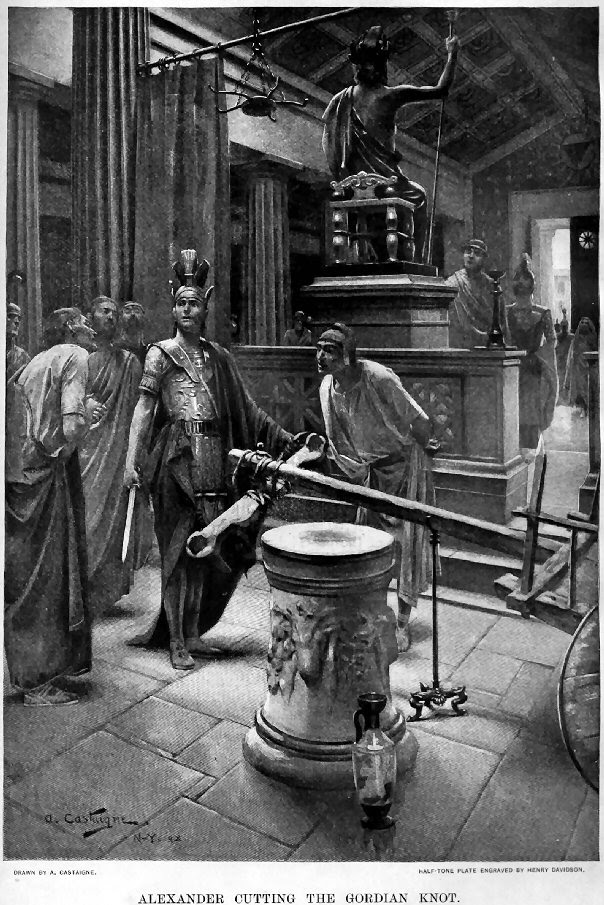
Finally, someone (not me) said we should perhaps just cut the Gordian Knot. Some of us expressed agreement, the rest had blank looks.
Yes, another classical allusion had been used. And, for those who knew the reference, most effectively as well.
If you're not familiar with the story, in ancient times the Gordian Knot was considered such a complex knot that it was impossible to untie. Alexander the Great, wishing to untether a cart secured by the Gordian Knot, didn't bother to try untying the impossible knot -- he simply unsheathed his sword and cut the rope. The Gordian Knot was still intact, but no longer an impedance to the use of the cart.
Which was the point my colleague wanted to make at the meeting? If we can't solve this problem (which wasn't our main task), let's cut loose the people causing it and move on.
And that's the value of having a basic knowledge of the classics. Clear communication in a small number of words. After all, "Cutting the Gordian Knot" is only four words --and look at how many it took to explain the phrase.
Barry Schwartz’s book, "The Paradox of Choice" outlines an increasingly common aspect of modern life – having too many options. Sometimes when there are too many choices, it’s so difficult to pick one that I continually put off making a decision. Which results in no choice being made at all.
That happened to me recently in a group discussion. Each of us was supposed to name our favorite song. I didn’t know what to say. When it comes to music, I have too many choices.
My number one favorite song? Sorry, don’t have one.
If you’re talking about classical music, my most favorite composition is probably Kurt Hessenberg’s Second Symphony, simply the best-constructed musical composition I’ve ever heard. But if I want something with deep spirituality, then it’s Alan Hovhaness’ “Mysterious Mountain” -- or Ralph Vaughn Williams’ “Pilgrim’s Progress.” But then there’s Dowland’s “Can She Excuse My Wrongs?”and the Beethoven first string quartet and, well, the list goes on.
And the same is true of other genres. The number one golden oldie that takes me back to high school? “Things I’d Like to Say” by the New Colony Six. Except when it’s “Prologue” by Chicago. Or Sugarloaf’s “Green-Eyed Lady,” or Cornelius Brothers and Sister Rose, or the Ides of March, or any of several other bands.
And if I want to go back to the early sixties, my favorite track is Petula Clark’s “Colour My World” except when it’s the Standells singing “Sometimes Good Guys Don’t Wear White, ” or any of a dozen other songs.
Movie soundtracks? My favorite’s Alfred Newman’s How the West Was Won, except when it’s Miklos Rozsa’s King of Kings. Or Erich Korngold’s score for The Adventures of Robin Hood, or Elmer Bernstein’s Hallelujah Trail, or a few others.
Ditto with musicals, soul, funk, pop, rock, new wave, punk, jazz, folk, grime (yes, I have a few favorites here), bluegrass, and even country.
Too many choices. I can’t decide.
So I do the only thing I can. I just enjoy every piece of music on its own merit, and how it meets my needs.
And I never answer the question of what’s my favorite song.
- Ralph