Showing posts with label piano music. Show all posts

Tuesday, October 11, 2022

New Louise Farrenc piano series dazzles with technique

At first, this might seem an odd way to launch a new piano series. Usually Volume One features the strongest (or most famous) works by the composer. This ensures maximum interest and provides some momentum for the series itself. 

A volume of Études doesn't seem to have that immediate appeal. After all, these are short little pieces -- 87 in all, most under 1:30. But for Louise Farrenc, it's absolutely the right way to start the series. 

Farrenc was a consummate pianist as well as a gifted composer. She was famous for her piano technique. So much so, that she was appointed Professor of Piano at the Paris Conservatory. Farrenc developed her own curriculum and wrote her etudes to develop techniques. 

What raises them above the didactic is Farrenc's compositional talent. Yes, each etude is primarily concerned with a particular technical skill. Rather than using a melody to string together some exercises, Farrenc creates melodies that can only be fully realized through those techniques. 

Every one of these etudes is worthy of the concert hall. And especially as performed by Maria Stratigou. She has done a thorough study of these works. That deep understanding of what Farrenc was doing in these pieces has informed her playing. 

First and foremost, Stratigou concentrates on the musicality of the etudes. Melodies are beautifully phrased. And no matter how complex the music, it never sounds busy or cluttered. The technical is always subservient to the musical. 

This collection showcases Farrenc's remarkable skill as a pianist. (After all, I'm assuming she could play all these knuckle-busters.) And at the same time, it demonstrates her skill as a composer. 

These etudes get this Farrenc piano series off on a flying start. I am very much looking forward to hearing more from this remarkable performer -- and pianist.

Louise Farrenc: Complete Piano Works 1, Études
Maria Stratigou, piano
Grand Piano
2 CD Set

Tuesday, October 12, 2021

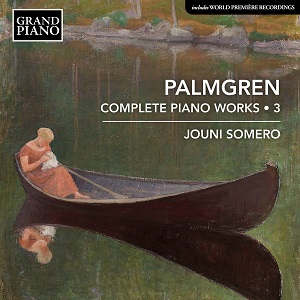
Jouni Somero surveys Selim Palmgren piano repertoire

This volume in Grand Piano's series spans fifty years of Selim Palmgren compositions. They show the development of the composer over time. 

The album opens with Three Piano Pieces, Op. 4, written in 1893. Palmgren was 15. These are charming, unprepossessing pieces with traces of Brahms and Schumann. 

Palmgren wrote his Lyrical Intermezzo, Op. 8 after he began his musical studies in Berlin. The music is more sophisticated, and the piano technique is also more challenging.    

The latest work on the album is Sun and Clouds, Op. 102. It's also the longest piece on the album. Each of the twelve movements depicts a different month of the year.

Though written during the height of the second world war, the music is sunny and optimistic. The textures are much thicker than those in Palmgren's early works. And the technique more advanced -- as befitting a student of Busoni. 

Jouni Somero is an exceptional performer. And so are his interpretations of his fellow countryman's music. Somero plays with authority. He brings out the simple charms of Palmgren's early works. And delivers his mature pieces with power and verve. 

The more of Palmgren's music I hear, the more I want to hear. Looking forward to volume 4.

Selim Palmgren
Complete Piano Works 3
Jouni Somero, piano
Grand Piano GP869

Thursday, August 27, 2020

Pioneers: Piano Works by Female Composers

Hiroko Ishimoto presents an illuminating program of piano music spanning almost 300 years. And all of it by women. It's a terrific recording, with exceptional performances. I heartily recommend it.

Before digging into the details, let's do a little thought experiment. What if this were a recording of similar music -- by male composers? Well, it probably wouldn't be titled "Pioneers." And the subtitle would simply be "piano works."

That's how deeply ingrained gender bias is in the classical music world. Projects like Ishimoto's address that. Some of the composers presented here are already well-known. Clara Schumann, Amy Beach, Cecile Chaminade, and Lili Boulanger are already well-represented in recordings and performances.

Of comparable quality to the works of those composers are the other women in this program. Some were major figures in their own countries. Agathe Grøndahl of Norway studied with Franz Liszt and was a colleague of Edward Grieg.

Croatian Dora Pejacevic composed the first modern symphony in her country. Anna Bon was a keyboard virtuoso, a published composer at age 16, and possibly worked with Franz Joseph Haydn.

And there's more. Every composer has a story, and every composer (as represented here) is worth listening to. My recommendation: get this release, and use it as a starting point for your own exploration of women composers, past and present.

Pioneers: Piano Works by Female Composers
Hiroko Ishimoto, piano
Grand Piano GP844

Tuesday, June 23, 2020

Bechara El-Khoury Piano Sonatas Effectively Blend Traditions

Increasingly, composers seem to be going their own way. These pioneers blend different music traditions and styles together.

When it's done well, a truly unique composer's voice emerges. And that (in my opinion) is what happens with this collection of Bechara El-Khoury piano works.

El-Khoury is best known for his orchestral works. In those, he weaves together Lebanese and French influences. The latter is particularly obvious in his orchestrations.

These works for solo piano, though, strip away that layer. Yet even here, El-Khoury's love of French music is apparent. The Piano Sonata No. 1, written when El-Khoury was in his twenties, has a mixed atonal/highly chromatic sound. Some of the chord voicings gave me hints of Ravel.

The second sonata was written four years later. And yet it shows a remarkable development of style. While there are still some hints of atonality, the harmonies have a thick, Impressionist feel to them. This sonata, unlike the first, has just two movements; Lento con sereno and Presto con fuoco.

The other two sonatas, composed in the 21st Century also follow that structure. Both have a slow first movement and a second fast movement. In both, the harmonies, though still thick, have a different quality. They're not aggressively dissonant, yet not warmly consonant either. Can I call it post-Impressionist?

Giacomo Scinardo delivers thoughtful performances of these works. In the slow movements, El-Khoury is often introspective, and Scinardo's playing successfully communicates that. He is also more than a match for the considerable technical demands of the music (especially in the later sonatas).

I first came to love El-Khoury's music through his orchestral works. This album helped me appreciate his aesthetic even more. Recommended to anyone looking for a composer who follows his own path, even when it crosses those of others.

Bechara El-Khoury: Piano Sonatas Nos. 1-4
Giacomo Scinardo, piano
Naxos. 8.579022

Wednesday, December 18, 2019

Han Chen delivers pristine performances of Anton Rubinstein sonatas

Anton Rubinstein, both as a pianist and a composer, was wildly popular with the general public. His colleagues, though, had a different opinion. Russian musicians considered him too German (and Germans too Russian). Although he had tremendous technical ability, Franz Liszt remained unimpressed, calling him ‘a Pseudo-musician of the Future’.

Shortly after his death, Rubinstein's music lapsed into obscurity. It's now enjoying something of a renaissance.

This release features two of Rubinstein's piano sonatas, plus Three Serenades.

The first sonata, written in 1848 is a sprawling, thunderous work. Stylistically, I thought it a blend of Beethoven piano effects with Schubert melodic form. These two elements blend quite well, creating a sonata that's substantial musically, and challenging technically.

Ditto the second sonata finished two years later. Liszt seems to be the inspiration here. The music is more complex and decidedly more difficult.

Pianist Han Chen may be young, but he has the technique to do Rubinstein's music justice. No matter how complicated or rapid the passage, Chen plays cleanly and expressively.

And Chen's performances never let the pyrotechnics distract the listener. Chen integrates all the flourishes, chordal runs, and contrapuntal passages into the overall flow of the music.

The Three Serenades are positioned between the two sonatas. These are simple, tuneful compositions that provide welcome relief between the powerhouse sonatas.

Does this release "prove" that Rubinstine was Liszt's equal? Perhaps not. But Han Chen does show that Rubinstein's solo piano music is worthy of our attention. I'd say Liszt's assessment was a little off the mark.

Anton Rubinstein: Piano Sonatas Nos. 1 and 2; Three Serenades
Han Chen, piano
Naxos 8-573989

Thursday, August 01, 2019

Pianist Jinghu Zhao Launches Carl Czerny Series

Now, this is an ambitious recording project. Carl Czerny wrote over 1,000 works -- a substantial portion for solo piano. If you still collect CDs, you might want to clear a shelf for this series.

Volume one features five works, only one an entirely original Czerny composition. Variations, fantasies, and impromptus based on existing melodies were extremely popular in the early 1800s.

The album opens with L’Écho des Alpes Suisses, Livre 2, published in 1838. No. 1, Introduction & Variations brillantes sur l’air suisse Alles liebt Tout aime, Op. 428 follows a traditional theme and variations structure.

No. 2, Impromptu brillants sur un thème national Suisse, Op. 429 has a freer structure, and lets Czerny develop the theme in interesting and unexpected ways.

The 1844 Fantaisie sur des Mélodies de Beethoven, Op. 752 is based on "Gedenke mein!", a short song. Czerny studied with Beethoven, and was the soloist for the premiere of the "Emporer Concerto." He takes this modest little tune and develops it into a powerful pianistic tour-de-force -- much as Beethoven did with Diabelli's theme.

The Impromptu sentimental sur le thème ‘O nume benefico’ de l’opéra La Gazza ladra, de Rossini, Op. 523 benefits greatly from the quality of the source material. Czerny has a lot to work with, and he makes the most of it.

The solo original work, Hommage aux Dames, Op. 136 is actually the slightest on the album. It's a simple little Biedermeier confection.

Pianist Jingshu Zhao plays with remarkable precision and sensitivity. Her considerable technique is always in service to the music. We hear Rossini's melody sing out through the cloud of notes surrounding it. Beethoven's tune thunders with portent. The Swiss melodies exude charm.

I'm impressed -- and ready for the next of hopefully many volumes.

Carl Czerny: Piano Music, Volume One
Jinghu Zhao, piano
Toccata Classics

Saturday, April 06, 2019

Jan Ladislav Dussek - Complete Piano Concertos, Vol. 6 features transcriptions

This release features the Opus 9 Piano Sonatas of Jan Ladislav Dussek. Originally, they were written for a melodic instrument + piano, a common practice of the late 1700s. The melodic instrument could either be a violin or flute -- performer's choice.

Innovations in pianoforte construction allow for longer sustained notes. Dussek could transcribe these works for solo piano and still retain the lyrical phrasing of the melodies. The divide between right hand and left hand is more pronounced than it would be in work originally conceived for the fortepiano.

In fact, as it is the Grand Sonata in E-flat major, Op. 75. This 1811 work was written for the keyboard, and it shows. Dussek's showing off his skill with this work, pushing the limits of the instrument from start to finish.

Viviana Sofronitsky plays a replica of a 1792 Anton Walter fortepiano. In their day, Walter instruments were quite desirable -- Mozart owned one. Walter's innovation was a backcheck. This prevented the hammer from bouncing on the key during rapid and/or loud passages.

Nevertheless, I thought the instrument used in this recording had a jangly sound. Walter instruments were somewhat light, and this pianoforte has a lightweight sound. It also has a somewhat bright sound.

While I didn't love the sound of the pianoforte, I thought the playing of it top-notch. Sofronitsky performed these works with something of a swagger. Dussek used these works as a vehicle for his abilities in concert, and she does a little showing off herself. It works -- and it works beautifully.

Jan Ladislav Dussek: Complete Piano Sonatas, Volume 6
Viviana Sofronitsky, fortepiano
Brilliant Classics 95598

Tuesday, February 19, 2019

Dussek Complete Piano Sonatas Volume 5 - Enlightening performances


Jan Ladislav Dussek was a pioneering piano virtuoso who continually pushed the boundaries of his instrument. And in some cases, he was responsible for some of the improvements made to the fortepiano -- especially range.

Volume 5 in Brilliant Classics' series features pianist Wolfgang Brunner. His performances are top-notch. But I found his liner notes even more rewarding.

In them, Brunner compares and contrasts the differences between Viennese and English fortepianos of the early 1800s. I found it a revelation. I now better understand the importance of matching the music with an instrument of its time.

Brunner plays the Sonata in A minor, Op. 18, No. 2 on a Viennese fortepiano. The sonata is similar in style to those of Haydn. The texture is thin, the voicing simple and straightforward. The light and responsive action of the fortepiano was well-suited to this music.

Brunner also uses this instrument for the Sonata in G major, Op. 45, No. 2. Published in 1802, the three Op. 45 sonatas show major advances in playing and compositional technique. There are more chords (and chords in motion). The harmonies are more complex, and there is more motion in the inner voices.

The Viennese fortepiano lets all the detail of the music show through. Runs sound cleanly executed and the whole sonata has a feel of elegance about it.
Brunner uses an English Broadwood fortepiano for the first and third sonatas of the Op. 45 set. The sound is fatter, and the action a little louder. The English fortepianos tended to smear the sound more than their Viennese counterparts.

If the second sonata invoked Haydn, the other two conjured up Beethoven. The sound was brawny, bold, and a little rough around the edges. Elegance was replaced with raw emotion.

A revelation indeed.

Jan Ladislav Dussek: Complete Piano Sonatas, Vol. 5
Sonatas Op. 18, No. 2 and Op. 45
Wolfgang Brunner, fortepiano
Brilliant Classics 95605

Wednesday, November 28, 2018

Dussek Complete Piano Sonatas Volume 4 - Illuminating


This release features sonatas that span Dussek's career. And since they're played on fortepianos of the period, they also provide insight into the development of the piano.

The Sonata in A-flat major, Op. 5 No. 3 and the Sonata in B-flat major, Op. 24 are relatively early works. Written in 1788 and 1793 respectively, Tuija Hakkila performs them on a 1790s 5-octave restored Viennese fortepiano.

The Sonata in A, Op. 43 (1800) and the Sonata in F sharp minor, Op. 61 (1806) are played on a copy of a 1799 Longman Clementi fortepiano. It has a 6-octave range, and three strings per note (vs. two for the Viennese instrument).

The differences are audible. The Viennese instrument is noisier. I could easily hear the sound of the action, and there was a slight buzzing in the upper register. The Longman Clementi had an overall smoother sound across the instrument's range. And it had a stronger sound as well, with action that was almost unnoticeable.

The music reflects the instrument it was written for. The early sonatas on this release sound less expressive, and closer to the Baroque than the later works. Dussek takes full advantage of the newer instrument, expanding the range of the music, and increasing the contrast in dynamics.

Tuija Hakkila is a superb performer, matching her touch to the capabilities of the instruments. The Vienna fortepiano sounded a little fragile, and Hakkila plays it gently (yet expressively).

The Longman Clementi seemed robust enough to handle Dussek's grand gestures. And Hakkila doesn't hold back.

Of the four volumes in this series, I found this installment the most interesting, and the most instructive. And there's some fine music-making going on here, too.

Jan Ladislav Dussek
Complete Piano Sonatas, Vol. 4
Sonatas Op. 5 No. 3; Op. 24; Op. 43, and Op. 61
Tuija Hakkila, piano
Brilliant 95604

Sunday, September 02, 2018

Clementi Piano Sonatas, Opp. 25, 33 & 46 - more than mechanical

Mozart wrote, "Clementi is a good clavicembalist and with this, there is no more to say. He plays well with his right hand, his strong point is the passages in thirds. For the rest he has no sentiment or taste, - in a word he is simply a mechanicus."

I'm not sure I entirely agree with that assessment -- especially after listening to this recording. Yes, Clementi often uses thirds. But his music is technically challenging. And in the right hands (as they are here), quite interesting.

Most of the sonatas on this release come from the early 1790s when Clementi was in direct competition with Mozart. The textures of the Op. 25 and Op. 33 sonatas are transparent. Clementi does favor the right hand, giving it the complicated runs while the left outlines the harmonies (or in some cases simple melodies).

I found the Op. 46 sonata especially interesting. It was written in 1820, fifteen years after the previous sonatas. It's a more complex work, with thicker textures and more of a balance between the hands. And yet, it's a sonata that was published the same year as Beethoven's Piano Sonata No. 30 in E major, Op. 109. Clementi's sonata pales in comparison. It's a simpler work and one that almost sounds old-fashioned. Advanced for Clementi, but lagging compared to his contemporaries.

However, these works lack neither sentiment nor taste. All are skillfully constructed. And taken on their own merits, are quite attractive.

Stefan Chaplikov plays elegantly, and with a light touch. The rapid passages flow smoothly and seemingly without effort. Chaplikov favors soft rather than loud dynamics, but that's in keeping with the music. If you like Mozart and Haydn piano music, you should enjoy this release as well.

Muzio Clementi: Keyboard Sonatas
Op. 33, Nos. 2 & 3; Op. 46, Op. 25, Nos. 1 & 3
Stefan Chaplikov, piano
Naxos