Friday, June 06, 2014

CCC 104 - Loris Ohannes Chobanian

Armenian-American composer Loris Ohannes Chobanian is this week's  Consonant Classical Challenge feature. In addition to being a respected educator, Chobanian is also a professional classical guitarist, and a talented conductor. As might be expected, Chobanian has composed a significant amount of music for guitar and guitar ensembles -- as well as the lute.

Chobanian's music has a practical feel to it. It's sometimes complex, but never impossible to play. Perhaps his experience as a conductor and performer make him sympathetic to the challenges of the players.

Chobanian uses tonality in innovative ways. His chordal structures are often triadic, and move about freely, unconstrained by the notions of major and minor keys. There are clear tonal centers in Chobian's works, though, that give the listener a point of reference. The distance the music travels from that reference point provides dramatic tension, and its return brings about a satisfying resolution.

Chobanian "Requiem April 24," uses modal harmonic motion to weaken the sense of major and minor keys. At the same time, it frees Chobanian to move the music in unexpected directions. And because most of it is supported by triads, the audience is never lost.


"Four Legends for String Orchestra" was written for the Baldwin-Wallace Junior Youth Orchestra. Individually, the parts don't require much in the way of technique -- ideal for younger players. Chobanian compensates by using rich harmonies, and simple counterpoint, creating a work that's engaging to listen to as a legitimate concert work, rather than a student exercise piece.


"Dowland in Armenia" combines renaissance musical structure with Armenian folk inflections in a sophsiticated work that's far more than just an arrangement of John Dowland tunes. And because Chobnian is a guitarist himself, the music lays quite well on the instrument.


Just how skillful is Chobanian as a guitarist? Here he is performing his work "Lament for Homeland."


Loris Chobanian has enjoyed a successful career as a performer, conductor, and a composer. He's enjoyed several important commissions by major ensembles. He's composed large amount of orchestral music, as well as chamber works, and -- of course -- guitar works. He's also written a number of works for wind ensemble that should be heard by a wider audience.

It's a shame his music isn't programmed more often -- and I'm not just talking about his guitar works. I, for one, would like to hear Chobanian's cello concerto in performance sometime.

Recommended Recordings:

Concierto del Fuego (The Music of Loris Ohannes Chobanian)

Chamber Works With Guitar

Jamerica: American Music for the Guitar Quartet

Thursday, June 05, 2014

Re-paving Paradise in the O-Gauge Zen Garden (Part 3)

After painting the road surface with
flat black paint, I added white warning
strips at the crossings with flat white.
In Part 2, I showed how I filled in a side street using a pre-made roadway. Since it wasn't wide enough for the main street, my option was to paint it.

When I originally decided to add lines to the roadway (see: DOT in the O-Gauge Zen Garden) my intention was to use a Sharpie paint marker to draw the lines. It turned out that the marker didn't make a line of a consistent thickness, nor did it cover adequately.

The solution was simple -- I used flat white paint with a very small brush. I had some scrap cork that I could practice on, and it's a good thing I did. I found that the white paint covered the black with one coat, but that coat had to be carefully applied.

I outlined the areas to paint with painter's tape. I marked on my ruler not only where the center of the road was, but the 1/16" on either side of it that I wanted to lay my tape.

Final check before painting. Note I also added parking lanes
at left.
I placed the tape very lightly on the surface so I could adjust it easily. To borrow an old builder's phrase, I was careful to measure twice, paint once. Once I had double-checked the measurements along the entire length of the road, I pressed the tape onto the surface, making sure it was smoothly applied over the entire length.

On my practice surface, I learned I needed to always paint away from the edge of the tape. Because cork has an irregular surface, when I painted towards the tape, small amounts of paint got pushed underneath the tape. This meant I had ragged edges when I removed the tape.

 When I painted the rectangular strips at the railroad crossings, (see image above), it was easy to do. With the very thin area exposed for the lane lines, I had to use short brush strokes with the smallest amount of paint to keep from brushing away from one edge and into another with the same stroke.

The most difficult part of the process wasn't the painting. Rather it was the positioning. Even with much of the scenery removed, there were still objects I had to lean over to reach the  roadway. Next layout, maybe I'll do this detail work before I add a mountain and telephone poles with wires!

As you can see from the image below, the finished project looked just the way I had envisioned it. The roads of my O-gauge zen garden are a little safer.

There's just one thing: I think the ramps at the crossings should have some type of warning marks painted on them.

That's going to require a stencil, I think, and that makes it a project for another day.

A definite improvement.

Wednesday, June 04, 2014

Moments of Love - Labelle and Wyner present engaging program

Moments of Love
Ravel, Saint-Saeës, Wyner, Hahn, Britten
Dominique Labelle, soprano
Yehdi Wyner, piano
Bridge Records

Dominique Labelle and Yehdi Wyner have put together an engaging program with "Moments of Love." Labelle's voice has a warm lower register and a very clean upper register that she uses to great effect in this musical examination of love's multiplicity. There's a real chemistry between singer and accompanist that makes the listening experience even more enjoyable.

Featured on the recording is Ravel's Trois Poéms de Stéphane Mallarmé and a selection of songs by Saint-Saëns. Labelle's voice is well-suited to this French repertoire, sounding slightly mysterious in the Ravel, and inviting and charming with Saint-Saëns' selections.

There's something about the composer playing his own work -- especially one as accomplished a performer as Wyner. "The Second Madrigal: Voices of Women" was originally written for soprano and chamber ensemble. His adaptation of the work for voice and solo piano is quite effective. The composition seems to borrow gestures from mid-century atonality, but still (to my ears) rooted around tonal centers. The result is music that conveys deep emotion though apparent dissonance -- emotion Labelle expresses quite effectively.

Reynaldo Hahn's youthful art songs are sung with a simple beauty entirely appropriate to the material, and the disc ends with four songs from Britten. Jazz and tin-pan alley rubs shoulders with classical in these numbers, and Labelle delivers with a wink and smile.

Tuesday, June 03, 2014

Pearls Before the Wheel

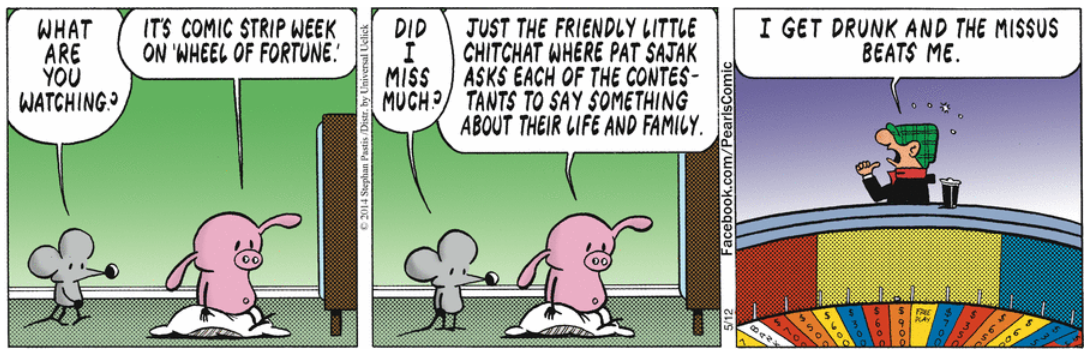
Stephen Pastis recently completed a brilliant story arc in Pearls Before Swine. In addition to providing five strips of stand-alone humor, he also made some pointed commentary about some comic strips that are long since past their prime. Monday's sequence sets up the premise: it's Comic Strip Week on Wheel of Fortune. And the first contestant to be introduced is Andy Capp. (click on images to enlarge)


Reg Smythe started Andy Capp in 1957, and even after his death in 1998, the strip shambles on. Pastis points out the obvious that readers seem to disregard in this "loveable" character. Capp never works, drinks constantly, and abuses his wife verbally and cheats on her as well. One has to wonder -- why is this strip still around?

Tuesday introduces the next contestant -- The title character from B.C. This is another legacy strip, started by Johnny Hart in 1958 and continued after his death in 2007.


Hart became a born-again Christian, and considered B.C. part of his ministry. In the latter part of his life B.C. became increasingly heavy-handed in its Christian messaging. B.C.'s opening remark nails the overt tone of Hart's latter strips perfectly.

Wednesday's sequence was something of a surprise. I didn't expect Pastis to introduce one of his own creations, but he did --  Larry the croc.


In retrospect, it was a perfect choice. There's a general perception that Wheel of Fortune contestants aren't always the brightest bunch (Jeopardy snags those). Having the dimmest character from the Pearls cast just reinforces that notion.

Thursday the game starts.


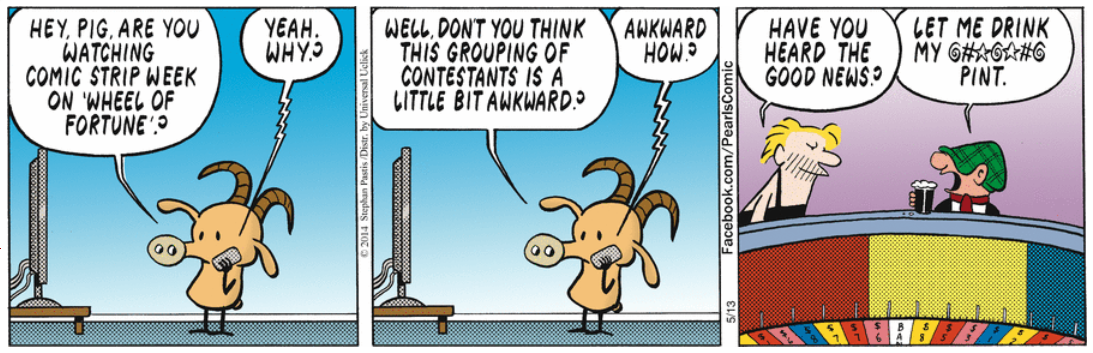
Andy Capp's too drunk to think, and B.C. tries to shoehorn Jesus into the answer. Both play out the worst traits of their respective characters.

Two important things happen in Friday's sequence. First is the obvious joke: Pastis is such a nobody that even with just one letter missing, Larry can't identify his creator.


But there's a more pointed commentary, too. Larry sets it up by mistaking Pastis for a homeless person. B.C., who's been proudly displaying his Christianity all week, immediately says he has no spare change. A mordant comment on the nature of B.C.'s (and by extension Hart's) faith.

And the final day is just for fun.


Monday, June 02, 2014

Diabelli Project 043 - Piano Piece in F-sharp minor

The Diabelli Project is about offering my weekly flash-composition sketches freely to all. Like Antonio Diabelli's theme these sketches aren't great music. But perhaps (as in Diabelli's case) there's a Beethoven out there who can do great things with them.

This week I dashed out another little piano piece, although a little different than the the previous one (Diabelli Project 042). I returned to my second favorite odd meter, (5/8 time -- 7/8's my favorite), and wrote melody over a simple bass figure. (click on image to enlarge)


According to my self-imposed rules, when I run out of time, I have to stop -- wherever I am. In this case, it was in mid-thought, which is why the last measure is open-ended. Where does it go from here? That's up to you. If you'd like to finish the piece, or want to use any part of it as the basis for your own composition, you're certainly welcome to. Just share your results with me -- I'm kind of curious to discover what happens next.