Friday, November 30, 2012

CCC 052 Arturo Marquez

American classical music lovers seem to be a little myopic. European composers are well-represented on the concert stage, and there's a few Americans as well. But that's about it. And that's too bad -- because there are many outstanding composers living and working both north and south of our borders.

Mexican composer Arturo Marquez is our selection this time for the Consonant Classical Challenge. Marquez incorporates the traditional music of his native land into his musical language, and the results have been very successful. His series of danzóns for orchestra successfully translate the essence of this popular Latin American dance, similar to what Brahms did with the Viennese popular dance, the waltz.

Marquez uses very simply chordal harmonies, coupled with exciting, syncopated rhythms. Those two characteristics of Mexican folk music make Marquez' compositions accessible and appealing to a wide audience -- both classical and non-classical

One of his most recent works, the Conga del fuego nuevo, is a perfect summation of Marquez' style.


Marquez has written extensively for both orchestral and chamber ensembles. His Cello Concerto No. 2 is one of his larger works. Yet even with its more sophisticated construction, Marquez' musical language remains consistent.


The series of danzóns have proved Marquez' most popular compositions -- especially with the championing of conductor Gustavo Dudamel (whose popularity also extends beyond the traditional classical audiences). Danzón No. 2 not only captures the excitement of this Latin American dance, but also demonstrates Marquez' skill at orchestration.


Marquez has achieved a high degree of popularity -- abroad. His music can be challenging to perform. It takes a high-energy ensemble to really bring this compositions to life. But what life! I've enjoyed his shorter works immensely. I would love to hear some of Arturo Marquez' major compositions performed, too.

RECOMMENDED RECORDINGS 

Fiesta

Danzón

Discoveries

Tuesday, November 27, 2012

NaNoWriMo - The Beginning of the End

Day 27 of the National November Writing Month challenge and I'm still writing about about the pace I need to (45,894 words as of this morning). Three days and about  5,000 words to go -- since I'm now averaging about 1,000 words an hour, I should make it. And remember, when it comes to the word count, its strictly quantity, not quality here!

Something unusual happened today. I wrote the end of the story. I normally just follow my outline, and as the story diverges from it just keep writing sequentially so I can see where it goes. This time, though, as the story unfolded I realized there were a lot of loose ends I needed to tie up -- more than I could remember. So, I started in on the last chapter. Here's a sample. It's open-ended, because I'm still in the thick of the story writing more loose ends and clues that need to be resolved.

The adventure continues!

"The Commissar Commands"


Chapter 20 – A Plot Revealed
A small group gathered in one of the private rooms of the Metro Club. Carlton sat in one of the overstuffed leather chairs, reflecting on how different this meeting one from their first meeting with King in this very room. King was there, of course. He held himself stiffly, his abdomen tightly bandaged under his clothes to restrict movement. Ambrose had the couch all to himself, his corpulent frame seemed to spread out to fill the space. 

Lieutenant MacGuffy had wheeled in Michaels. The arms merchant had sustained a broken collarbone from his fall, as well as a sprained ankle. Michael’s patrician features were drawn and haggard. He had been assured by the doctors he would make a full recovery, but the trials of his brush with death still wore heavily on him. 
 
Commissioner Rowland leaned against the fireplace, hands in his pockets. “I’m not sure I understand this at all,” he said. “So Harris was the Commissar. But why?”

“Misdirection,” said King. “Ricco was a malcontent – the kind revolutionists like to recruit. He worked at Eagle Iron Works. I guess as one of his employees, Ricco came to Harris’ attention. Harris then came up with the idea of creating this Commissar character as a way to conceal his identity and contacted Ricco to recruit him to the cause." 

"Ricco only ever knew Harris as the Commissar. Amazing how something as simple as a false mustache and a distinctive outfit can make an effective disguise.” He looked at Raymond owlishly.

Without seeming to notice, Raymond walked over to the decanter and poured a drink. 

“Do tell,” he said blandly, as he raised the glass to his lips.

King continued.”Harris' charade not only fooled his men, it fooled us, too. We were all looking for an organization led by a foreign power. But there was no commissar, no secret spy ring. Just Harris and his dupes.”

MacGuffey snapped his fingers. “Now I get it,” said the grizzled detective, “When we raided the Seven Seas tavern, you remarked on the fact that there was no electrical outlet in the radio room.”

“Exactly,” said the federal agent. “It was an odd detail, but I didn’t know why at the time. Later we discovered that Harris just filled the room with radio consoles and monitors on them – they weren’t connected to anything.”

“Just like the phony chemical plant we set up as bait,” Carlton remarked wryly. 

King laughed, “Exactly. Funny that Harris fell for the same gag he pulled himself. Harris used a wind-up Victrola playing a record of radio sounds effects.”

“And the dummy?” asked MacGuffey. 

“All part of the deception. The dummy sitting at the table was another bit of stage business, but an important one.  Harris made sure his men saw into the room every time they met. The dummy was far enough away that it looked real. And Harris was careful to only hold the door open long enough to let his men see it, but not long enough for them to notice that it didn’t move.”

“Taken all together, it had the effect Harris wanted. His men saw radio gear, they heard radio sound effects, and there seemed to be an operator sitting at the controls. To his followers, it looked like the Commissar was emerging from the command center of a large spy network rather than just someone playing a lone hand.”

Monday, November 26, 2012

Pearls Before the Double Bounce

Much as I enjoy reading the daily comics, I seldom laugh out loud when I do. I did today when I read Pearls Before Swine. Here's the strip in question. I'll explain why afterwards. (click on image to enlarge)


I often engage in wordplay, so I usually see pun-based punchlines coming long before the setup's done. Not so this time, which is why I laughed. A key component to humor is the element of surprise, which is what Stephen Pastis so masterfully achieved.

Neighbor Bob is a recurring character in Pearls, so I didn't realize that his name would be an important part of the pun. I was anticipating the punchline to be "No sari" (No, sorry). So when it turned out to be a play on the expression "No siree, Bob," I was taken by surprise. And I laughed.

But the real treat was the last panel where Pastis makes another pun on the word "Sari" -- the one I had expected, but didn't get, and therefore no longer expected. Two punchlines, or as I like to think of it, a double bounce.

Masterful. And funny.

Wednesday, November 21, 2012

Thankful for time off

I'm taking a short break from the Internet this Thanksgiving. No Twitter, Google+ or even Facebook (well, mostly on that last one). And I'll be taking time off from this blog. For the next three days, I'll be spending my time exclusively in the analog world -- and loving every minute of it.

Have a happy Thanksgiving, everyone. See you (virtually) next week!

Tuesday, November 20, 2012

The Alley Comes to Tracy 2

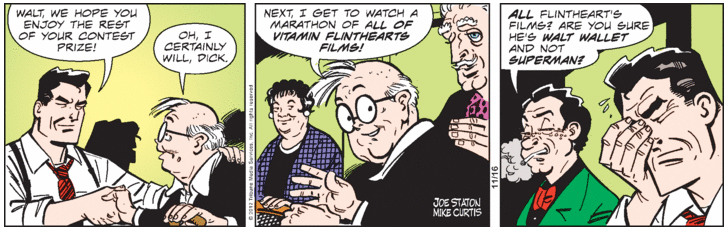
I recently posted about Walt Wallet's cameo (from Gasoline Alley) in Dick Tracy (The Alley Comes to Tracy). I thought it was just a single sequence, but I was wrong. Mike Curtis and Joe Staton spun out the crossover for a full week. And how enjoyable it was for us comics fans.

Here's the entire sequence, which mainly serves as a break in the action between one story arc and another. A few things of interest. Baby Judy was abandoned in Walt's car in 1935, and was adopted by the Wallets. In the flashback sequence both Dick Tracy and Walt Wallet appear as they were drawn in 1935 by their respective creators Chester Gould and Frank King. What fun! (click on images to enlarge)