Tuesday, May 31, 2016

Spam Roundup May, 2016


There's spam, and then there's spam so oddly written it's somewhat amusing. Here's a roundup of some of the "best" comments I received this month from spambots around the world.

Non sequiter plus ultra 

 - I read this post completely about the resemblence of most recent and preceding technologies. It's an amazing article. [This in response to a review of some Dvorak piano trios.] 

 - Hi, its good piece of writing concerning media print, we all be familiar with media is a great source of data. [Again, the post was about Dvorak piano trios.]

 - Thanks for your marvelous posting?! I certainly enjoyed reading it, you may be a great author. [I may very well be -- but how would I know?] 

Lumbering along goes on

My short post about small vintage Japanese tinplate toy (The Straco Layout, Part 23 -- Lumbering Along) continues to be popular among the spambots. Clearly, it's not the content that's attracting them.

 - thank you for the good writup. It in fact was a amusement account it. Look advanced to more added agreeable from you. [I'm all about adding agreeable.]

 - What I don't understood is if truth be told you've no longer actually much more smartly-favored than you may be right now. [You mean I'm past my prime smartly-favored-wise?] 

 - It's like your read my mind! You appear to know a lot about this, like you wrote the book in it or something [Or something.]

RE: Fastidious 

No comments used -- or rather, misused -- the word fastidious this month. But the comments to my post Fastidious Spam more than made up for that lack.

 - these are really enourmous ideas in regarding blogging. You have touched some pleasant factors here. [Nothing pleasant about the mis-use of "fastidious," bub.] 

 - great points altogether, you just won a emblem new reader [I wonder what an emblem new reader is.]

Awesome! Its really remarkable paragraph [Which one? The post had seven.] 

Pretty section of content. [Yes, just gorgeous.] 

You can definitely see your expertise within the work you write. the world hopes for more passionate writes like you who are not afraid to say how they believe. [I'm not afraid. Misuse the word "fastidious" and I'll tell the world.]

That's all for this month. Try to touch only pleasant factors, and remember -- you, too, may be a great author.

Monday, May 30, 2016

Diabelli Project 112 - Wind Trio

The Diabelli Project is about offering my weekly flash-composition sketches freely to all. Like Antonio Diabelli's theme, these sketches aren't great music. But perhaps (as in Diabelli's case) there's a Beethoven out there who can do great things with them.

This isn't the first flash composition sketch of a wind trio I've done (see parts 106 and 076). But it is the most fully developed. Looking at the three sketches together, I think this one might work very well as a slow middle movement while the others could work as outer movements. Hmm. This one I'll have to explore further.


As always, this sketch, in all or in parts, is available for anyone to use. I'd love to see the direction someone else takes this. Just be sure to share the results.


Friday, May 27, 2016

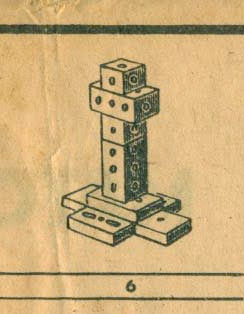
Line Mar Match Box Construction 006 - Field Cross

006. Field Cross
I found a Line Mar Match Box Construction Set from the 1930s, complete and with instructions. The box claimed the set made 100 different toys. I decided to test that claim -- one toy at a time. You can read all the posts for the Line Mar construction project at 100 Toys.

006. Field Cross

Even though this construction set has dowels and grommets, the first twenty or so toys in the instruction sheet just involve stacking the metal parts on each other without securing them.

I'm not sure, but I think I cheated a little when I built the field cross. No matter how I bent the pieces, I just couldn't get them to stack properly. So I ran a dowel rod down through the cross, and that helped to stabilize the structure.

The instruction sheet just has the one image for this toy. Without a back view, I don't know if using a dowel is "allowed" or not.

But it worked.

Even with the dowel running through the lower part of the cross
it still doesn't look all that stable to me. 

Thursday, May 26, 2016

Tasmin Little: British Violin Sonatas, Volume Two

You don't have to be Czech to play Dvorak, Spanish to play Rodrigo, nor British to play Vaughan Williams. And yet an artist who shares the composer's nationality often brings a deeper understanding to the music, a certain authenticity to the performances. That thought occurred to me as I listened to British Violin Sonatas, Volume 2.

In my review of Volume 1, I said: "Tasmin Little played with an expressive yet precise manner, letting the merits of the compositions speak for themselves." Her performances in volume two are just as beautifully clear, but with (I think) more emotional investment. And the musical chemistry between Tasmin Little and Piers Lane is just as strong as it was in Volume 1.

The disc opens with Frank Bridge's 1904 Sonata. It's a somewhat conservative work for Bridge, who in the 1920s abandoned English pastoralism, if not tonality altogether. Although this is is an early work, there are times when the melody threatens to slip the constraints of late-Romantic tonality.

John Ireland's Violin Sonata No. 1 features long phrases that extend across wide intervals. Little's violin practically sings these melodies, bring out their structural and emotive beauty. Little and Lane make the shifting textures and moods of the work seem like a conversation between two close friends.

The Sonata of Arthur Bliss is an eleven-minute work densely packed with musical ideas. In some ways, it's the most English-sounding of the lot, especially with its melodic turns. But the texture and cross-currents make this so much more than just another pretty pastoral.

The program concludes with  the Romance and Pastorale of Ralph Vaughan Willimas leading into William Lloyd Webber's beautiful "The Gardens at Eastwell." Both are quintessential examples of the English pastoral style and make a lovely way to end the program.

My review of Volume 1 concluded: "I look forward to volume two!" Three years later, I can say it was definitely worth the wait. Now I look forward to volume three!

British Violin Sonatas, Volume 2
Tasmin Little, violin; Piers Lane, piano
Frank Bridge: sonata; John Ireland: Sonata No. 1 in D minor; Sir Arthur Bliss: Sonata; Ralph Vaughan Williams: Two Pieces; William Lloyd Webber: The Gardens at Eastwell
Chandos CHAN 10899


Wednesday, May 25, 2016

Seeking Sakai, Part 2

In part 1 I shared the details about an early H0-scale tinplate set I found. It was manufactured by Sakai, a company that was founded in Japan around 1947.

Recently I found out quite a lot about this set from a variety of sources.

Turns out this is Sakai also.
There was a Japanese company called Seki that operated before the war. They competed primarily with Marx in the US, offering some interesting variants on Marx and low-end Lionel and American Flyer 0-gauge sets.

Seki and Sakai are sometimes confused, but they were different companies. Seki ceased operation during the Second World War. Sakai Seisakusho Ltd. began operation after the war, offering different products.

From a Seki/Sakai online group, I learned that Sakai manufactured the mystery train set (at right) I've talked about before on this blog. They also made an 0-gauge tinplate train set sporting "Hudson & Pacific" livery that's quite desirable.

I've seen boxed examples on eBay of their H0-gauge switches and tracks. They survived into the 1960s, offering plastic H0 rolling stock and at least one locomotive.

And eventually, I found what I was looking for -- an example of my set in its original box. The set was made by Sakai for Macys Department stores and offered under their Stalwart house brand. Although the example I found only had the train, I'm sure it came originally came complete with track and transformer.


No question. It's a match. Too bad this example's missing the track and transformer.


The headline reads "Macys Own Stalwart H0 Electric Train Set"
But when was this set offered? There's no copyright notice on the box to indicate the year, and I don't have access to an archive of Macys catalogs. But I did find a newspaper ad from 1953, featuring the set. So there it is. This set was made by Sakai for Macys, imported and sold in 1953 for $9.98.

Don't be fooled by the price. In today's dollars, that set would sell for $89.61. This was a premium set offered for a premium price. And well worth it, I think. The quality of the materials and details of construction are in keeping with what one would expect from Macys. Nomura, Straco, and Bandai battery-operated toy train sets may have been good enough for Woolworth's and Western Auto, but not for Macys.