Just by reading Lio on a daily basis, I can tell creator Mark Tatulli has some strong opinions about "legacy strips," and most especially zombie strips. The former are comic strips that continue after the original creator's died. Dick Tracy is a good example, having passed through several creative teams after Chester Gould's retirement. Some legacy strips take the characters and develop them further, keeping pace with current trends (like Blondie). Others simply recycle the same tropes over and over, becoming less relevant and less entertaining with each iteration (like Beetle Bailey).
Worse still are the zombie strips, which are simply reprints. "Peanuts" is such a strip. Charles Schultz has departed, but his daily sequences show up again and again, like reruns of "I Love Lucy."
In the September 9, 2014 sequence, Tatulli makes a pointed comment about Peanuts, and it's creative stasis. (click on image to enlarge)
When Charles Schultz started "Peanuts" in 1952, it didn't look like any other comic strip -- nor did it read like one. Before the "Peanuts" gang became licensing commodities, the strip had a markedly different character.
Tatulli reminds the characters -- and us -- just how far Peanuts has strayed from its origins. Perhaps it's time to retire it for good and give the space to the next ground-breaking and original comic strip that can revitalize the form.
Views and reviews of over-looked and under-appreciated culture and creativity
Showing posts sorted by relevance for query tatulli peanuts. Sort by date Show all posts
Tuesday, November 11, 2014
Tuesday, December 13, 2016
Lio and the stale Peanuts
Cameos of one comic strip character in another's strip can happen for many reasons -- cross-promotion, joint story lines, special events, and mordant commentary.
The latter, I think, is the reason behind Charlie Brown's cameo in the June 20, 2016 installment of Lio. Mark Tatulli's riffed on Peanuts before, always (as I interpret it) to criticize this strip that is continually rerun in newspapers. It's past time to retire Peanuts and give that real estate to a contemporary comic strip. There are plenty of worthy strips that need to be seen.
In this case, Tatulli upends another now overly-familiar Peanuts trope -- the kite eating tree.
It's simple, and it makes the point. On the left side of the panel is the old -- Charlie Brown and the sign. On the right, the new -- Lio and the tree-eating kite. Placement is not accidental. We read from left to right, so moving from Charlie Brown to Lio is seen as a progression.
My takeaway from this panel is this: the kite-eating tree is gone. Can we please move on, now?
Thursday, March 28, 2013
Lio and the Comics Change 3 - The Rerunuts
Mark Tatulli, creator of Lio,
seems to share some of my opinions about newspaper comics. His
brilliant story arc last week made several mordant points about the
state of the industry, and offered up some humor that worked on
different levels. Rather than write one massive commentary about the
sequence, I'm break it up into three parts, (The Beginning, The Transition, and The Rerunuts) each examining two days of
continuity in detail.
The Rerunuts
In the final two sequences of Lio's story arc, the newspaper has apparently settled on a replacement for Mrs. Ivanna Laff {Momma], the Rerunuts [Peanuts]. (click on images to enlarge)
Tatulli's made his feelings about Charles Shultz' legacy strip Peanuts clear in previous sequences, like the one below.
And I have to agree. With space on the comics page at a premium, why clutter it up with reruns? Personally, I think giving the space to current comics that might attract new readers would be more productive.
I think that's the point of Tatulli's Rerunuts sequences. In Friday's strip, Lio's father laughs at the Rerunuts' stale gag. Is Lio's question mark indicating he doesn't understand why his father thinks the Rerunuts are funny, or that he doesn't understand the strip's the hopelessly dated reference? Both, I think.
Saturday's sequence ends the story arc.
The Rerunuts are in -- they've succeeded in offending the least number of people. And why not? The Jimmy Carter joke would have been inoffensive even when Carter was president. Bloom County, this is not. (And I don't think the final word in the panel is there by accident, either.)
Tatulli goes right to the heart of the problem. Newspapers are continually pressuring comics syndicates to shrink the size of the strips -- presumably to make room for more comics. But what do they do with that room? Waste it with irrelevant legacy strips that do nothing to grow readership. And decreased space impacts the artwork, making it more difficult to create any type of visually engaging comics.
In time, we may be reduced to reading Bazooka Joe-sized strips in the papers -- if they last that long.
The Rerunuts
In the final two sequences of Lio's story arc, the newspaper has apparently settled on a replacement for Mrs. Ivanna Laff {Momma], the Rerunuts [Peanuts]. (click on images to enlarge)
Tatulli's made his feelings about Charles Shultz' legacy strip Peanuts clear in previous sequences, like the one below.
And I have to agree. With space on the comics page at a premium, why clutter it up with reruns? Personally, I think giving the space to current comics that might attract new readers would be more productive.
I think that's the point of Tatulli's Rerunuts sequences. In Friday's strip, Lio's father laughs at the Rerunuts' stale gag. Is Lio's question mark indicating he doesn't understand why his father thinks the Rerunuts are funny, or that he doesn't understand the strip's the hopelessly dated reference? Both, I think.
Saturday's sequence ends the story arc.
![]() |
| If space keeps shrinking, will this be the future of comics in newspapers? |
Tatulli goes right to the heart of the problem. Newspapers are continually pressuring comics syndicates to shrink the size of the strips -- presumably to make room for more comics. But what do they do with that room? Waste it with irrelevant legacy strips that do nothing to grow readership. And decreased space impacts the artwork, making it more difficult to create any type of visually engaging comics.
In time, we may be reduced to reading Bazooka Joe-sized strips in the papers -- if they last that long.
Monday, April 08, 2013
Lio and the Walking Dead
They're called "legacy strips." Comic strips that continue to run after their creator has retired or died. In some cases, the creative chores are handed down to the creator's children, or even grandchildren. In others, a new team is brought in to continue the story.
I've commented on them before. Sometimes the new team revitalizes the strip, as in the case of Dick Tracy (Mike Curtis and Joe Staton the latest of several to follow Chester Gould). Often, the team just maintains the strip without introducing any new elements. In essence, keeping it on life support, like Beetle Bailey (Sons Brian and Greg Walker taking over from father Mort Walker). And sometimes -- as in the case of Peanuts -- the old strip is just rerun.
That was the point of Mark Tatulli's recent sequence with the Rerunuts. And that's definitely the point of this Lio panel (click on image to enlarge).
The Peanuts strip is dead. Yet it keeps walking around the comics page. Which makes it, in my opinion, not a legacy strip, but a zombie strip.
I'm with Tatulli on this one. Every single Peanuts daily sequence is available in multiple book collections. Charles Schultz's creation was brilliant, and it's been preserved. Peanuts won't go away -- really. Can we not get this off the comics page and make way for something new, relevant, innovative and (dare I say it) -- alive?
Wednesday, June 19, 2013
Lio and the Comics Commentary
I've commented on legacy strips before. Those comic strips whose creators have passed on, while they live on -- sort of. Mark Tatulli has mordantly commented on these space-wasters (see: Lio and the Walking Dead for one example). His 6/11/13 sequence in Lio says it again -- and brilliantly. (click on image to enlarge)
There was a time when Hagar the Horrible was moderately innovative and funny. The original creator Mort Walker had no problem bringing in new characters, and had a clear idea of where the medieval setting and modern topical humor should intersect. But Mort Walker retired in 1989, and his son Chris Browne took over.
It seems to me that Chris is doing little more than protecting his father's legacy. The strip is frozen in time -- and that time is the late 1980's. Are there really no talented young cartoonists with fresh ideas anymore? Of course there are, but Hagar's taking up the space.
Worse is Peanuts. Charles Schultz died in 2000, and the strip has been in reruns for the past 13 years. Even though every single Peanuts strip has remained in print, newspapers are still recycling it rather than take a chance on a new comic.
Tatulli nailed it with this sequence. Want to capture a new generation of readers? Let them see strips drawn by artists who are excited to be creating them -- not ones carefully going through the motions, or worse yet dead and not even here at all.
Tuesday, January 06, 2015
Mike Du Jour's cameo du jour
Some newspaper comic strip artists make cameos a regular part of their repertoire -- such as Steven Pastis (Pearls Before Swine) and Mark Tatulli (Lio). Others do so occasionally, which sometimes make them even more effective. (see: cameos)
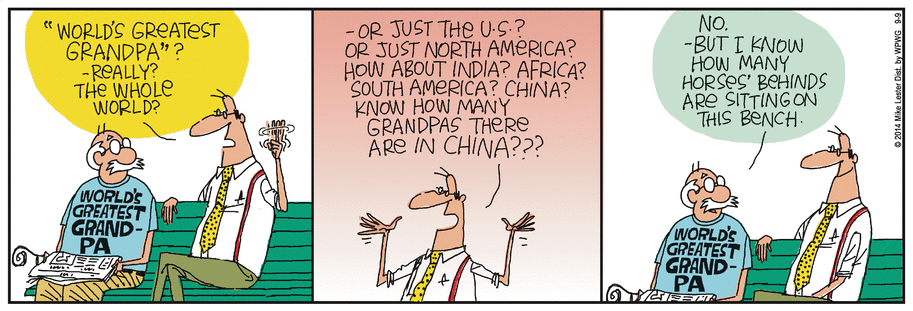
In an early September, 2014 sequence, Mike Lester did just that in his strip Mike Du Jour. Here's the sequence. (click on images to enlarge)
There were two things I particularly liked about this story arc. First, the cameo was an unusual choice. Most comic strip cameos are familiar figures from Peanuts, Family Circus or other legacy strips. Earl of Brian Crane's Pickles isn't one of those.
Second, I love the way Lester references Crane's strip.
And of course, the primary focus of Lester's humor is about the T-shirt. The grandfather could be anyone and the jokes would have still worked. But making it a recognizable grandfather just added to the fun. At least for some of us.
Tuesday, October 03, 2017
A Compendium of Comic Strip Cameos
Cameos in film and television are common. In comic strips, they're not. One of the challenges is copyright, of course. When the Spirit did an extended appearance in Dick Tracy (site), the current owners of Will Eisner's intellectual property had to clear character treatment and depiction.
The other challenge is the blending of style. Sometimes the artist of the strip can't convincingly duplicate the style of cameo's artist. In the cases that appeared in June 2017 strips, that wasn't a problem. The first example comes from Blondie.
Dean Young''s clean style was a perfect match for Greg and Mort Walker's. Although Blondie is more detailed than Beetle Bailey, the styles were close enough to make Sarge's appearance appear natural.
Mark Tatulli has riffed on Peanuts many times in his strip Lio. His depiction of Charles Shultz's characters is close enough for the gag to work.
In September 2017, Jim Scancarelli sent Joel looking for his sidekick Rufus in an extended Gasoline Alley sequence.
This isn't the first time Gasoline Alley has featured Dick Tracy characters (see The Alley Comes to Tracy). Scancarelli draws Tracy and B.O. Plenty in the style of their creator, Chester Gould. If you're not familiar with the current iteration of Dick Tracy, it works. If you are (as I am), it seems a little off -- almost as if we're looking at an alternate universe, Dick Tracy!
Still, all three strips are good examples of comic strip artists showing they can draw in more than one style.
The other challenge is the blending of style. Sometimes the artist of the strip can't convincingly duplicate the style of cameo's artist. In the cases that appeared in June 2017 strips, that wasn't a problem. The first example comes from Blondie.
Dean Young''s clean style was a perfect match for Greg and Mort Walker's. Although Blondie is more detailed than Beetle Bailey, the styles were close enough to make Sarge's appearance appear natural.
Mark Tatulli has riffed on Peanuts many times in his strip Lio. His depiction of Charles Shultz's characters is close enough for the gag to work.
In September 2017, Jim Scancarelli sent Joel looking for his sidekick Rufus in an extended Gasoline Alley sequence.
Still, all three strips are good examples of comic strip artists showing they can draw in more than one style.
Subscribe to:
Posts (Atom)