Showing posts with label Barney and Clyde. Show all posts

Tuesday, July 11, 2017

Comical deconstruction

I always enjoy comic strips that step outside their allotted spaces to make fun of comic conventions. In this case, two very different comic strips offered humor based on comic strip pacing.

The first comes from a sequence of Barney & Clyde originally published 4/18/17.  This smartly-written (and drawn) strip by Gene Weingarten, Dan Weingarten, and David Clark has a long history of playing with comic strip conventions.


The second comes from the 2/5/17 Sunday edition of Beetle Bailey. From the outset, Mort Walker's strip was always a simple gag-a-day comic. Over the years, the strip has grown a little, though still within comfortable boundaries.


In both cases, the punchline arrives in the last panel -- which is also an integral part of the joke. It's interesting to me to see how the two creative teams handled the same concept. In Barney & Clyde, the punchline "you'll never know when you're in life's fourth panel" is humorous because, well, that's where it is.

At the same time, it's left unclear as to whether Cynthia and her teacher are aware that they're in a comic strip. That ambiguity also gives the line a little more weight.

I felt differently about Beetle Baily's take. There's nothing wrong with the joke itself, and it's certainly true. Comic strip (and animated characters) often hang in the air for an unrealistically long time for comic effect.

And yet, to me, this sequence just seems lazy. I suspect that if there had been an additional panel or two to fill, we would have seen Sarge and Beetle hang in the air even longer. I guess the difference is that Barney & Clyde use the observation to base the punchline one, while Beetle Bailey lets the observation be the punchline.

Tuesday, June 27, 2017

A Clutch of Comic Cameos

Two creative teams, two comic strips, two different uses for cameos. Having one comic strip character show up in another is something that's becoming more common -- especially in certain strips. But it's why a character appears that makes or breaks the sequence.

In this 1/12/17 sequence from Baldo, by Hector Cantu and Carlos Castellanos, the cameo reinforces the gag.


The third-panel punch line would be a little flat without Goofy appearing in the second. And without the punch line in the third panel, Goofy's appearance doesn't make much sense. Both are needed to land the joke.

The 5/3/17 sequence of Barney & Clyde takes a different approach.


Here the cameo is used for some meta-humor. it's something the creative team of Gene Weingarten, Dan Weingarten, and David Clark excel in.

Rex Morgan, M.D. is indeed a respected physician.  The strip often tackles important medical issues in a fairly accurate fashion. And, in those papers that run both comics, Rex Morgan would be local to Barney & Clyde (most likely on the same page). The humor rests all on references to the world of newspaper comics.

Thursday, October 13, 2016

Barney and Clyde and Lio

Meta humor in a newspaper comic strip is a rare thing. One example can brighten an entire comics page for me. So imagine my pleasure when two comic strips went meta on the same day -- August 21, 2016.

Both strips have a long history of playing with the concept of comics. I've cited Mark Tatulli's Lio in many posts. Tatulli's well established the fact that Lio knows he's living in a comic strip.


So it's not surprising that when thing go really badly, he'd op out.

Note how Tatulli treats the sequence. The biggest panel sets up the situation. The middle panel shows Lio's father looking for his missing son. The smaller panel size suggests what's to come. Tatulli's drawn the father's eyes to point us in the direction of the final panel (and payoff).

Lio does not want to go to school and does not want to be in the strip anymore. His panel is the smallest of the three, suggesting minimal participation. Even the gutter between his panel and the previous one is wider than that of the first two.

The second example is from Barney and Clyde by Gene Weingarten, Dan Weingarten & David Clark. In this case, the team uses character cameos to make their point. Frank and Ernest by Bob Thaves (now drawn and written by his son, Tom Thaves) has always been an unpretentious and unabashedly corny gag-a-day strip.


Commonplace wordplay is the norm for Frank and Ernest -- but not Barney and Clyde. Making the gag about a misplaced script allowed the Barney and Clyde team to get by with awful pun -- and stretch the gag from three panels to eight (nicely filling up a Sunday spread).

Sometimes  cameos are used for one strip to comment on another. In this case, I don't think it was a criticism of Thaves' work -- rather, just way to fill up a page, with a wink to the reader.

Two gems in one Sunday! That's why I keep subscribing.

Tuesday, November 24, 2015

Barney & Clyde Desert Peanuts

Long-time readers of this blog know how I feel about "Peanuts." Yes, it was a great strip and Charles M. Schultz influenced an entire generation of newspaper cartoonists with his inventiveness and imagination.

However.

Schultz died in 2000, and for the past 15 years his comic strip has been in reruns, taking up space that should be used to showcase the current generation of comic strip creators.

I wonder if the moribund nature of this zombie strip (it's dead, but it's still moving) is what creators Gene Weingarten, Dan Weingarten and David Clark had in mind with their September 29, 2015 sequence in "Barney and Clyde." (click on image to enlarge)


 For those not overly familiar with the world of Peanuts, it's a reference to Spike, Snoopy's brother who lives in Needles, Arizona. His sole companion is a cactus.


Yep, 15 years after the end of the strip, that's how I imagined Spike would end up.

Tuesday, October 13, 2015

Barney and Clyde in Perspective

The creative team behind Barney and Clyde (Gene Weingarten, Dan Weingarten & David Clark) often have fun with the conventions of the genre. The sequence published June 6, 2015 doesn't quite break the fourth wall, but it's still a clever pun (I think). (click on image to enlarge)


The idea of taking a single scene and breaking it up into panels to show motion isn't new, of course. And because it isn't, the reader doesn't immediately notice the careful arrangements of the tombstones. At least, not until the third panel. And even then, the wording is such that for many (myself included), the reference to perspective in the visual arts doesn't immediately register. It's only while reading the fourth panel that the joke hits.


And I think that's why Clyde's shown looking back to the third panel, to refer back to the location of the actual punchline. It's a subtle gag -- but a good one.

Tuesday, September 29, 2015

Barney & Clyde - Meta Flashback

As long-time readers of this blog know, I appreciate comic strips with meta-sensibilities. That is, those strips that acknowledge that they are indeed two-dimensional creations bounded by the conventions of the genre. Take the May 30, 2015 sequence in Barney & Clyde (click on image to enlarge)


The cliche of having your life pass before your eyes is an old one -- but it gets an interesting twist in the hands of writers Gene and Dan Weingarten and artist David Clark. Of course a cartoon character's going to see old comic strips. That's the sole documentation of his life. But there's something else -- the actual gag is the amount of time that flashback took. Because that's the time it takes the average reader to scan the entire sequence. Meta, indeed!

Tuesday, September 15, 2015

Barney and Clyde and the Wind

Referencing one work of art in another is clever -- but referencing two can be genius. The sequence run in Barney and Clyde on April 27, 2015 was one such example. Here's the strip itself: (click on image to enlarge).


If your a comics fan, you may recognize that the mouse has morphed into the maniac Rat from Stephen Pastis' Pearls Before Swine. (see below)


Really observant readers will also note the reference to The Wind in the Willows by Kenneth Grahame, and especially its classic illustrations.


But those are just extra layers. To really get to the heart of this strip's gag, you need to put together the title of the book referenced, and the function of the drug being advertised. It's then that you realize that it's not just wind in the willows, its the rabbits breaking wind in the willows (a phrase that would not be allowed in the comic).

Kudos to the Barney and Clyde creative team, Gene Weingarten, Dan Weingarten & David Clark.

Tuesday, August 11, 2015

Barney & Clyde and an Old Friend

It was just a throw away gag for a daily strip. But it was done well.

In the April 17, 2015 sequence of Barney & Clyde, Dwayne interviews a job seeker. (click on image to enlarge)


Of course the humor revolves around the cultural legacy of Bazooka Joe. His raison d'etre was indeed to sell gum. Topps Company began selling their Bazooka brand bubble gum in 1947. In 1953 or 1954 (sources vary), they introduced Bazooka Joe and his Gang as a comic feature. The comic (like the one pictured below) was wrapped inside the package, and included a fortune and a premium one could get with a boatload of Bazooka Joe comics and a little bit of cash.

The top panel shows most of the regulars, including (L to R), Mort,
Pesky (Joe's kid brother),Hungry Herman,  Jane (Joes girlfriend),
and finally Bazooka Joe.
Topps discontinued the comic insert in 2012 (as mentioned in the Barney and Clyde sequence), Although the company still uses Joe occasionally, for all intents and purposes, he's disappeared. To any kid who chewed gum in the late 20th century, Bazooka Joe was a familiar comic character. Kudos to Gene Weingarten, Dan Weingarten and David Clark for the reference.

Tuesday, April 21, 2015

Meta Barney & Clyde 4

The creative team of Gene Weingarten, Dan Weingarten, and David Clark present an interesting concept in the February 8, 2014 sequence of their strip, Barney & Clyde. (click on image to enlarge) 


The strip occasionally has cameos from other comics (see: Meta Barney & Clyde). And now we know why -- those other strips aren't just on a different part of the newspaper. They're in alternate universes! It explains so much. Thanks, guys, for being so mindblowingly meta.

Tuesday, December 23, 2014

Barney & Clyde Finesse Aging

In the world of newspaper comic strips, aging is something of a problem. A conversation that might take a few minutes in the real world (if we were all so witty), can be a full week of comic continuity. Most comic strip characters don't age at all. Like the Simpsons, their forever frozen at whatever age they were when they walked into the scene.

Sometimes there's partial aging. While PJ of the "Family Circus" will forever be a toddler, "Blondie's" Baby Dumpling grew from child to teenager -- and then stopped aging. 

A few strips have their characters age, although at a slower rate than the real world. Rex Morgan, MD is a good example. When it premiered in 1948, Morgan was a newly-minted doctor in his early 30s. In the current continuity he's the father of a precocious 8-year old. But not as an old man in his late sixties, but as one in his early forties. 

In a 9/28/14 Barney & Clyde sequence, Gene Weingarten, Dan Weingarten, and David Clark make plain a common ploy used in strips where aging is an issue..


That is to say, never provide specific birthdates for characters. Because anyone can do the math.

Tuesday, January 28, 2014

Barney & Clyde -- and Garfield

The sequence in Barney & Clyde published 1/3/14 had a rather clever reference to another comic strip. And I wonder -- was it a one-sided reference on the part of the creative team -- Gene & Dan Weingarten and David Clark -- or was Jim Davis also involved? Here's the sequence in question:
(click on images to enlarge)


Folks who are avid comics readers know that the full name of Garfield's owner is Jon Arbuckle. His girlfriend, veterinarian Liz doesn't appear in every sequence, but she did in Garfield's 1/3/14 sequence. And Garfield comes between them, making the Barney & Clyde sequence appear to provide commentary on the action!


Coincidence? Perhaps. But it did make reading Garfield a little more enjoyable (at least that day). Thanks, B&C!

Thursday, December 05, 2013

Meta Barney & Clyde 3

Barney & Clyde (Gene and Dan Weingarten, writers; David Clark, art) is one of those comic strips that sometimes comments on comic strips (see: Meta Barney & Clyde, and Meta Barney & Clyde 2).

In this case, there's some harsh criticism all around -- but I can't deny it's justified. Every gag comic has its tropes -- situations the creator returns to again and again. But when they're overused, well, they just might end up in Barney & Clyde. (click on image to enlarge).

Monday, March 18, 2013

Barney & Clyde and Esoterica

This past Sunday's sequence of Barney & Clyde featured a rather clever visual pun -- if anyone understood it. The creative team of Gene & Dan Weingarten and David Clark certainly get points in my book. (click on image to enlarge)


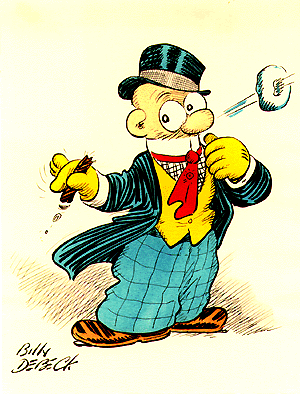
The pun references a cartoon character of the 1920's -- Barney Google. The comic strip Barney Google (and his googly eyes) began in 1919, and reached the peak of its popularity right before the Great Depression. Billy DeBeck's creation spawned animated cartoons, comic books, and even a hit song.


In 1934 Barney Google visited a relative in the hills of North Carolina -- Snuffy Smith. Snuffy Smith would eventually take over the strip, and it runs under that name today. Although Barney Google makes an occasional appearance, he's not a current character for most contemporary comics readers.

Comic enthusiasts (like myself) who enjoy classic strips would instantly get the reference. But for the average reader? I'm not so sure. Although they could always Google it...

Monday, January 30, 2012

Comics Crossover - Barney & Clyde

I always appreciate cross-references between comics. Done well, they can add to the humor of the strip. And they're a nice treat for folks (like me) who appreciate the genre. Sometimes the references are subtle, other times not.

This past Sunday Barney & Clyde decided to go for the obvious. (click on the image to enlarge)


As you can see, this is one tough focus group. And what I appreciate about it is that it's carefully constructed to communicate the gag to the widest possible audience.

Older comics readers will recognize George Wilson from Dennis the Menace, and J.C. Dithers, Dagwood's boss in Blondie. Casual readers will spot Wally from Dilbert, and Lucy from Peanuts. And those who prefer newer comics will be glad to find Pearls Before Swine's Rat, Earl, co-star of Pickles, and Bucky, star of Get Fuzzy.


Something for everyone, no matter how slight or deep your knowledge of comic strips might be. Another carefully constructed panel, to be read in a matter of seconds. But still worth a second look.

Monday, November 07, 2011

Breaking the Fourth Wall for the Second Time

Just two weeks before I cited a sequence in the comic strip Barney and Clyde. In it, the characters first explained the concept of breaking the fourth wall, and then did so.  This Sunday, they did it again, but for a different reason. Encapsulated within the sequence is a brief history of Dennis the Menace, and why that comic is less edgy. And the the characters act on that knowledge for the punchline. (click on image to enlarge)


There's a danger of comic strips becoming too self-referential of course, which would further shrink their readership. But for now, these type of gags add a welcome spice to my daily reading.

Sunday, October 30, 2011

Barney and Clyde and Pearls

Recently I wrote about a cross-over between the "Pearls Before Swine" and "Dennis the Menace" comic strips. Shortly thereafter, I noted a similar meta-take on comics in the "Barney & Clyde" strip.

So I really appreciated the October 29,  2011 sequence in "Barney & Clyde" which references... "Pearls Before Swine" with their character Rat severing as the punchline..

Brilliant. This is what keeps me reading the funnies, folks! (click on the image below to enlarge).


Sunday, October 23, 2011

Meta Barney & Clyde

Just last week I cited a sequence in Sally Forth that showed the characters being aware of the fact that they're in a comic strip. Today, the characters in Barney & Clyde did something similar. (click on the image below to enlarge)


The primary difference is the style of humor, and the payoff. With Sally Forth, the characters never address the reader directly, but it's clear that they're talking not so much to each other, but to the reader. In Barney & Clyde, the characters explain the concept of "breaking the fourth wall" and the payoff is that they then do so themselves.

I certainly enjoyed the joke. And, not that two instances make a trend, but I'm looking forward to other strips going meta!