Patrick McDonnell, creator of Mutts is a serious fan of sequential art. In honor of ComicsCon, he published the following sequence July 15-21, 2019. Each panel is an homage to a classic Marvel Comics character (mostly from the Silver Age).
If you're also a fan of classic comic books, this was a real treat.
Views and reviews of over-looked and under-appreciated culture and creativity
Showing posts with label Mutts. Show all posts
Tuesday, July 23, 2019
Tuesday, December 11, 2018
Mutts 3-Panel Meta
Patrick McDonnell, the creator of Mutts, has played with comic strip conventions before. The week of December 3-8, 2018 he riffed on a core concept of the art.
Daily humor strips usually have three panels. The first sets up the premise. The middle establishes the pattern. The third upends the pattern with the punchline.
In the sequence below, note how each daily strip plays with a different aspect of this convention.
In the first strip, McDonnell brings to our attention that, while each panel may look identical, each represents a different moment in time. The characters move from the second to the third panel because time has passed.
In the second sequence, McDonnell further explores this concept. The background to all three panels is identical, each representing the same scene in a different moment. Mooch refuses to leave the first panel, so he's absent from the second. Earl does the same in the second, so the third panel is empty. The humor derives from characters willing themselves out of the sequence.
The third sequence further develops the concept. Here, Earl remains in all three panels. Mooch however, disappears from the sequence.
The fourth sequence presents another variant. First neither characters stayed in the timeline through all three panels. Then Earl stayed. Now both appear in the last panel. But Mooch still opted out of the timeline in the second panel. So where did he go?
Note the changes in the fifth sequence. Here the landscape spans all three panels. So each panel still represents a different moment, but now also a different location. McDonnell places Mooth and Earl's word balloon across panels one and two. And Earl isn't in the second panel -- he's calling from the third. Here, the humor plays on the function of that last panel.
The final sequence also plays on the role of the last panel. The bear (the punchline) arrives too soon.
For those interested in the art of sequential art, this week entertained on several levels.
Daily humor strips usually have three panels. The first sets up the premise. The middle establishes the pattern. The third upends the pattern with the punchline.
In the sequence below, note how each daily strip plays with a different aspect of this convention.
In the first strip, McDonnell brings to our attention that, while each panel may look identical, each represents a different moment in time. The characters move from the second to the third panel because time has passed.
In the second sequence, McDonnell further explores this concept. The background to all three panels is identical, each representing the same scene in a different moment. Mooch refuses to leave the first panel, so he's absent from the second. Earl does the same in the second, so the third panel is empty. The humor derives from characters willing themselves out of the sequence.
The third sequence further develops the concept. Here, Earl remains in all three panels. Mooch however, disappears from the sequence.
The fourth sequence presents another variant. First neither characters stayed in the timeline through all three panels. Then Earl stayed. Now both appear in the last panel. But Mooch still opted out of the timeline in the second panel. So where did he go?
The final sequence also plays on the role of the last panel. The bear (the punchline) arrives too soon.
For those interested in the art of sequential art, this week entertained on several levels.
Tuesday, May 29, 2018
Mutts Goes Meta
During the week of May 21-26, 2018 cartoonist Patrick McDonnell stepped outside of his comic strip. Mutts spent the week contemplating the structure of the 3-panel gag strip -- as a way to deliver 3-panel gags.
The strip above addresses the pacing of the 3-panel gag. Many of the other strips for the week looked at different aspects of the structure - and most don't need additional commentary.
The last of the sequence references Ernie Bushmiller. Bushmiller was the original artist/writer for Nancy. Bushmiller pared down his strip to its bare essence, and his tenure is one that most comic strip artists admire (including Patrick McDonnell, apparently).
And for a week of strips that looked at the foundation of the 3-panel form, it made perfect sense.
Tuesday, November 01, 2016
Lio and Mutts
The Sunday comic strips have more real estate than then dailies. And artists like Mark Tatulli of Lio take full advantage of it. Tatulli's played with the concept of comic strip borders before. This sequence from May 22, 2016 shows what Tatulli can do given space:
Tatulli does a great job capturing the style of Patrick McDonnell for the Mutts panels. Note that the clumsy robot not only crashed through the various panels on his journey tracking right, but he also seems to have kicked his foot and destroyed the Mutts title panel at the far left. The robot's drawn with his rear leg doing just such a kick, to subtly plant that idea in the reader's head (should they be reading this strip as carefully as I am).
Also, note the use of color. At each break in the panel borders, there's no color at all. It's an effective way to draw the eye to the breaks, helping us track the progress of the robot. And it may have another purpose, too. No matter what colors are in the comic strip panels, the gutters (the space between two panels) is always white. Is Tatulli suggesting that if the borders are broken, the white contained in the gutters leaks into the panels?
I like to think so.
Tuesday, December 29, 2015
The Vintage Comics Mutts
Mutts creator Patrick McDonnell has riffed on his acorn-bombing squirrels many times. And like the last two times noted in this blog (The Mighty Marvel Mutts and the The Mighty Marvel Mutts 2), there's an overarching theme. And if you're aware of that theme, then the Sunday sequence which appears to be stand-alone, has even greater impact.
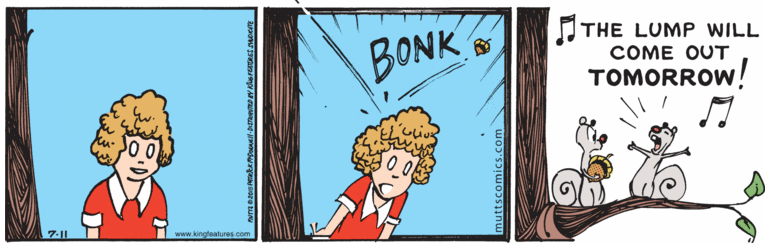
July 6-12, 2015 McDonnell features a variety of comic strip characters, some well-known, some obscure. Here's the run-down: (click on images to enlarge)
7/6/15 - Robin is the first victim. He's one of the oldest DC Comics character. He was introduced by Bill Finger and Bob Crane in 1940 as a companion for Batman.
7/7/15 We've moved from comic books to comic strips with Dennis the Menace. Hank Ketchem started the single panel strip in 1951.
7/8/15 And now we're back to comic books. Richie Rich is a character created by Alfred Harvey and Warren Kremer. He first appeared in Little Dot (see below) in 1953, but eventually was published in his own Harvey comic book beginning in 1960.
7/9/15 Little Dot is another Harvey comic book character, She was created in 1949 by Alfred Harvey and Vic Herman as a back-up feature in another Harvey book, and received her own title in 1953.
7/10/15 Charles Schultz's Charlie Brown, though a comic strip character, is a contemporary of Lil' Dot. Peanuts premiered in newspapers in 1950.
7/10/15 Little Orphan Annie is another vintage comic strip character. In fact, it's the oldest one in the series. Harold Grey began the strip in 1924 (although the punchline refers to the 1982 movie musical).
7/11/15 And we finish with a reference to Superman, with a version of the classic 1938 cover of Action Comics. The cycle started with one of DC Comic's earliest heroes, and it ends with their earliest.
Another great sequence by Patrick McDonnell -- especially for die-hard comics fans.
Tuesday, April 07, 2015
Lio and the Fourth Wall 9
In his comic strip Lio, Mark Tatulli often incorporates the unseen conventions of the genre into his humor, breaking the fourth wall in a way that's often unexpected. (follow link for other examples).
In this example, Tatulli has characters from other strips past and present threatening to break in -- and it's quite a mix of characters. (click on image to enlarge)
A brilliant way to call an invisible convention to our attention once again. And a nice overview of the depiction of the feline in the funnies over the years... (even if one character doesn't belong)
- Hobbes, from "Calvin and Hobbes (1985-1995) by Bill Watterson
- Mooch, from "Mutts" (1994 - ) by Patrick McDonnell
- Bill the Cat, from "Bloom County" (1980-1989) and "Opus" (2003-2008) by Berkeley Breathed
- Bucky Cat from "Get Fuzzy" (1999 - ) by Darby Conley
- Krazy Kat from "Krazy Kat" (1913-1944) by George Herriman
- Garfield from "Garfield" (1978 - ) by Jim Davis
- Felix the Cat - an animated cartoon character created in 1919 by Pat Sullivan and Otto Messmer
Tuesday, October 28, 2014
The Mighty Marvel Mutts 2
The week of July 21-27, 2014 the comic strip "Mutts" ran a sequence involving superheroes. This isn't the first time Patrick McDonnell has riffed on the targets of his acorn-bombing squirrels (see The Mighty Marvel Mutts).
Before, the sequence built up to a Sunday panel that enlarged the theme. This time, the buildup is deliberately anti-climactic. The daily sequences follow the same pattern with the squirrel's comment in the last panel referring to the superhero either by name or attribute. (click on images to enlarge)
7/21/14
This series starts out with an interesting variation on the theme. Superman is invulnerable, and therefore the only character unaffected by the acorn bonk (as the second panel shows). But just in case he does get angry, the squirrel decides to hide his identity (and reference Supe's own alter-ego Clark Kent in the process).
7/22/14
The Flash, like Superman is a DC Comics superhero.The squirrel must have pretty good reflexes to nail the Flash's noggin as he runs at supersonic speeds!
7/23/14
O'Donnell breaks the trend here and goes with a Marvel instead of a DC Comics superhero -- Dr.Strange, Master of the Mystic Arts. The second panel reaction pays homage to Steve Ditko, the first artist to portray the doctor and his mystic effects.
7/24/14
The hero formerly known as Captain Marvel had his name changed to the phrase that turns him into a superhero -- Shazam. DC Comics changed the character's name after Marvel comics (who also have a Captain Marvel) sued and won.
7/25/14
The victim is Mr. Fantastic from the Fantastic Four, another Marvel Comics character. Perhaps a little foreshadowing of Sunday's sequence?
7/26/14
The daily sequence wraps up with another DC Comics icon -- Batman. And note that there are two acorns tossed this time.
7/27/14
What makes this different than McDonnell's earlier squirrel/superhero sequence is that the action's
changed. Rather than having the squirrels drop an acorn once again, O'Donnell shifts the scene to have Mooch and Earl contemplate the nature of superheroes (or at least that of their nemesis, Butchie).
The Sunday sequence is clearly tied to the week's theme. The first two panels reference Marvel's classic masthead, and the Fantastic Four, issue 49. The original Jack Kirby cover features the arrival of Galactus, with the Fantastic Four fleeing before him.
Another great sequence from Patrick McDonnell that not only can be appreciated by the average newspaper comics reader, but one delivering a richer form of humor for the comic book fan as well.
Tuesday, February 18, 2014
Mutts and Krazy Kats
Patrick McDonnell, creator of Mutts seeds his comic strip with vintage pop culture references. Some of subtle, some obvious -- but all are great fun. January 29, 2014, he folded one of his running gags into a brilliant reference to George Herriman's Krazy Kat. (click on image to enlarge)
Those two squirrels have been bouncing acorns off of noggins for some time now -- and the victims haven't always been characters within the strip (The Mighty Marvel Mutts). In this case, it's the context that's the cameo.
It's an amusing sequence for the casual reader. I think that's probably why McDonnell chose to spell Krazy Kat the standard way -- using the K's would have been confusing for someone who wasn't familiar with Herriman's work.
Comics fans, I think, got more enjoyment from this sequence. Krazy Kat revolved around the odd relationship between Ignatz the mouse and Krazy Kat. Ignatz throw bricks at Krazy Kat, which Krazy would interpret as signs of love. As you can see from a typical Krazy Kat panel, McDonnell's sequence is spot-on. And the punch line is almost a knowing wink of the eye to comics lovers.
Tuesday, February 11, 2014
Mutts and Kings 2
Mutts creator Patrick McDonnell clearly has affection for the Little King. This classic comic strip was drawn by Otto Soglow between 1931 and 1975 in a style that was uniquely Soglow's. McDonnell has framed his strip in Little King-like sequences at least three times to my knowledge. Once on a daily page (see Mutts and Kings), and
ta Sunday sequence (Little Mutts).
His most recent tribute is note-perfect in the look, pacing, and type of humor Soglow specialized in. (click on image to enlarge)
And its done in such a way that the gag works on two levels. If you have no knowledge of the Little King, then the gag just seems to be about how cats rule. But to those who are students of the sequential arts, every panel is a treat.
Wednesday, September 04, 2013
The Mighty Marvel Mutts
Many comic strip artists riff on a joke. It's an easy way to come up with new material. And with the need to produce a gag every single day, that can be a godsend. But in the hands of a masterful artist, such as Patrick McDonnell, the riffs can build to an even bigger payoff.
Among the supporting cast of his comic strip Mutts are a pair of mischievous squirrels who bounce nuts off the heads of innocent bystanders. In mid-July 2013, the victims were superheroes. Each daily strip was essentially the same.
Panel one: superhero walks under tree.
Panel two: superhero gets bonked.
Panel three: squirrel makes a comment appropriate to the superhero.
Most comic strip riffs run from Monday to Saturday. Sunday strips are usually stand-alone, mostly because they're in a larger format, and they're printed in color.
Here's the entire sequence-- can you see why it merits special attention? (click on images to enlarge)
Did you notice how McDonnell carefully set up the finale? First, he limited the victims to just Marvel superheroes. So the appearance of the Hulk seemed like just another in a series. But it wasn't. Because of all the superheroes presented, the Hulk is the only one whose recognition mostly depends on color. We know Captain America by his shield; Iron Man by his armor, Spiderman by his webbed costume. The Hulk we know by his green skin.
Thus, the gag involving the Hulk only works in color -- and many newspapers only print their comics in color on Sunday.
The final sequence also breaks the three-panel pattern. The additional panel (the largest) gives us a different outcome that the rest of the series. And also notice the squirrel's reaction. It's not a snappy observations. It hints that maybe they've carried this prank a little to far.
Well, actually not. McDonnell carried the riff exactly as far as it needed to go to deliver the unexpected conclusion. Surprise is at the heart of humor. As a seasoned comics reader, I didn't see this one coming. And I heartily enjoyed it.
Saturday, March 24, 2012
Mutts and Kings
As I mentioned, this was the week for comic strip crossovers. In Mutts, Patrick McDonnell has been illustrating a series of quotes about spring. McDonnell's style draws inspiration from the golden age of comic strips (1920's-1930's), and he often includes homages to other artists both in and outside the world of sequential art. (click on image to enlarge)
The strip is entirely self-contained. Anyone can read and enjoy it without knowing anything else about comics.
Ah, but if you did...
Then you might find that crown and ermine robe looking very familiar. And you would be right.
They're both a reference to the Little King, a classic comic strip character drawn by Otto Soglow between 1931 and 1975.
And there's another subtle link. The Little King was mostly a pantomime strip. The lead character never talked. Although the characters in Mutts often have something to say, for this panel, Mooch is silent.
Wholesome, indeed. And fun.
Subscribe to:
Posts (Atom)